
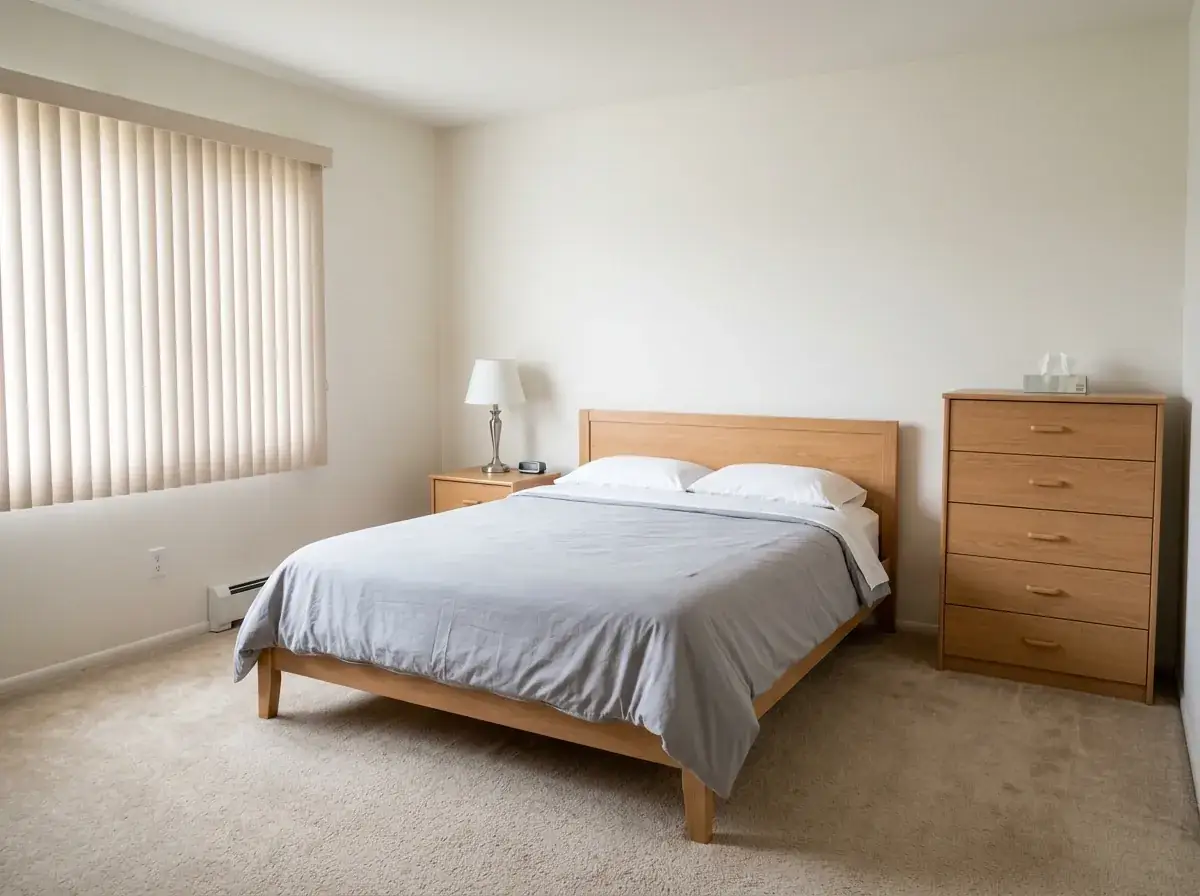

I took one ordinary 11-by-12 bedroom — single window, builder-beige walls, wall-to-wall carpet — and ran it through twelve different design directions. Same square footage every time. What changes is the bed, the lighting, the floor treatment, and the one or two pieces that carry the room. If you live in a right-sized house and your bedroom is the smallest box on the plan, this is the study I wish I’d had before I started moving furniture around at 7 a.m. on a Saturday.
What’s in this study
- Modern Elegance with a Touch of Gold
- Mid-Century Modern
- Breezy Coastal Retreat
- Serene Scandi Minimalism
- Earthy Organic Boho
- Timeless Classic
- Raw & Refined Industrial
- Bright Boho-Beach Fusion
- Bold Art Deco
- Cozy Scandi-Japandi Texture
- Minimalist Japandi Zen
- Contemporary Bouclé & Brass
- What Actually Moves the Needle
- Common Questions
Modern Elegance with a Touch of Gold
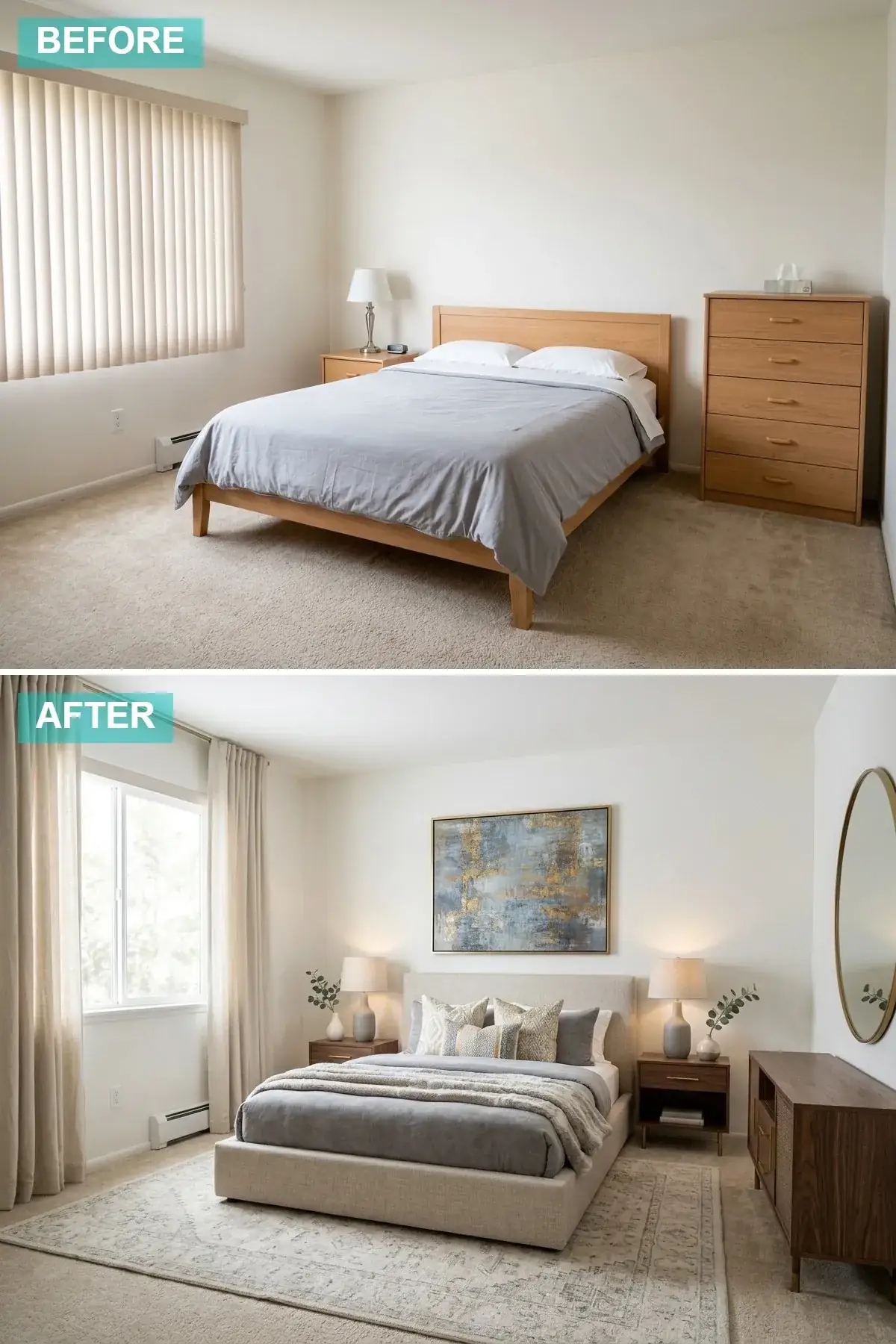
This is the version I’d hand a client who wants the room to feel considered without going cold. A tailored upholstered bed in light beige does the heavy lifting, and dark walnut nightstands with brass pulls give the eye somewhere to land. The gold tones in the abstract piece above the bed repeat in the lamps and the round mirror — that repetition is what reads as “designed” rather than “decorated.” Floor-to-ceiling curtains hung above the window casing pull the eye up, which matters in a room with an 8-foot ceiling. A patterned rug under the front two-thirds of the bed anchors the sleeping zone. The discipline here is restraint: three metals max, two woods, one art moment.
Color Palette
Light Beige
#D9D0C1
A neutral, calming fabric tone that keeps the largest object in the room quiet.
Dark Walnut
#5C4033
Rich wood that adds warmth and grounds the lighter palette.
Soft Gold
#C8B273
A warm metal repeated three times to read intentional.
Cream & Grey
#EBEBE0
A patterned base that ties the room together underfoot.
Styling Notes
- Repeat one metal at least three times — lamp, mirror, drawer pull — so it reads as a decision, not an accident.
- Hang curtains at the ceiling line, not the window frame; in a low room it buys you visual height for the price of longer panels.
- Run the rug under the front two-thirds of the bed so it frames the sleeping zone without disappearing under furniture.
- Keep the bedding tonal and layer texture instead of color — that’s where the hotel feel comes from. If you want the full version of this, I broke it down in my boutique-hotel master bedroom guide.
Mid-Century Modern
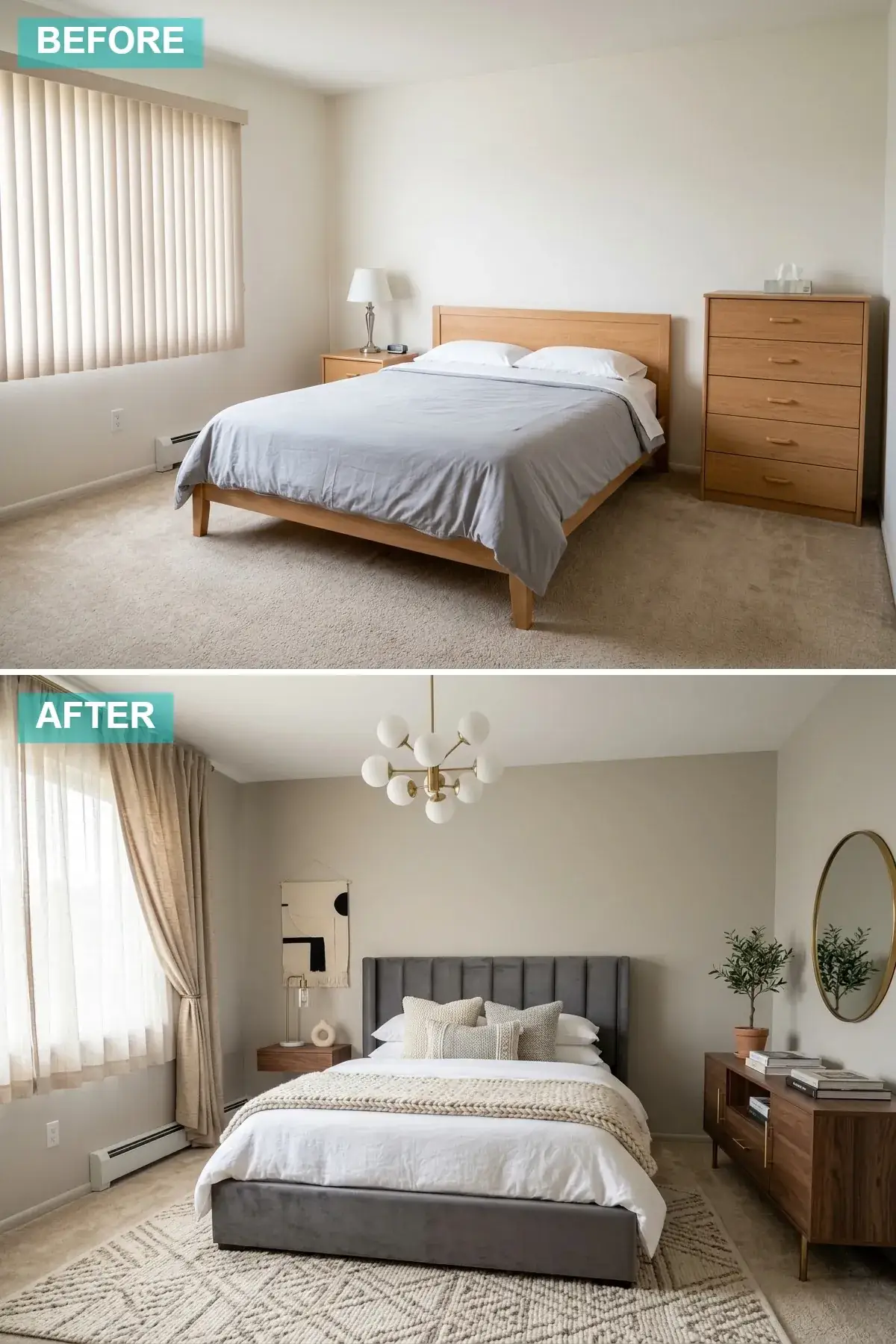
Mid-century furniture earns its place in a small room because the tapered legs let light travel underneath — visually, the floor keeps going, and the room breathes. A grey velvet channel-tufted bed carries the wall, walnut pieces with clean lines do the rest, and a sputnik chandelier replaces the builder fixture as a real focal point. A round mirror, a woven hanging, and a potted olive bring in the organic note that keeps mid-century from feeling like a furniture showroom. This is one of my favorite directions for a compact bedroom precisely because raised-leg furniture refuses to feel heavy.
Color Palette
Charcoal Grey
#555D61
A bold, sophisticated fabric that holds the main wall.
Mid-Tone Walnut
#8A5A3C
The classic mid-century wood tone.
Greige
#BDBAB0
A warm, versatile neutral background.
Aged Brass
#B5A642
A vintage-inspired metallic finish.
Styling Notes
- Choose raised, tapered-leg furniture in a small room — visible floor under the bed and dresser keeps the space feeling open.
- Hang the statement fixture as your focal point, then keep everything else quiet so it doesn’t compete.
- Use velvet on exactly one piece; more than that and the room tips from retro into heavy.
- Add one real plant to break up the wood-and-metal geometry.
Breezy Coastal Retreat
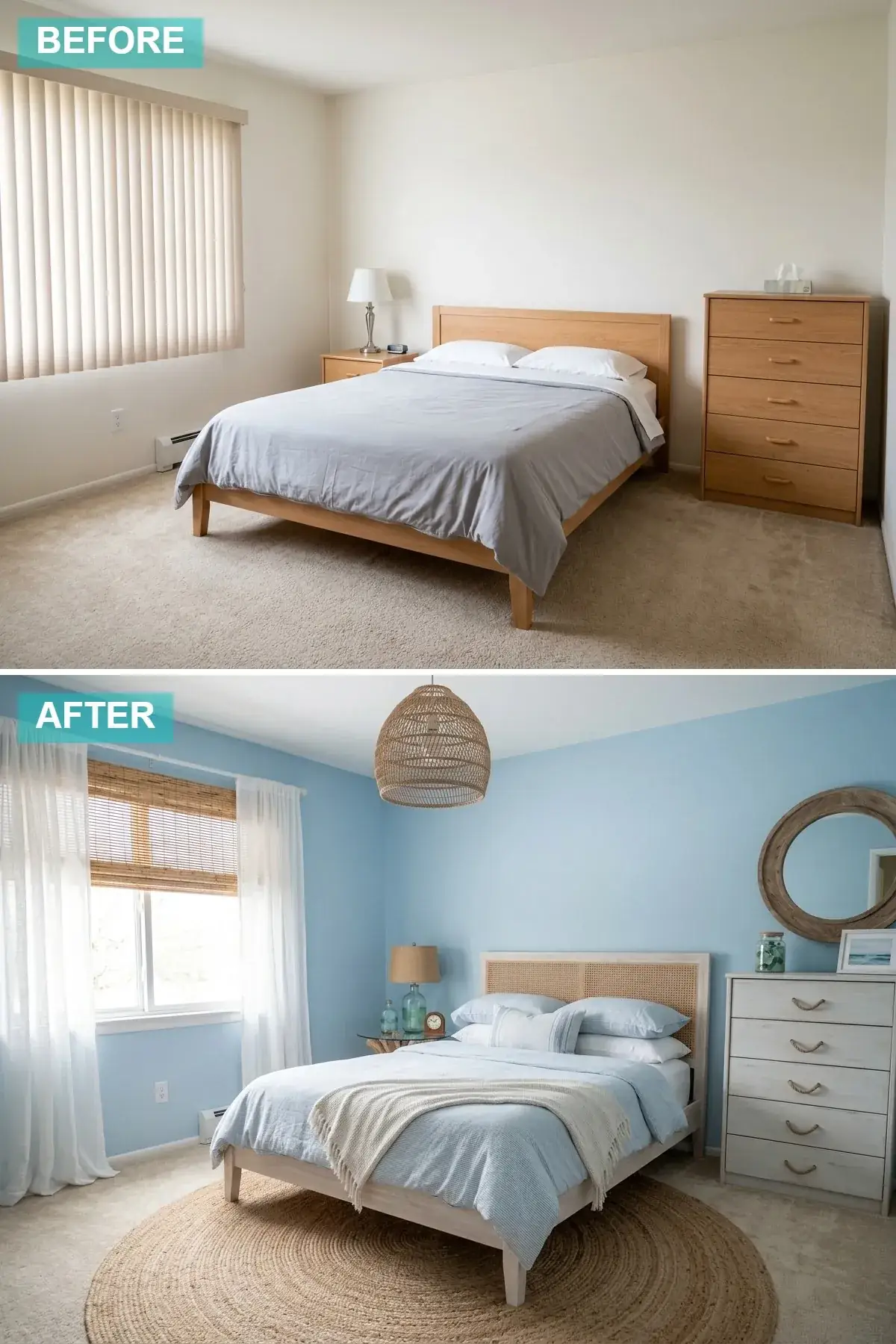
Out here on the West Coast, “coastal” doesn’t have to mean nautical kitsch. A soft sky-blue wall, a cane-and-wood bed, distressed white storage, and a round jute rug get you a room that feels like the light off the water without a single anchor motif. The window gets layered — sheers for privacy, a bamboo shade for actual light control — which is the move I recommend for any bedroom where you need the room dark by 9 and bright by 7. Natural fibers do the texture work so the pale palette never goes flat.
Color Palette
Sky Blue
#A2C4D9
Evokes a sense of calm and open sky.
Natural Cane & Wood
#C9B296
Adds organic texture and warmth.
Distressed White
#EFEFEF
A bright, airy finish.
Jute Brown
#BA9F7A
Grounds the space with natural fiber.
Styling Notes
- Keep the blue soft and chalky — saturated nautical blue reads juvenile fast.
- Layer a sheer over a bamboo shade so you control privacy and blackout independently.
- Lean on rattan, cane, and jute for texture instead of adding more color.
- Let the wood tones stay light and a little weathered; high-gloss finishes fight the relaxed mood.
Serene Scandi Minimalism
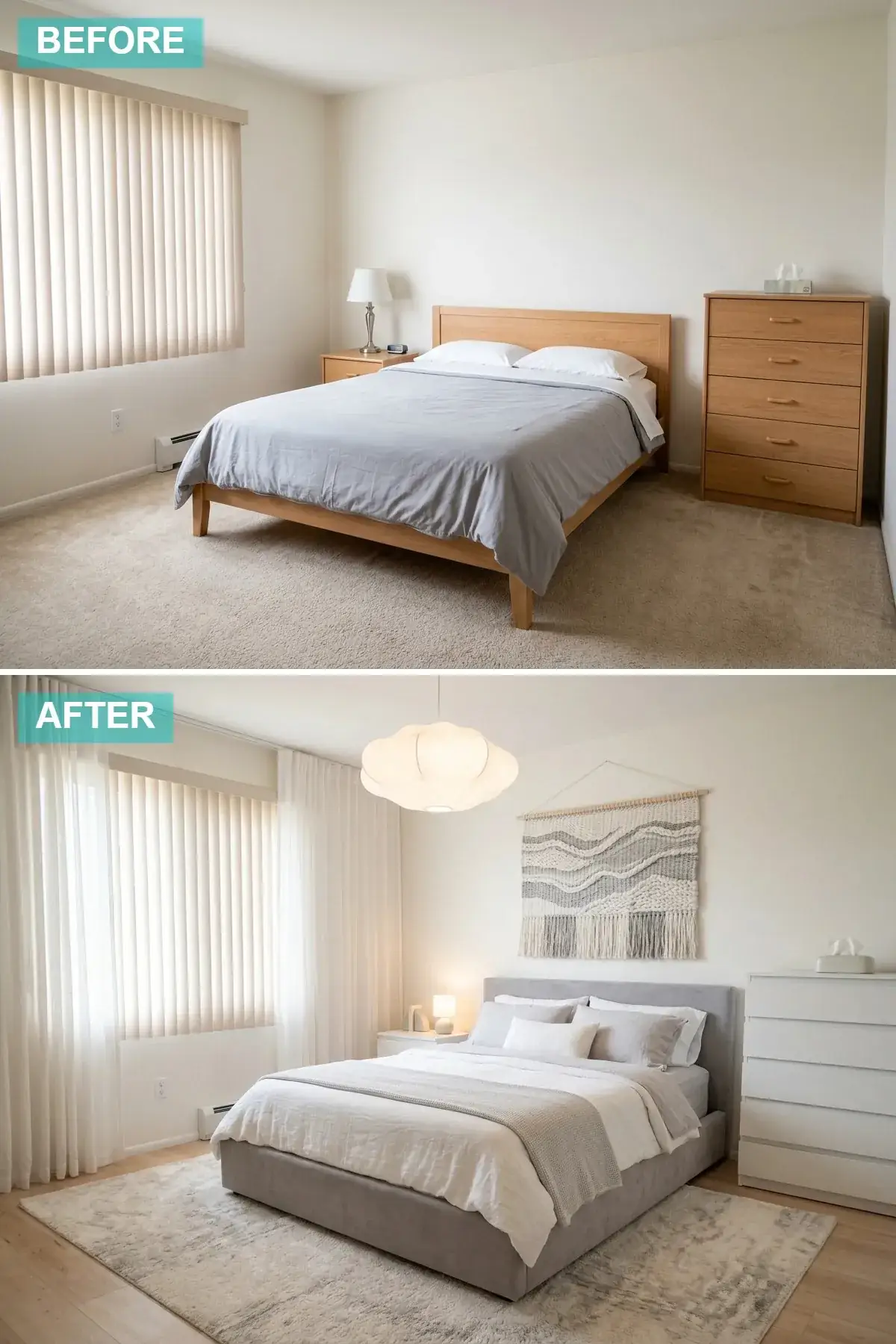
This is the most honest answer for a genuinely small room: stop fighting the walls and let the furniture disappear into them. A grey upholstered bed, sleek white storage that blends into white walls, one large woven hanging as the single decor gesture, and a cloud-shaped pendant. The palette is whites, greys, and pale wood. People assume minimalism is about owning less; in a compact bedroom it’s really about reducing visual edges so the eye has nowhere to snag — which is exactly why the room reads larger than its footprint. If a tech-free corner appeals to you, I built a whole quiet-luxury reading nook on this same logic.
Color Palette
Pure White
#FFFFFF
Creates a clean, bright, open feeling.
Light Grey
#B0B3B5
A soft neutral that adds gentle contrast.
Cream & Grey Wool
#DCD6C8
Adds soft texture and interest to the wall.
Off-White Paper
#F2F0E6
Provides a soft, diffused glow.
Styling Notes
- Match storage to the wall color so the largest pieces recede instead of announcing themselves.
- Build interest with texture — wool, linen, woven fiber — not with extra color or objects.
- Keep horizontal surfaces clear; in a tight room, a cluttered nightstand is the thing your eye fixes on first.
- Use one large textile as a headboard alternative when wall space is your only real canvas.
Earthy Organic Boho
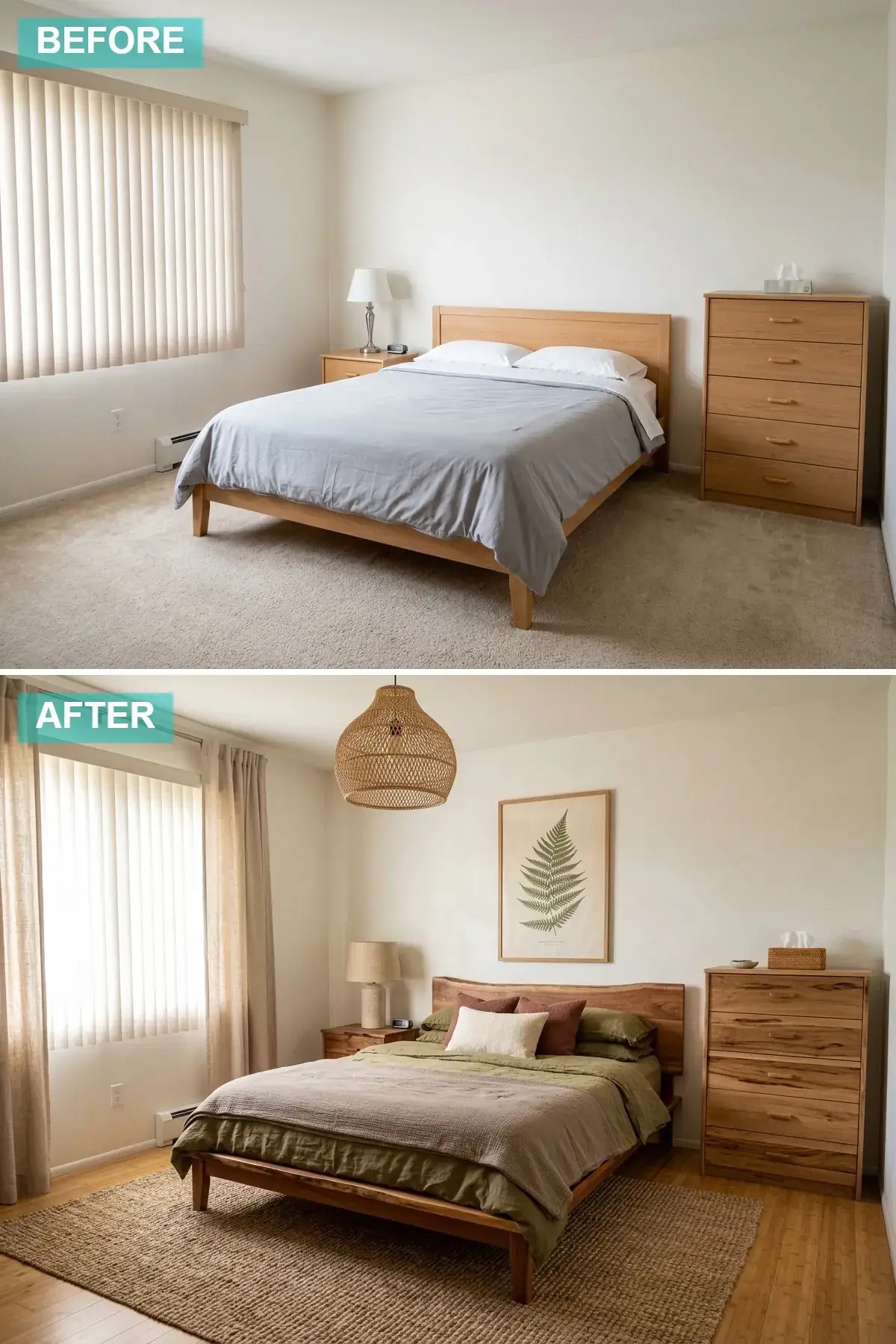
This is warm minimalism’s louder cousin. A live-edge wood bed anchors the room, complementary (not matching) wood pieces fill in, and a woven pendant plus a chunky jute rug pile on the texture. Bedding in olive and terracotta and one large botanical print keep it tied to the natural world. The reason this works in a small footprint is that the warmth comes from materials, not from a crowded surface — you can read this room as full and calm at the same time. It’s the same biophilic instinct I leaned on in my biophilic bedroom sanctuary.
Color Palette
Warm Acacia
#966F49
Highlights the natural beauty of the wood grain.
Olive Green
#7D8455
A grounding, natural color.
Natural Woven Fiber
#BFA37C
Adds significant texture and organic feel.
Light Oak
#C2A883
Complements the other wood tones in the room.
Styling Notes
- Let furniture show its grain and organic edges — perfectly matched wood sets kill the look.
- Pull your palette straight from nature: greens, browns, terracotta.
- Layer jute, linen, and basketry so the texture, not the object count, carries the room.
- Bring in one real plant or a botanical print to keep the earthiness honest.
Timeless Classic
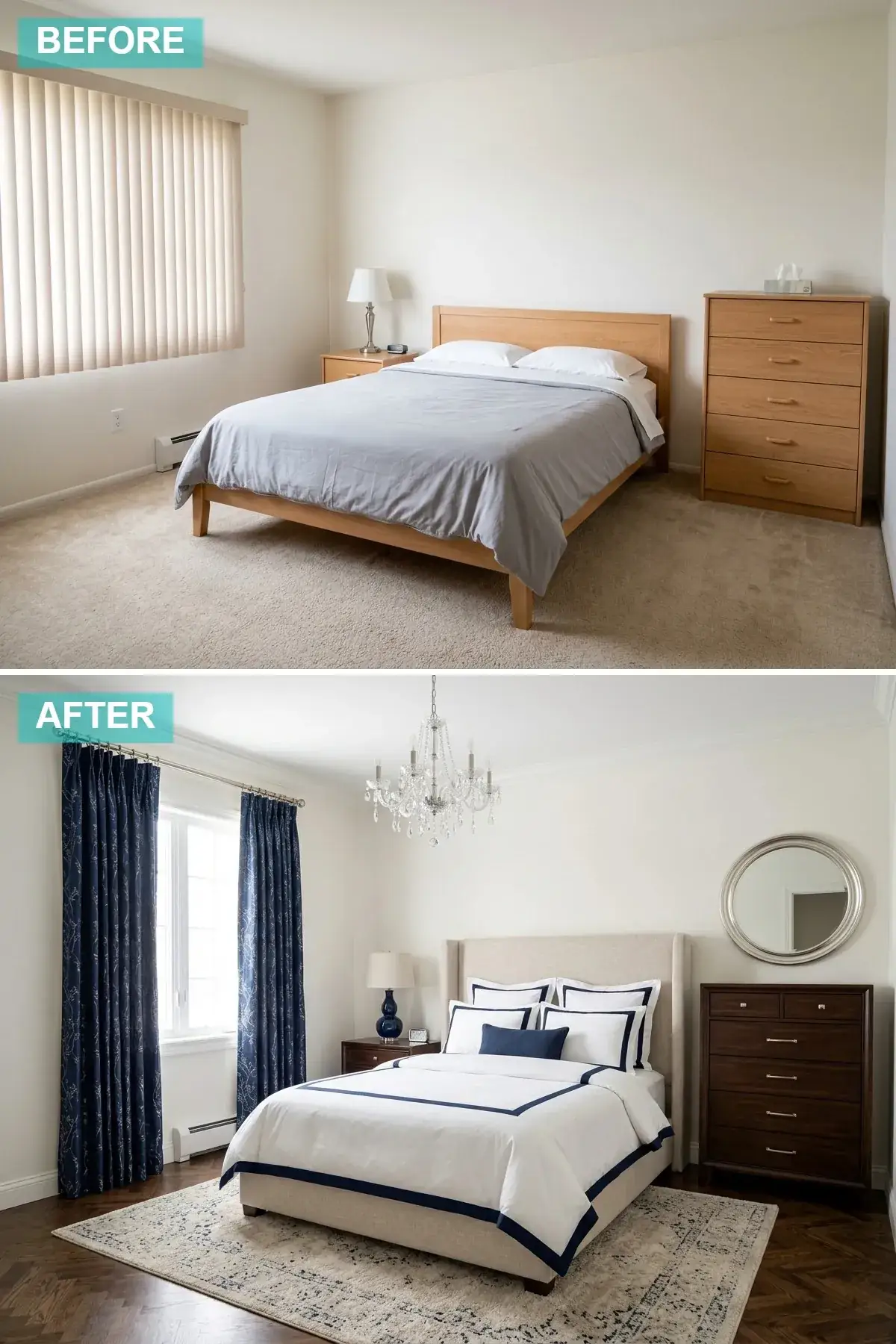
The classic direction is the one place I’d actually touch the floor. Pulling the carpet and laying dark herringbone wood gives the room a foundation that every other piece sits on more convincingly. A tall wingback bed and dark wood furniture build presence; a crystal fixture, patterned blue curtains, and hotel-style bedding with navy trim finish it. The risk in a small room is scale — a wingback this tall only works if you keep the rest of the room low and let that headboard own the vertical. Done right, it reads collected and permanent rather than crowded.
Color Palette
Dark Herringbone Wood
#4A3121
A classic, elegant flooring choice.
Navy Blue
#1B2F4A
A timeless, sophisticated accent color.
Espresso Wood
#332419
Dark, rich wood for a substantial feel.
Clear Crystal & Silver
#E0E0E0
Adds sparkle and a touch of glamour.
Styling Notes
- If the budget reaches the floor, do that first — wood or quality laminate under everything else changes the whole room.
- Navy and white is the safest classic pairing that still reads current.
- Let one tall element — usually the headboard — own the vertical, and keep everything else low.
- Choose bedding with tailored details like contrast trim; that’s where “hotel” lives.
Raw & Refined Industrial
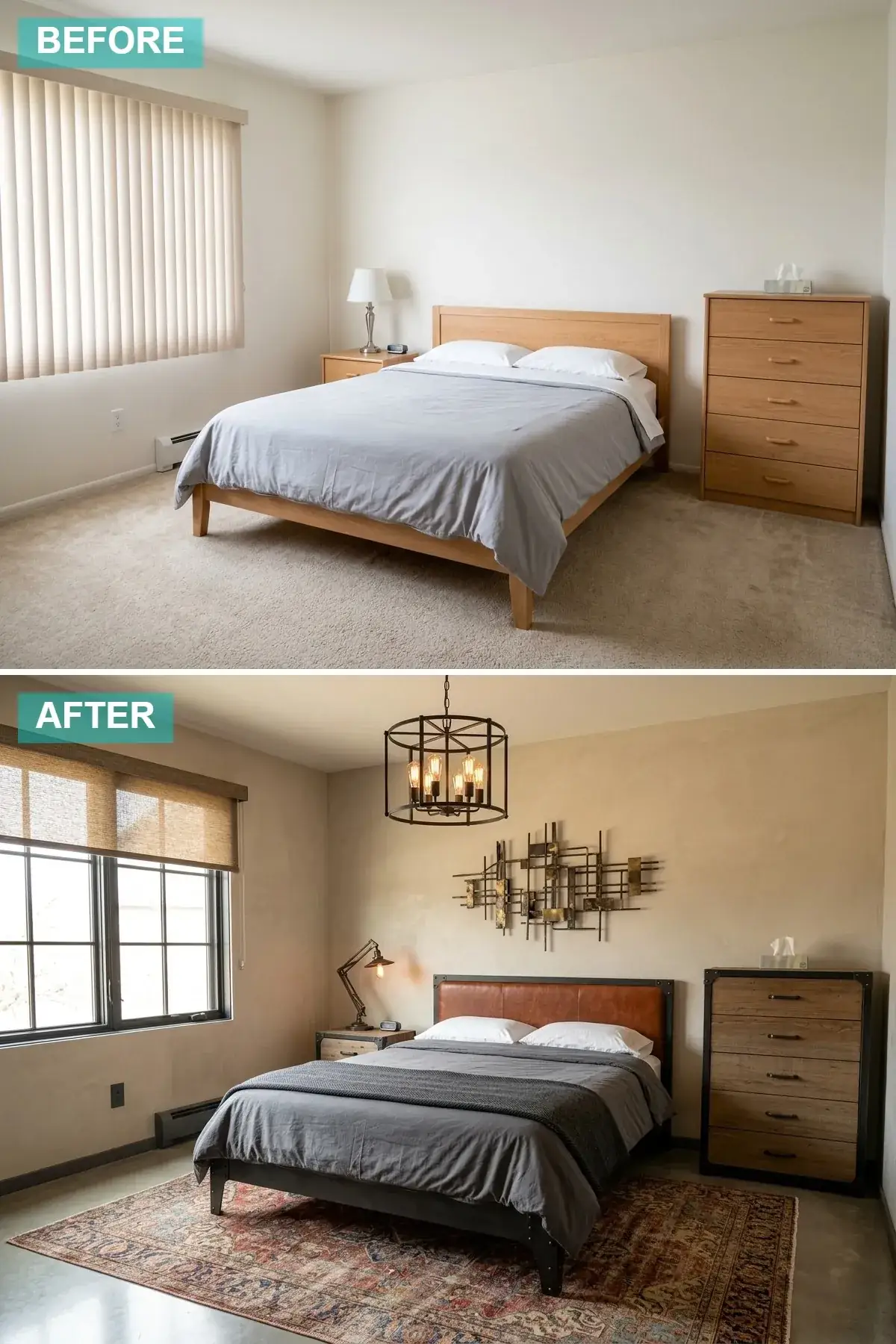
Industrial gets a bad rap for feeling cold, and in a small room that’s a real danger. The fix is the cognac leather headboard — one warm, tactile element that keeps the concrete-look walls and matte-black metal from going clinical. Distressed plank dresser fronts add a second warm note. A cage pendant and an articulated desk lamp handle the light. The takeaway from this version is that any hard-edged style needs a deliberate warm counterweight, or it stops feeling like a bedroom.
Color Palette
Concrete Grey
#8C8F91
Creates a raw, urban foundation.
Cognac Leather
#9E5E33
Adds the warmth the industrial palette needs.
Matte Black Metal
#2C2C2C
A staple material for the industrial look.
Distressed Plank Wood
#8F765A
A rustic contrast to the metal and concrete.
Styling Notes
- Get the concrete look with faux-finish paint or peel-and-stick panels — no need to actually pour anything.
- Pair metal frames with distressed wood so the furniture isn’t all one temperature.
- Always add a warm counterweight — leather, wood, or a wool throw — or the room goes cold.
- Exposed-bulb and caged fixtures sell the style faster than any single piece of furniture.
Bright Boho-Beach Fusion
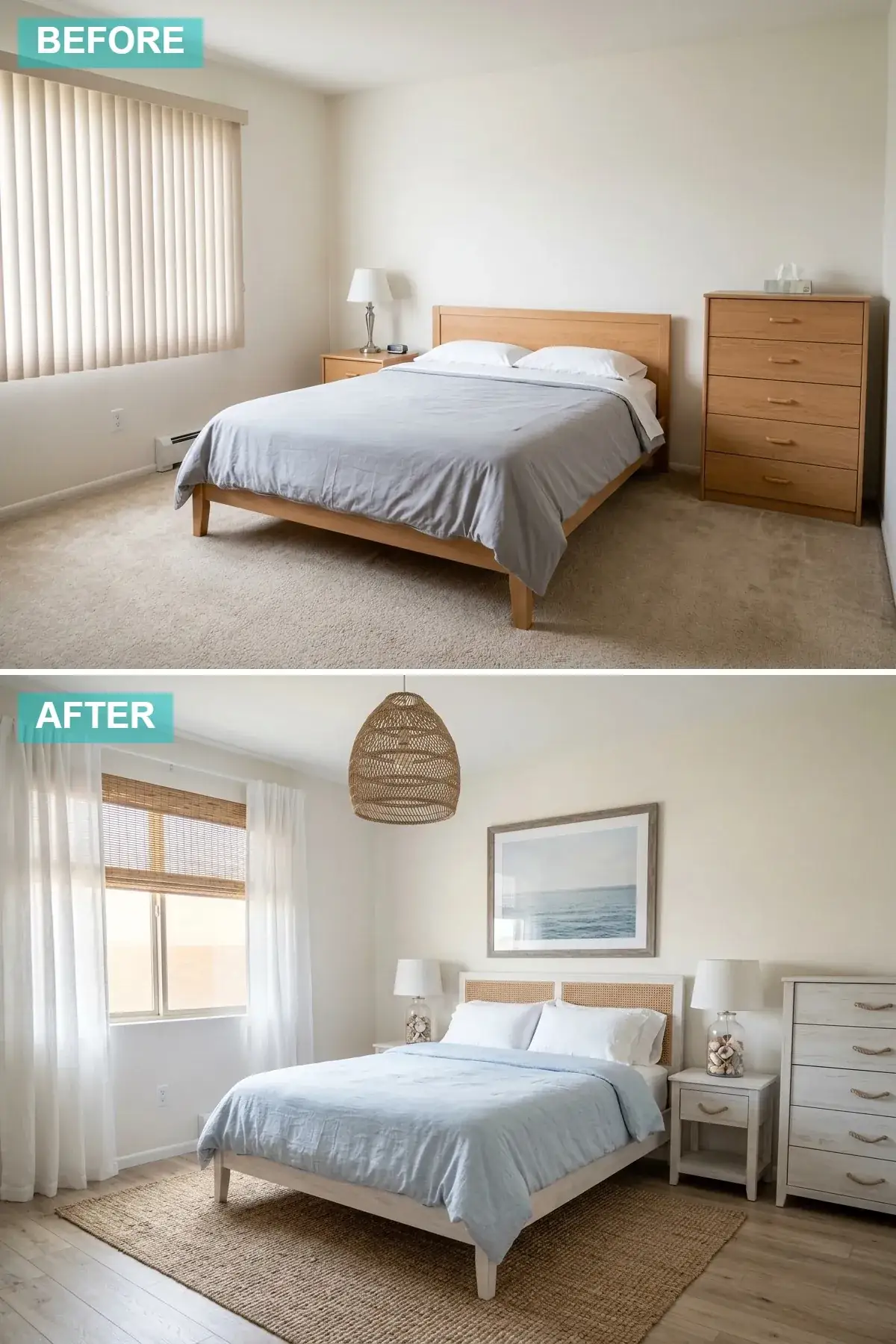
This is the lightest, airiest version in the set, and it’s the one I’d point a Pacific Northwest reader toward if their bedroom is north-facing and short on daylight. Light oak plank flooring replaces the carpet, the bed pairs a cane headboard with a white frame, and white storage with rope pulls keeps everything bright. A rattan pendant and jute rug add the texture; one oversized coastal print and pale chambray bedding finish it. White surfaces plus pale wood bounce what little light you get, so the room feels sunny even on a grey Portland morning.
Color Palette
Light Oak Plank
#D4BF9C
Brightens the room and adds natural grain.
White Wood
#F7F7F7
Keeps the look clean and airy.
Natural Rattan/Jute
#CCAB83
Essential for the boho-coastal feel.
Pale Chambray Blue
#BBD2E1
A soft, calming color reminiscent of the sea.
Styling Notes
- Pair white furniture with pale wood flooring to bounce light in a dim, north-facing room.
- Look for furniture with rope pulls or cane inserts — small details that carry the whole theme.
- Anchor the room with one oversized coastal print rather than a gallery of small frames.
- Use woven pendants and rugs to keep an all-light palette from reading flat.
Bold Art Deco
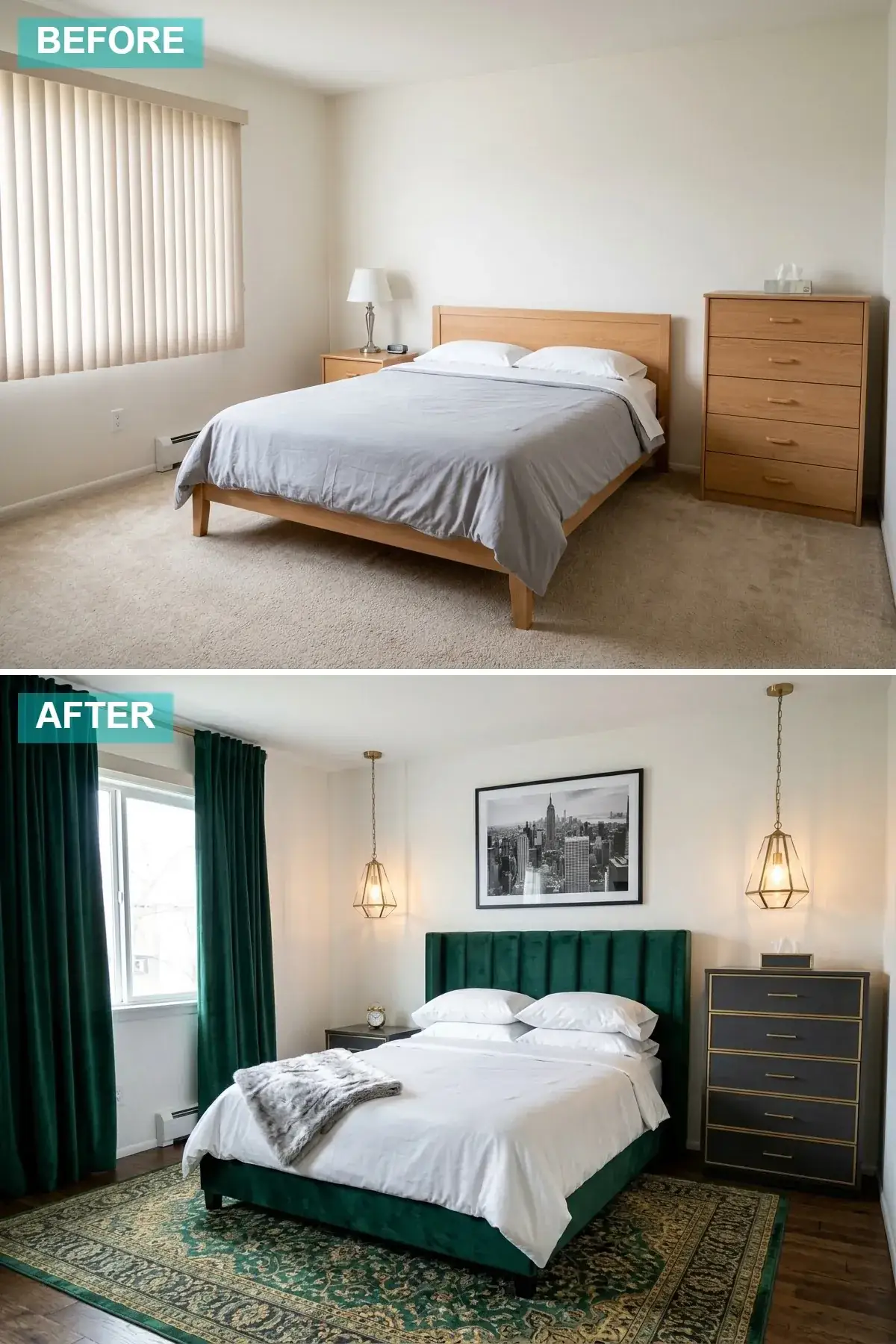
Most people are scared to go dark in a small room. This is the version that argues you should. An emerald velvet bed against a dark maple floor, black-and-gold furniture, geometric gold pendants used as bedside lights, and matching emerald curtains — the deep saturation actually makes the walls feel like they recede into shadow, which reads as depth, not confinement. Using pendants instead of table lamps frees the nightstands entirely, a genuinely useful move when surface space is scarce. It’s bold, but it’s disciplined: one jewel tone, one metal, one geometry.
Color Palette
Emerald Green Velvet
#00573F
A rich jewel tone that exudes luxury.
Black & Gold
#212121
A high-contrast, classic combination.
Brushed Gold Geometric
#D4AF37
Adds a touch of Gatsby-era style.
Dark Maple
#4E3524
A deep, rich foundation for the bold colors.
Styling Notes
- Don’t fear a dark jewel tone in a small room — deep color reads as depth, not shrinkage.
- Carry one geometry — fan, sunburst, chevron — through lighting, hardware, and pattern.
- Mix velvet with a single metal; emerald and gold is the cleanest Deco pairing.
- Hang pendants as bedside lights to clear the nightstands and gain surface in a tight room.
Cozy Scandi-Japandi Texture
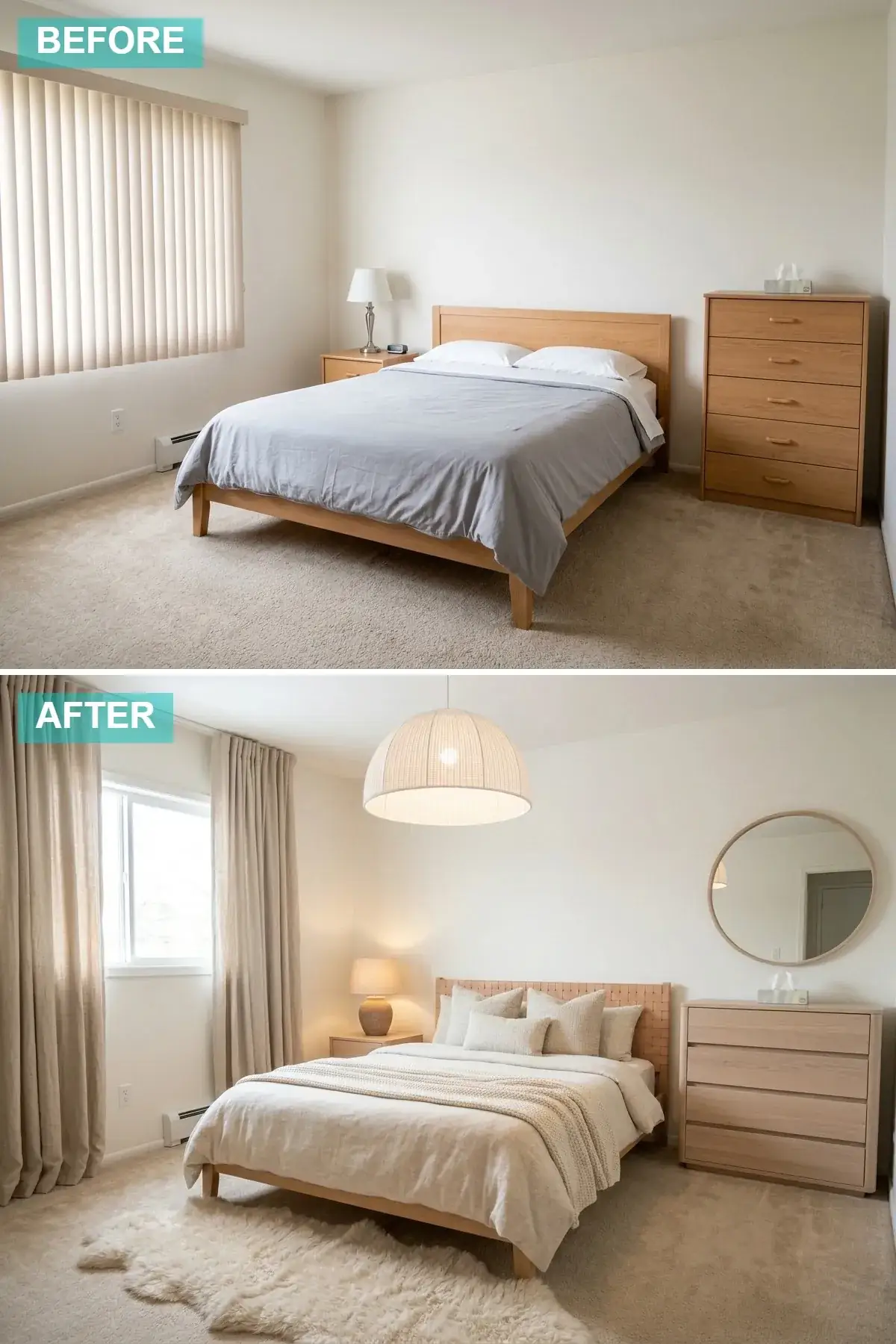
Japandi is where Scandinavian restraint meets Japanese warmth, and it’s my default recommendation for a compact bedroom that needs to feel calm but not stark. A woven leather strap headboard gives the room its one tactile signature; light ash furniture, a large paper pendant, and a round wood mirror keep the palette quiet. The coziness comes from layering — a plush sheepskin over a flatweave, bedding in three slightly different neutrals. Same low object count as the strict Scandi version, but it lands warmer because every surface invites touch.
Color Palette
Light Ash Wood
#E3D3B6
A pale, clean wood tone.
Tan Woven Leather
#C99E7A
Adds warmth and a unique tactile element.
White Paper/Fabric
#F8F7F2
Creates a soft, diffused light.
Cream Sheepskin
#FDFBF7
Provides ultimate softness and texture.
Styling Notes
- Build on a warm neutral base — creams, beiges, light woods — rather than cool greys.
- Make texture the whole point: woven leather, sheepskin, slubby linen.
- Choose a large, lightweight paper pendant for soft ambient light over the bed.
- Layer two rugs to add depth and warmth where a single flatweave would feel thin.
Minimalist Japandi Zen
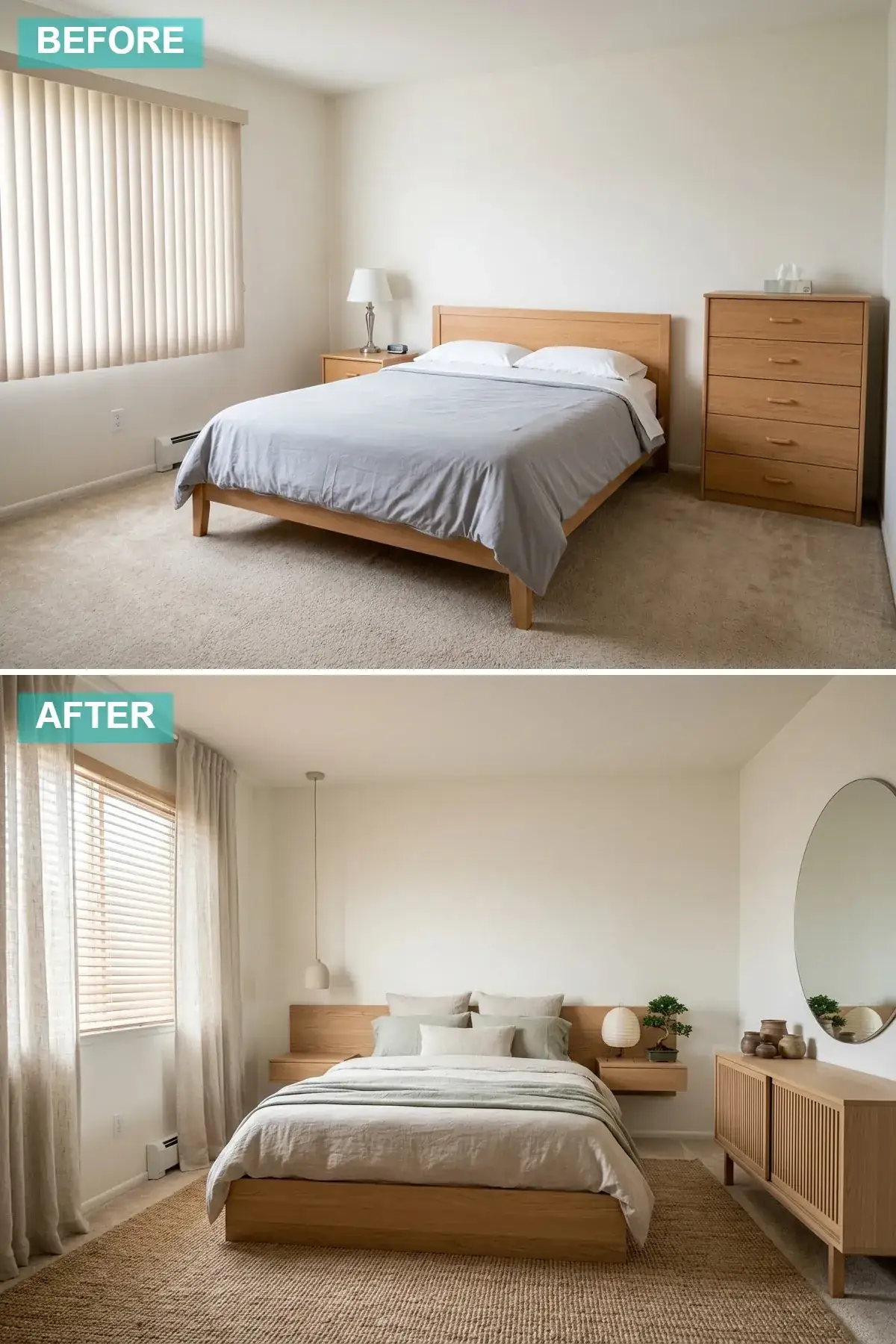
This is the version that thinks like an architect, and it’s the one I’d actually build into a compact plan. A built-in wood headboard with floating nightstands runs an unbroken horizontal line — that single continuous edge is what makes a small room feel resolved instead of furnished. A slatted console adds texture without adding clutter, wood blinds and linen filter the light, and the decor is two objects: a bonsai and a couple of earthenware vases. Floating the nightstands also keeps the floor visible underneath, which buys back the openness most compact bedrooms lose to bulky case goods.
Color Palette
Light Oak Wood
#D1B593
Used extensively for a cohesive, natural look.
Off-White Linen
#E8E4DB
A soft, natural background color.
Muted Sage
#A8B6A2
A subtle nod to nature.
Natural Wood Slats
#CCB393
Complements the furniture and controls light.
Styling Notes
- Consider a built-in headboard with floating nightstands — one continuous line is what makes a small room read resolved.
- Use slatted wood on a console or accent wall for texture without visual bulk.
- Keep decor to two or three deliberate objects; restraint is the entire style.
- Float case goods off the floor wherever you can to keep the room feeling open.
Contemporary Bouclé & Brass
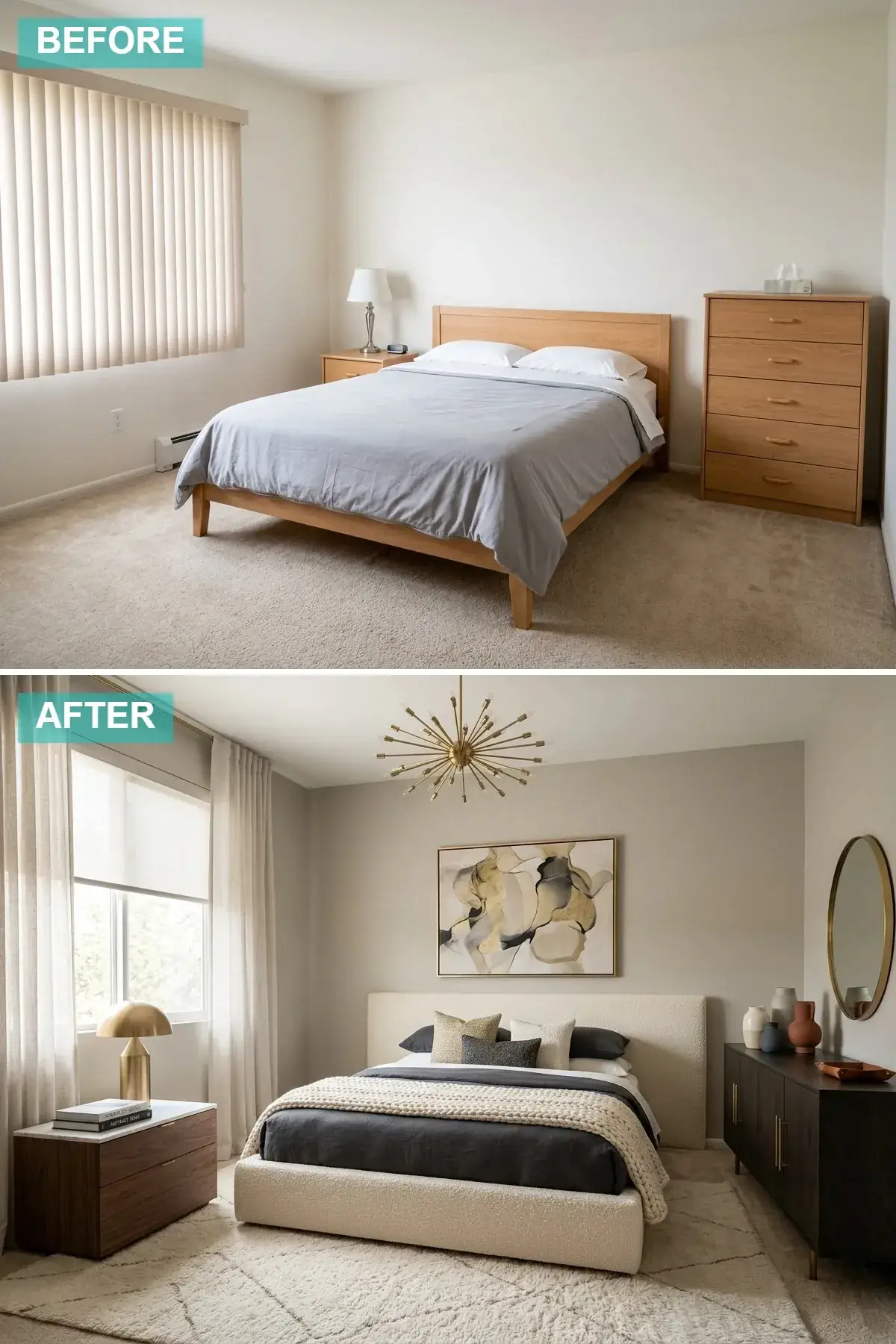
The most current-feeling version, built on one strong contrast. A cream bouclé bed brings the soft, nubby texture everyone’s after right now; dark walnut furniture with brass accents and marble tops gives it the hard, refined edge that keeps bouclé from going precious. A sputnik brass chandelier and a large abstract piece carry the eye up, and a Moroccan-pattern rug grounds it. The whole room runs on the tension between soft-and-light against dark-and-hard — get that one contrast right and the styling does itself.
Color Palette
Cream Bouclé
#F1EFE8
A trendy fabric with a rich, inviting texture.
Dark Walnut & Brass
#3D2B1F
A high-contrast, refined combination.
Polished Brass
#CBA44B
Adds a warm metallic gleam.
Charcoal Grey
#424242
Creates a bold, modern contrast.
Styling Notes
- Use bouclé on one large upholstered piece for the texture everyone’s chasing right now.
- Build the room on a single soft-vs-hard contrast: light bouclé against dark walnut.
- Repeat brass in lighting and hardware to warm up all that dark wood.
- Anchor with one large abstract piece pulled from the room’s own palette.
What Actually Moves the Needle
Across all twelve versions, the same three levers do most of the work — and none of them require more square footage:
- Lighting is the cheapest big win. Pulling the builder-grade dome and hanging a real pendant or chandelier — plus a second, lower light source — changes a room more per dollar than any furniture swap. In the Deco and mid-century versions, the fixture is the design.
- Window treatments buy you height and softness. Hanging curtains at the ceiling line instead of the frame, and layering a sheer over a blackout shade, makes a low compact room feel taller and gives you the light control a bedroom actually needs.
- One rug defines the sleeping zone. Even over existing carpet, a rug under the front two-thirds of the bed anchors it, adds the missing texture, and tells the eye where the room’s center is. It’s the move every single version above relies on.
If you want to see these levers pull a real room from start to finish, my master bedroom before-and-after walks one bedroom through the whole process — and the broader logic of warm, organic rooms lives in my piece on biophilic, organic-shaped design.
Common Questions
Which of these styles works best in a genuinely small bedroom?
The Minimalist Japandi Zen and Scandi versions are the safest for tight rooms, because matched-to-wall storage and floating, raised, or built-in furniture keep the floor visible and reduce the visual edges that make a space feel cramped. The Art Deco version proves dark color can work too — deep saturation reads as depth, not shrinkage — as long as you keep the object count low.
Can I really use a dark color in a small bedroom without it feeling closed in?
Yes. The instinct to paint everything white isn’t wrong, but it isn’t the only answer. A deep, saturated tone like emerald or charcoal lets the walls fall into shadow, which the eye reads as the room extending past its boundaries. The trick is to commit fully — dark walls, dark floor, restrained decor — rather than doing one dark accent wall, which just chops the room in half.
What’s the single highest-impact change if I only do one thing?
Swap the lighting. Replacing a builder-grade dome fixture with a real pendant or chandelier, and adding one lower light source, changes the feel of a bedroom more per dollar than new furniture or paint. Lighting sets the entire mood, and most builder bedrooms are badly under-lit to begin with.
Do I need new flooring to make a makeover look finished?
No. Most of these versions sit on the original floor with a well-placed rug doing the work. Flooring is worth changing only in the heavier directions — Classic and Art Deco — where a dark wood foundation supports the rest. For everything else, a rug under the front two-thirds of the bed is enough to anchor the room.
How do I keep a minimalist room from feeling cold and empty?
Lead with texture instead of objects. The Scandi-Japandi version owns roughly the same number of items as the strict Scandi one, but it reads warm because every surface — woven leather, sheepskin, slubby linen, pale wood — invites touch. Warm neutrals over cool greys, plus one tactile signature piece, is the difference between calm and clinical.
Conclusion
Same room, same footprint, twelve different lives. That’s the real lesson here — a compact bedroom isn’t a constraint you have to apologize for, it’s a tight brief that rewards good decisions and punishes clutter. Pick the direction that matches how you actually want to feel when you wake up, then spend your money on lighting, window treatments, and one anchoring rug before anything else. Get those three right and the room will feel finished no matter which of these twelve personalities you choose.
Sources & References
- American Lighting Association — guidance on layered ambient, task, and accent lighting in residential bedrooms.
- Sherwin-Williams Color Studio — reference for saturated and neutral interior paint behavior in low-light rooms.
- U.S. Department of Energy — Energy Saver — window-treatment and daylighting recommendations for residential rooms.
- Architectural Digest — contemporary reference on Japandi, bouclé, and warm-minimalist bedroom trends.
Comments
Loading comments…
Leave a comment
Your email won't be published — it's only used to let you know if we reply. Comments appear after approval.