
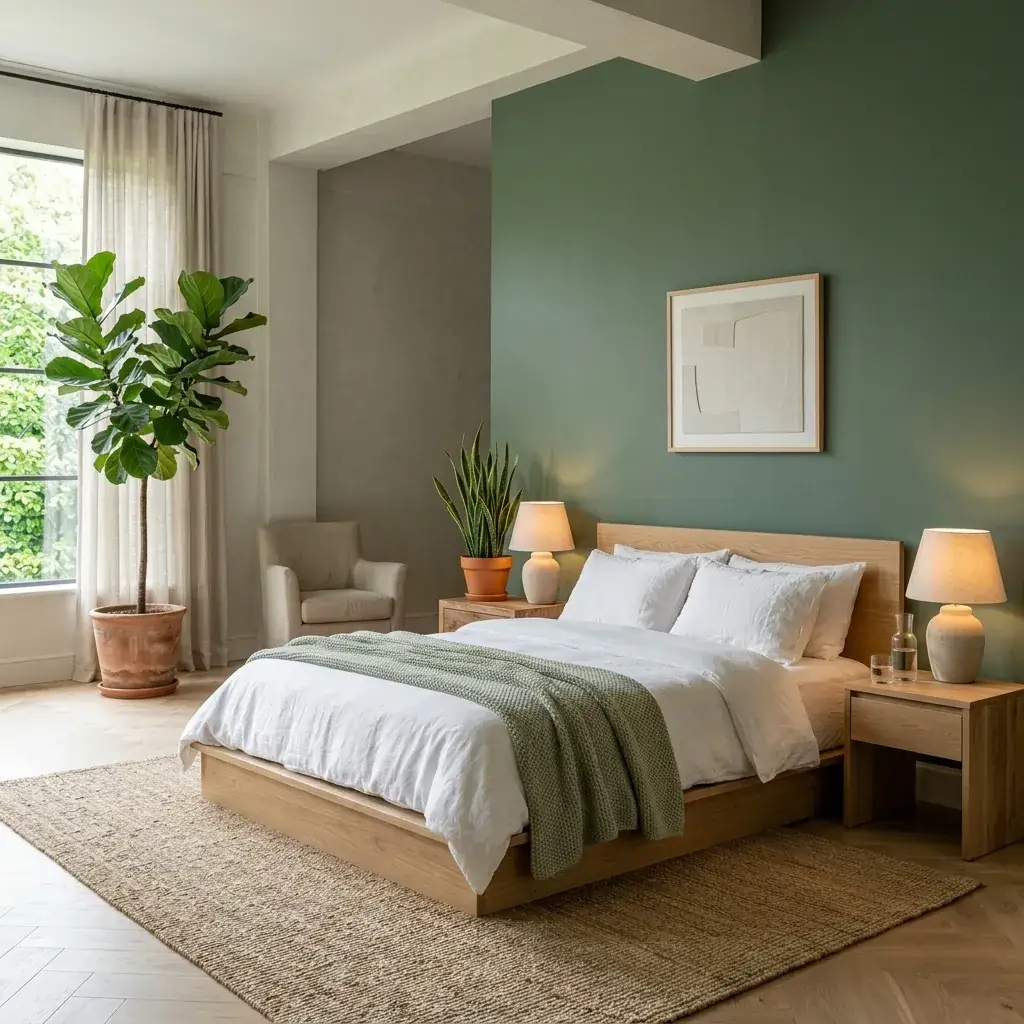

Hannah and Kalei came to me in February after thirteen months of tracking their sleep on a phone they kept charging six inches from their pillow. Hannah is a high-school physics teacher in Tacoma; Kalei works in clinical research at Multicare. They had spent the year on the apps and the supplements and the sound machines, and the data was unambiguous: their sleep was getting worse, not better. Their question to me, after a friend recommended the practice, was the right one: “We’ve tried everything except the room itself. Can the architecture do anything?”
Their primary bedroom is 11×12 — 132 sqft of usable space — in a 1,540 sqft 1923 craftsman in Tacoma’s Stadium District. Two windows on adjacent walls, north and east; original Doug fir floors; one small closet; a single overhead light; a queen bed against the longer wall. The bones are typical PNW compact-bedroom stock, which is to say constrained but workable. What I drafted for them over six weeks was ten architectural directions for the same room — ten complete material lists, ten lighting plans, ten storage strategies, ten tech-free programs that the architecture itself enforces rather than relies on willpower. They eventually chose direction nine (the built-in reading bench with slat wall) because the bench solves the nightstand problem AND the storage problem AND the reading-instead-of-scrolling problem in a single 86-inch-wide intervention. The install came in at $9,800.
Tech-free bedroom design is not a willpower problem; it is an architectural one. If your nightstand has space for a phone, the phone will be there. If your bed faces a wall socket near a hand, the charger cable will be plugged in. If the only reading light in the room is the screen of the device that woke you at 6 a.m., the device will be the morning’s first input. The architecture of the room either makes tech-free easy or it makes it a daily negotiation. The ten directions in this article all start from the assumption that the room itself should do the enforcement.
I’m Elliot Calloway. I’ve been on the boards eight-plus years, the last four almost entirely on compact homes and ADUs across the PNW corridor. The Hannah-and-Kalei brief is one I get more often each year — and the answer has slowly shifted from “buy these products” to “change these built-in moves.” Let’s walk all ten.
What’s in this article
- Sage-Walled Compact Primary — $4,800
- Beamed-Ceiling Loft Bedroom — $7,400
- Wainscoted Compact With Plant Window Sill — $6,200
- Reading-Nook Bedroom With Botanical Wallpaper — $5,400
- Arched-Window Compact Primary With Built-Ins — $14,800
- Moody Compact With Cove LED Headboard — $7,800
- Vaulted Compact Bedroom — $6,400
- The Tech-Free Nightstand: An Essentials-Only Audit — $480
- Built-In Reading Bench With Slat Wall — $9,800 (the chosen direction)
- Sage Sanctuary With Plant Console — $4,200
- Pro Tips From the Drafting Board
- Regional Fit: PNW & Mountain West Bedroom Notes
- Frequently Asked Questions
- Sources & References
- Final Thoughts
Who this article is for
- Owners of 1900-1940 PNW craftsmans, bungalows, and infill cottages with compact 110-180 sqft primary bedrooms.
- ADU owners and downsizers whose primary bedroom is the only bedroom and needs to perform multiple programs (sleep, reading, occasional WFH overflow) without crowding.
- Anyone who has tried apps, supplements, and sound machines and wants to test what the architecture can do that the wellness industry can’t.
- Couples whose nightstands have become charging stations and who want the architecture to break the habit rather than depending on daily willpower.
1. Sage-Walled Compact Primary — $4,800
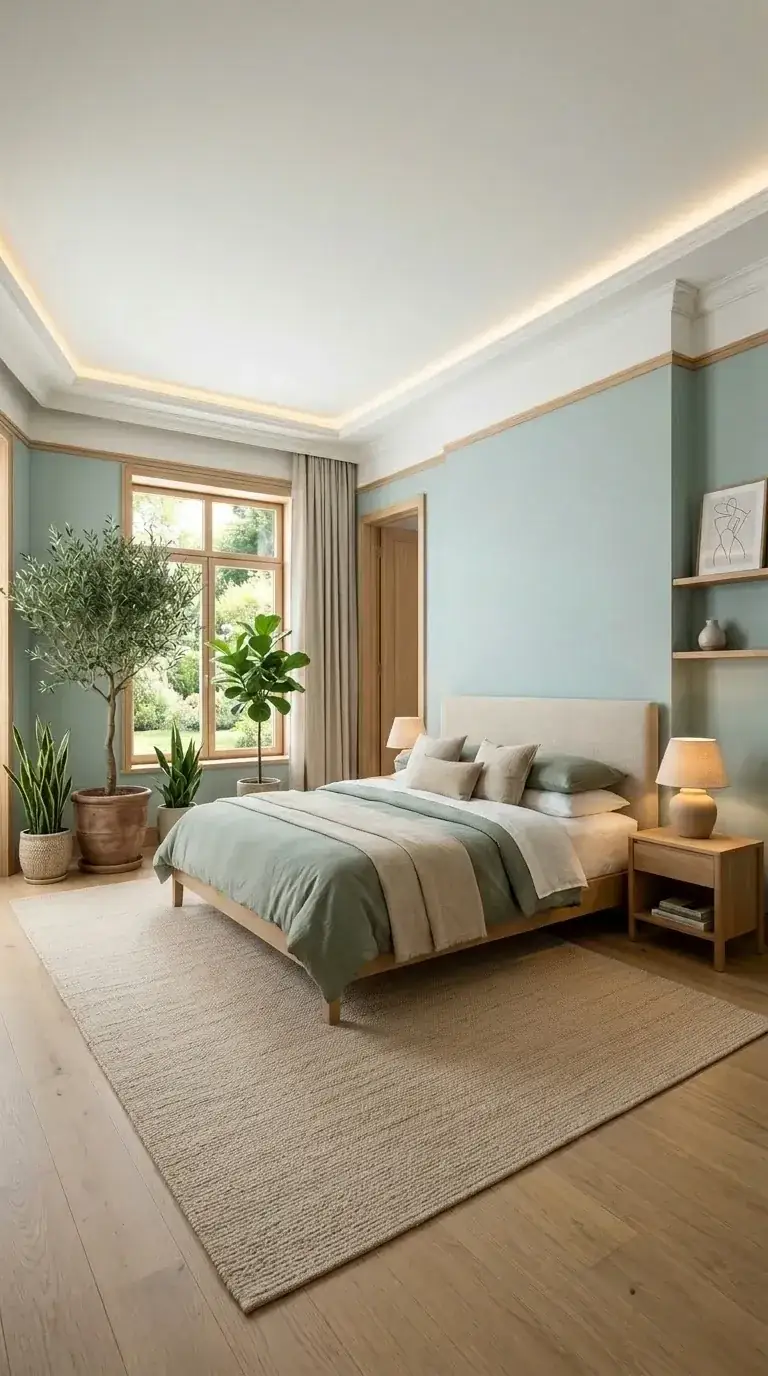
This is the most-drafted direction in my compact-bedroom archive because it works in almost any 110-180 sqft room without requiring architectural intervention. Walls drop to Farrow & Ball Pigeon No.25 in modern eggshell ($125/gallon × 1.5 = $185 for an 11×12 room with one accent wall). Existing 1923 wood trim, sand and re-coat with Rubio Monocoat Pure 5% rather than repaint white ($120 in materials). Bed frame is the Article Mara Queen upholstered in Heather Grey ($899) — the closed-base silhouette is critical because it denies floor-stash space (no charger cables disappearing under the bed). Linen duvet set is Coyuchi Organic Crinkled Percale in Natural ($340 for the queen set). Two layered blankets: a Pendleton Wool Mill Glacier National Park Stripe ($245) and a The Citizenry Stonewashed Linen Throw in Sand ($120). Jute rug is Annie Selke Bernardine 8×10 ($1,290). Two nightstands: The Joinery Astoria Mini 22″ in white oak ($580 each = $1,160) — handcrafted in Portland, three-week leadtime. Two ceramic table lamps from Heath Ceramics Sculptural Form in Opaque White ($240 each + $90 shades = $660). 6-foot olive tree (Olea europaea ‘Arbequina’) in 14-inch terra-cotta planter from Solabee Flowers Portland ($420 plant, $80 planter). Two floating walnut shelves from Beam & Anchor‘s Portland workshop ($120 pair). Total installed: $4,800 — the leanest complete-room treatment I draft for clients.
Color Palette
A muted blue-green-gray that reads sage in afternoon and slate at night — color temperature shifts that work with melatonin rhythms rather than against them.
Sand and re-oil the existing trim rather than paint over it — old-growth fir grain is character that paint will erase permanently.
Organic GOTS-certified linen — the wrinkle is the design intent, the durability is the differentiator from poly-blend equivalents.
Real terra-cotta develops a mineral haze in PNW humidity within two seasons — the patina is exactly what a compact bedroom needs to read as inhabited.
Styling Notes for This Look
- Pigeon walls require warm 2700K bulbs throughout the room. Cool 3000K LEDs in a sage room read as unintentionally minty and disrupt the color temperature shift the paint is doing across the day.
- Closed-base bed frames are the single most underspecified architectural decision in tech-free bedrooms — open-base frames invite charger cables, books, and dust accumulation that all signal “non-sanctuary” within months.
- One large specimen tree in the corner is the right plant count for a 132 sqft room. Three or four medium plants will read as a nursery in a compact volume; a single 6-foot tree reads as architectural punctuation.
2. Beamed-Ceiling Loft Bedroom — $7,400
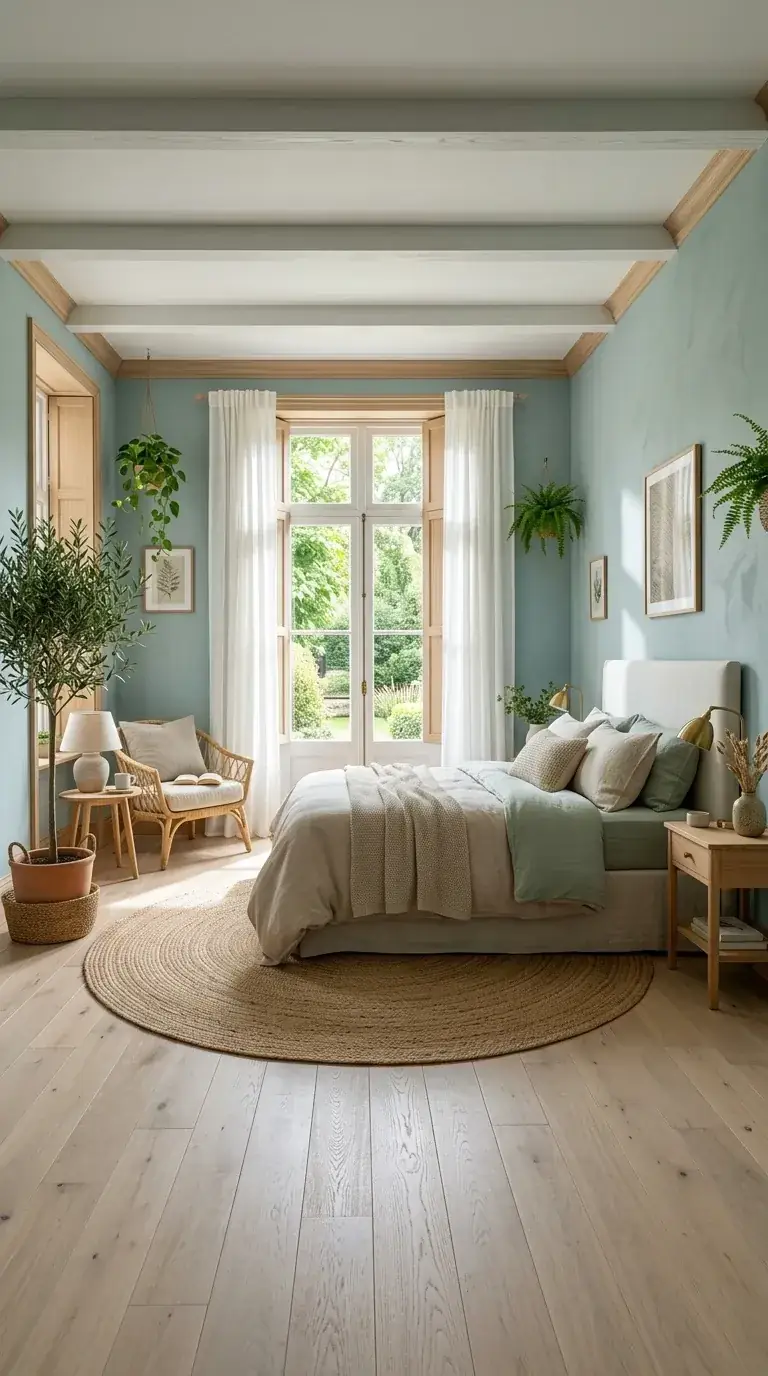
For the compact home with a real exposed-beam ceiling — typical of 1990s-2010s PNW shed-roof modernist infill, converted barns, and the small percentage of original craftsmans where the ceiling was opened during a previous renovation — the beams are doing architectural work that no other element can replicate, and the design move is to support them rather than fight them. Existing beams (assumed reclaimed Doug fir or visible structural lumber) treated with Rubio Monocoat Pure 5% if previous finishes are failing ($240 materials). If you do not have existing beams and want this look, faux beams from The Joinery in reclaimed-stock Doug fir run $180-280/linear foot installed — for a typical 12×14 room with three beams, budget $4,800-7,200 just for the beam install, which is why I rarely recommend faux beams to clients without existing structure. Walls in Benjamin Moore Salisbury Green HC-138 matte ($240). Upholstered queen bed Article Mara ($899). Linen bedding from Boll & Branch Heritage Linen ($340). Round jute rug Lulu & Georgia Arlo 8-foot ($890). Rattan armchair Article Otio in white oak with woven cane back ($699). Two side tables Floyd Round 18-inch in white oak ($395 each = $790). Three trailing plants in macrame hangers (one large pothos, one philodendron Brasil, one string-of-pearls) from Solabee Flowers ($90 plants, $60 hangers). 6-foot olive tree in terra-cotta planter ($500). Two ceramic table lamps Heath Ceramics ($660). Wall paint and trim labor: $480. Total: $7,400 assuming existing beams.
Color Palette
A blue-green-gray that holds well in PNW north-light bedrooms where pure aqua paints would read cool. Salisbury Green has just enough yellow undertone to keep it warm.
PNW-native Doug fir, oiled rather than stained — the natural color drift over five years is what makes this read as authentic rather than themed.
Real Indonesian rattan-grade cane has a tonal variation that synthetic cane cannot reproduce — Article and Schoolhouse both source authentic cane for their open-back chairs.
A subtle sage textile that pulls the wall color toward the bed without creating a matched-suite signal.
Styling Notes for This Look
- Hanging plants in compact bedrooms must be hung at minimum 78 inches above the floor to avoid the head-strike risk in the middle of the night — measure from the bottom of the longest trailer, not from the planter rim.
- Trailing species (pothos, philodendron Brasil, string-of-pearls, hoya) tolerate the lower-light conditions of north-facing PNW bedrooms better than upright tropical species — choose accordingly to avoid plant failure within the first nine months.
- Faux ceiling beams almost always read as faux in person even when they photograph well; spec real reclaimed lumber if at all possible, even if it limits which rooms you can apply this direction to.
3. Wainscoted Compact With Plant Window Sill — $6,200
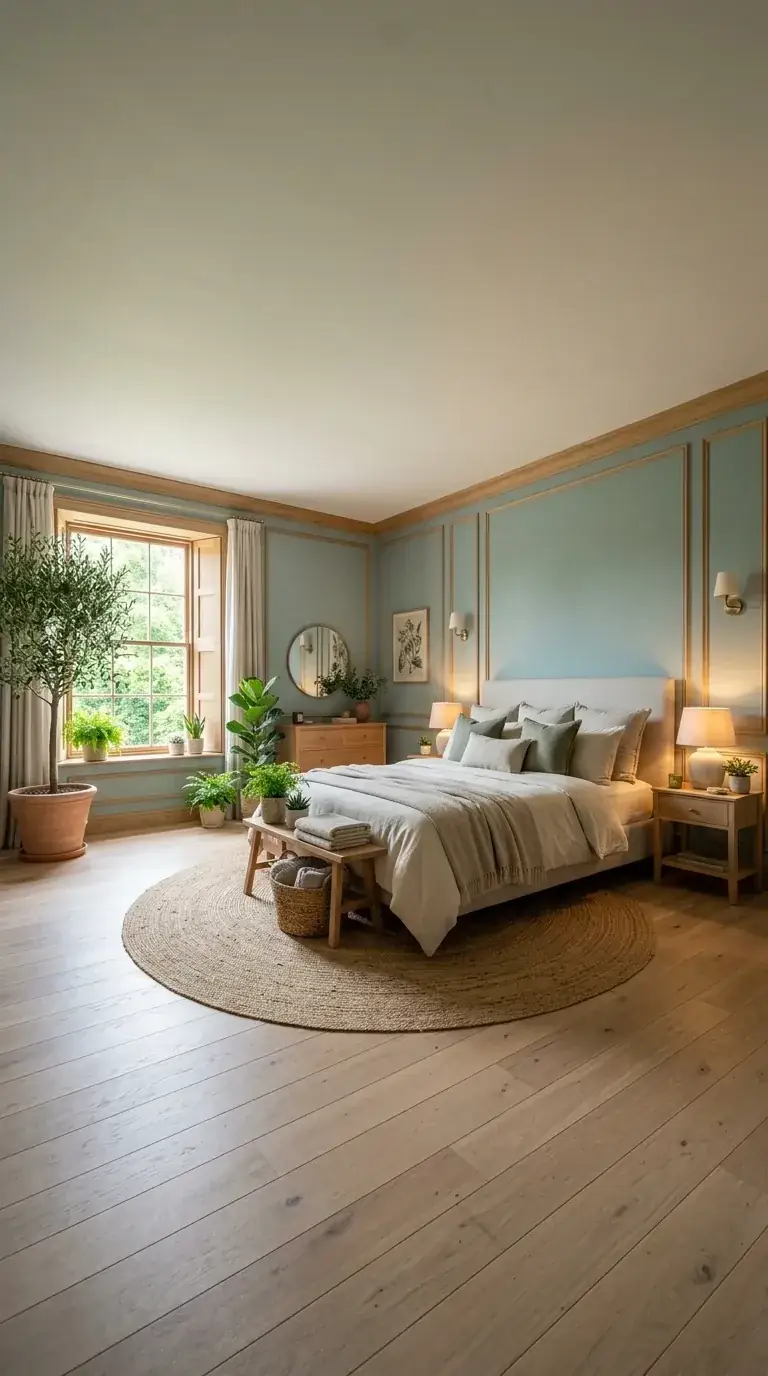
The direction I draft for compact-bedroom owners who came to seek refuge from the hyper-modern aesthetic and want a measured classical move that nonetheless still reads contemporary at 130 sqft. Walls below 42-inch wainscoting in Benjamin Moore White Dove OC-17; walls above and ceiling in Farrow & Ball Inchyra Blue No.289 matte ($340 paint). 1×4 picture-frame wainscoting in 4-panel rhythm around the room: $1,890 installed by a Portland trim carpenter (4-week leadtime, this is the line item with the longest delivery). Window sill deepening from existing 4-inch standard to 12-inch deepened sill: $480 carpentry. Bed frame is the Crate & Barrel Maxwell Queen in fumed white oak ($1,499). Bedding from Coyuchi Crinkled Percale ($340). Wood bench at end of bed: The Joinery Skyline Bench 60″ ($890). One walnut dresser Article Lenia 6-Drawer ($1,299) — the closed dresser absorbs all the small-item clutter that compact bedrooms accumulate. Two brass wall sconces flanking the bed: Hudson Valley Argon Sconce in aged brass ($340 each = $680). Two table lamps: skip — the wall sconces eliminate the need. Six potted plants on the deepened windowsill (mixed sansevieria, ZZ, philodendron, peace lily): $180 plants, $120 ceramic pots from Heath Ceramics. Round wall mirror: CB2 Pavillion 36″ in burnished brass ($299). Total: $6,200.
Color Palette
A muted blue-green that reads as dusty teal in afternoon and almost charcoal at night — it’s the F&B that holds a compact bedroom from feeling boxy.
White Dove holds a creamier read than Chantilly Lace under PNW north light — the difference matters at this color contrast level.
Fumed (ammonia-darkened) oak holds dimensional stability better than stained oak under PNW seasonal humidity swings.
Aged (lacquered) brass holds its color for ~10 years versus raw brass which patinas in 18 months. Stable warm honey is the right call for sconces you’ll see twice daily for a decade.
Styling Notes for This Look
- Wall-mounted sconces in the bedroom solve three problems at once: they free up the nightstand from lamps (which leaves room for a single book and an analog clock), they direct light away from the eye for evening reading, and they put the on-off switch at exactly head height so you do not have to roll over to turn off the light.
- Deepened window sills (12-inch minimum) in compact bedrooms are the highest-ROI architectural addition for biophilic plant display — the standard 4-inch sill cannot hold the 8-inch ceramic pots that most healthy houseplants need.
- Picture-frame wainscoting at 42 inches is the historically correct height for 1900-1940 PNW craftsmans; chair-rail at 36 inches will read as miscalibrated in a room with original 1920s baseboards.
4. Reading-Nook Bedroom With Botanical Wallpaper — $5,400
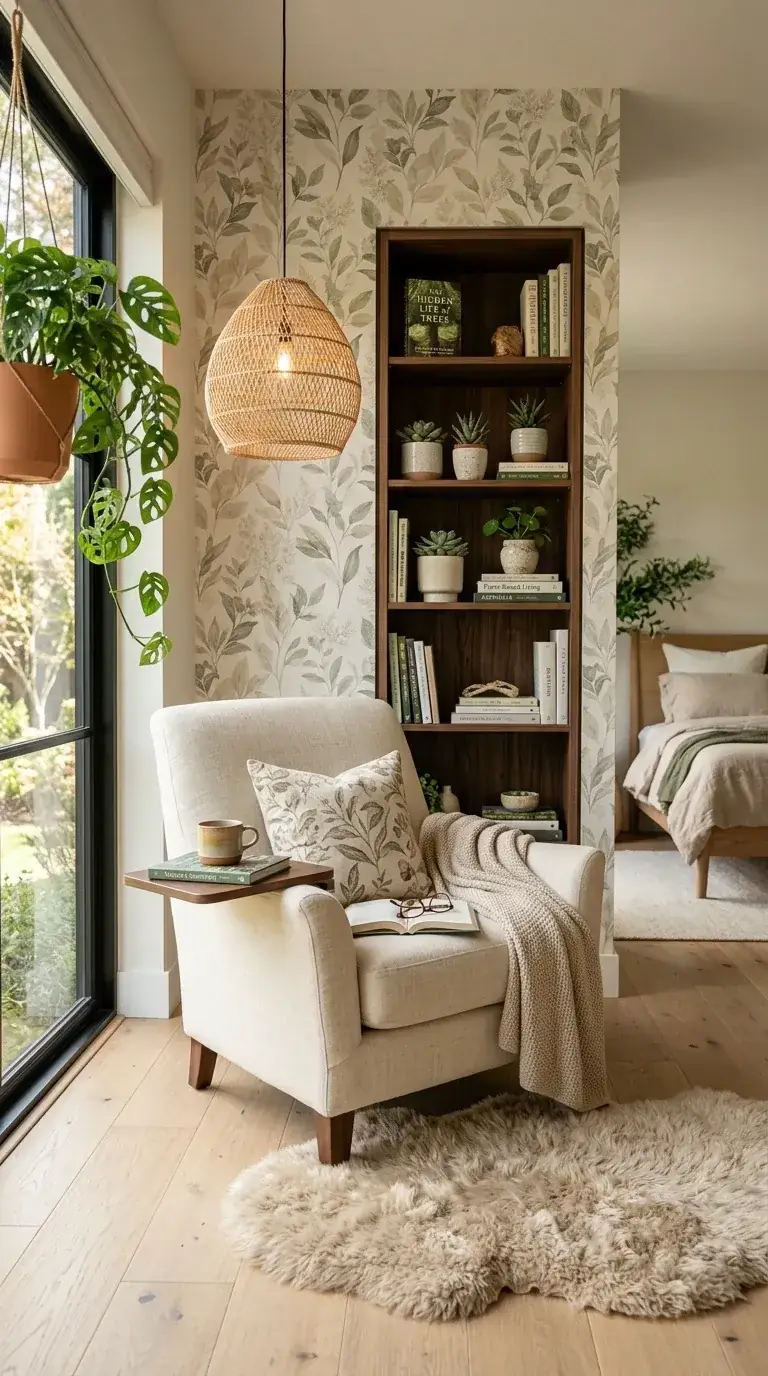
The most effective tech-free architectural move available in a compact bedroom is the dedicated reading-and-not-scrolling corner — a chair, a side table, a lamp, and a vertical bookshelf within arm’s reach. Walls in Schumacher Songbirds botanical wallpaper on a single 60-square-foot accent wall ($14/sqft installed = $840 for the wall). Adjacent walls in BM White Dove ($180). Reading armchair: Article Sven Drift Grey ($849) — the closed-arm modernist silhouette reads as deliberate rather than office. Clip-on armrest table: Hand-Eye Supply Brass Clip Table ($89). Sheepskin throw on the armchair: Pottery Barn Mongolian in Ivory ($129). Custom built-in bookshelf 36-inch wide x 84-inch tall in walnut: The Joinery custom shop ($2,400 — 8 weeks fabrication). Woven pendant light: Schoolhouse Bell Pendant in matte black with rattan shade ($340). Eight to ten small plants and pots on the bookshelf: $180 plants from Solabee, $120 in mixed Heath Ceramics and Cargo small pots. Books and decor for shelving (assume owners already have books to display): $0 for books, $80 for two ceramic vessels and a small sculpture. Throw blanket and pillow for the chair: $120 from Pendleton and West Elm. Total reading-corner installation: $5,400. The rest of the bedroom (bed, bedding, lighting) is sold separately as part of one of the other directions.
Color Palette
A near-white background that holds character without competing with the botanical pattern — pure white wallpaper backgrounds will read cold against the dark bookshelf.
Schumacher’s Songbirds palette uses a muted olive that ages well — saturated jewel-tone botanicals look fresh in showrooms but grow tired in a bedroom you live in.
Real walnut, not stained-oak imitation — the grain figure on a vertical bookshelf is doing visual work that paint cannot replicate.
Two soft-neutral textures around a single chair — the warmth that pulls owners off the bed and into the corner instead of toward the phone.
Styling Notes for This Look
- Reading-corner placement matters: the chair must face away from the bed, not toward it. Facing toward the bed turns the corner into a “place to look at the bed from” rather than a place to read; facing away creates the architectural separation that makes reading-instead-of-scrolling actually happen.
- Custom-built bookshelves cost roughly the same as five years of e-book purchases and last 30 years; the math favors investing in physical-book infrastructure if reading-not-scrolling is a real intention.
- If the bedroom is too small to dedicate 36 square feet to a reading corner, the alternative is a dedicated reading-not-scrolling bench at the foot of the bed (see direction nine) — the principle is the same: a place to read that is not the bed itself.
If you came in looking specifically for the reading-corner program rather than the wider compact-bedroom strategy, my deeper piece on this is Quiet Luxury’s Embrace: Designing Your Serene Tech-Free Reading Nook Sanctuary — same architectural argument, fully fleshed across a single-aesthetic deep-dive.
5. Arched-Window Compact Primary With Built-Ins — $14,800
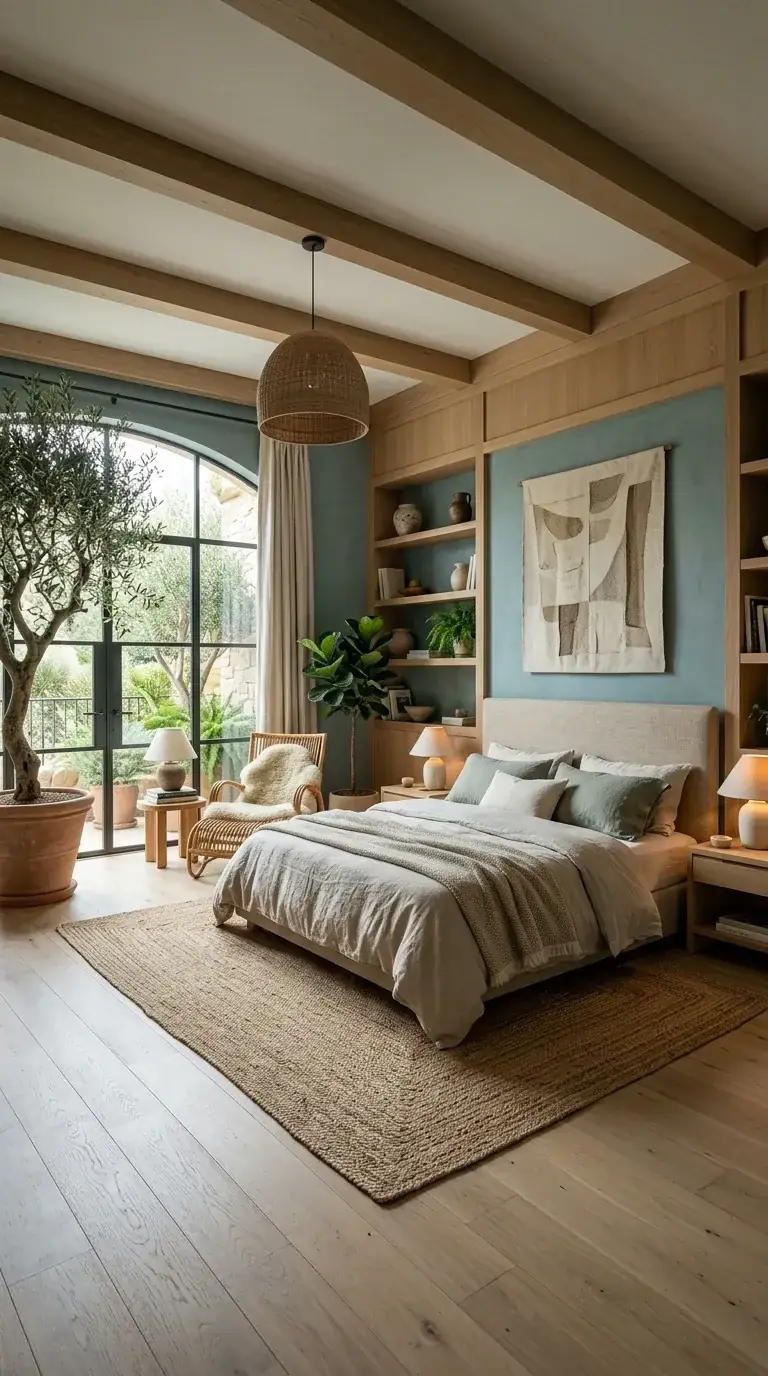
For the rare compact home with a real architectural advantage — an arched window from a custom build, a converted-warehouse aperture, or a renovated 1920s storefront-with-residential — this direction lets the architecture carry the room and uses the built-ins to absorb every functional program. Arched window, if specified new for a renovation: Marvin Ultimate Arched Casement in black aluminum-clad finish runs $4,200-7,800 depending on size; for an existing arched window with French-door access to a patio, this scheme works without the install. Walls in Benjamin Moore Senora Gray 1530 ($240). Existing wood beams treated with Rubio Monocoat ($240). Full-wall built-in shelving 96-inch wide x 96-inch tall in white oak veneer over MDF carcass: Built In Portland on Sandy Blvd ($5,890 — 10-week leadtime). Bed frame is the The Joinery Crescent Queen in solid white oak with a low-profile silhouette to keep sightlines to the arch ($2,890). Linen bedding from Coyuchi ($340). Rattan chaise lounge: Article Otio Lounge with cushion ($799). Large jute area rug 9×12 from Annie Selke Bernardine ($1,490). Woven pendant: Roll & Hill Mini Excel 18″ ($1,290). Two nightstands ($1,160 from The Joinery). Decor and plants for the built-in shelves (a 6-foot specimen tree in floor planter, plus 8-10 smaller plants on shelves): $480 plants and pots. Total: $14,800 — the most architecturally substantive direction in the article and accordingly the most expensive.
Color Palette
A dusty blue-green that holds well in PNW north-light bedrooms — a saturated-but-grayed register that doesn’t fight the patio view through the arched window.
Continuity between ceiling beams and built-in shelving — same wood species, same finish — keeps the room reading as architecturally coherent.
Organic linen — the wrinkle is the design intent, the durability is the differentiator from cheaper poly-blend equivalents.
Repeated three times across the room (rug, chaise rattan, smaller cane accents on the built-ins) to create a visual rhythm without saturating the palette.
Styling Notes for This Look
- Full-wall built-ins in compact bedrooms eliminate the need for a dresser, a media console, multiple bookshelves, and three or four storage baskets — the built-in absorbs all those programs into one architecturally honest surface.
- Low-profile platform beds (under 18 inches mattress-top height) are the right specification under arched windows; standard upholstered queen beds at 26-30 inches block the bottom third of the arch and ruin the architectural moment.
- The chaise placement matters: position so it faces the arched window from the side, not from in front of the bed, so the room reads as having two distinct programs (sleep + relax) rather than one mixed program.
6. Moody Compact With Cove LED Headboard — $7,800
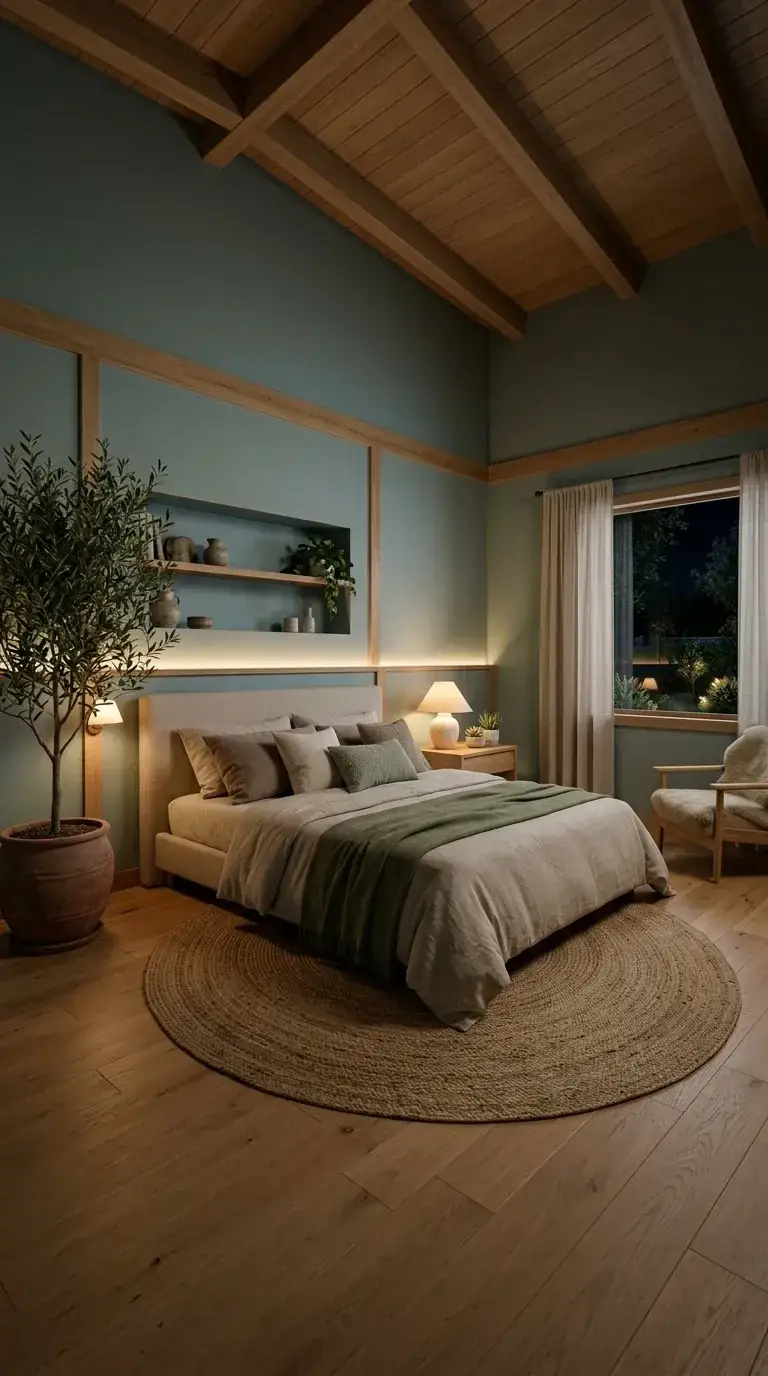
A direction for the compact-bedroom owner who finds bright Scandinavian rooms too clinical and wants an enveloping cocoon-like atmosphere where the lighting itself does the architectural work. Walls drop to Farrow & Ball De Nimes No.299 in dead flat ($185). Ceiling is the move that defines this scheme — wide-plank dark wood ceiling installation, TerraMai Reclaimed Doug Fir 8-inch stained walnut ($14/sqft installed = $1,640 for the 132 sqft ceiling). Built-in niche behind the headboard wall, custom 48-inch wide x 60-inch tall recessed shelf with integrated Diode LED Fluid View 2700K CRI 95 strip lighting in every shelf cavity: $1,890 cabinet + $480 LED system + $390 Lutron Caséta wireless dimmer = $2,760. Bed frame: Floyd Platform Queen in birch ($795) — low-profile, no headboard, because the lit niche IS the headboard. Linen bedding with dark accent throw: Brooklinen Linen Core Sheet in Carbon ($240) plus Pendleton Glacier National Park Stripe ($245). Round jute rug 8-foot ($890). Accent chair with sheepskin: IKEA Pello chair with a Solabee Living sheepskin throw ($89 chair + $129 sheepskin = $218). One walnut nightstand Article Lenia Mini ($499). 5-foot olive tree in 12-inch terra-cotta planter ($380). Wall paint and labor: $480. Total: $7,800 installed.
Color Palette
A deep slate-teal that reads as denim in afternoon and almost charcoal under the cove lighting at night — the color drift across the day is the entire design move.
Dark wood ceilings in compact rooms read as enveloping rather than oppressive only if the lighting is layered correctly — never spec a dark ceiling without confirming the lighting plan.
Lighter neutrals against dark walls keep the room from collapsing into one note — the contrast is what makes the cocoon read as deliberate.
CRI 95 at 2700K is the spec — anything cooler reads clinical, anything lower-CRI flattens the wood ceiling and the plants.
Styling Notes for This Look
- Cove LED lighting must be on a Lutron Caséta dimmer (or equivalent wireless control) so you can drop the cove brightness to 5-10% before sleep without standing up — the architectural-lighting argument fails if the dimmer is on the opposite wall from the bed.
- Dark wood ceilings work in compact rooms only if the wall color is also saturated — pairing dark ceilings with white walls reads as miscalibrated and visually pushes the ceiling down. Match the saturation level top-to-bottom.
- The lit niche behind the bed eliminates the need for a headboard, two bedside lamps, and a wall art piece simultaneously — a single architectural decision that does the work of three or four design moves.
7. Vaulted Compact Bedroom — $6,400
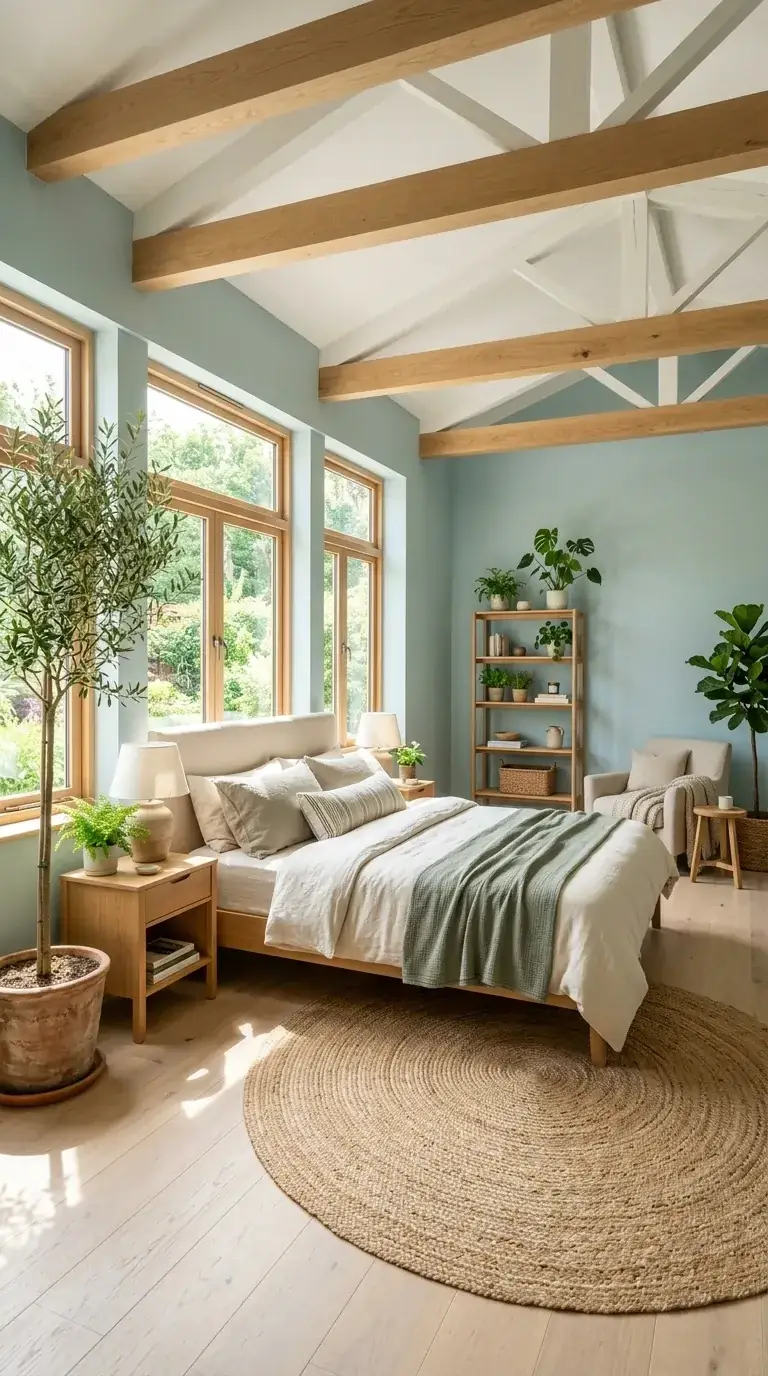
For the compact home with vaulted-ceiling architecture — typical of 1990s-2010s Bend infill, modern shed-roof PNW homes, and renovated single-story bungalows where the attic was opened — the volume is doing the room’s heavy lifting and the design move is to support rather than fill it. Walls in Benjamin Moore Borrowed Light 1660 matte ($240). Existing exposed trusses (assumed reclaimed Doug fir or visible structural lumber) treated with Rubio Monocoat Pure 5% ($240). Bed frame is the West Elm Andes Storage Bed Queen in white oak ($1,799) — the storage drawers underneath absorb the off-season clothing program that compact bedrooms otherwise need a dresser for. Linen bedding from Brooklinen Linen Core in Natural ($240). Round jute rug 9-foot from Lulu & Georgia Arlo ($1,090). Open wooden shelving unit 84-inch tall in white oak: Floyd Open Shelving 5-tier ($1,290). Upholstered armchair near the window: Article Sven Drift Grey ($849). One walnut nightstand Article Lenia Mini ($499). Two table lamps from Schoolhouse Isaac Mini in matte black ($390 pair). 6-foot olive tree in floor planter ($500). 5-7 smaller plants on the open shelving unit ($120 plants, $80 pots). Wall paint and labor: $480. Total: $6,400 — assuming existing vaulted-ceiling structure.
Color Palette
A pale sky-blue that holds well in vaulted rooms because the volume dilutes any cool tendency — the same paint reads gray in a low-ceiling room.
PNW-native Doug fir from TerraMai or local reclaimers — the wood that should run continuously through trusses, sills, and casing.
The infill panels between trusses kept slightly lighter than the wall color — this contrast is what makes the vaulted volume read taller than it is.
Earthy tones that ground the airy space — without these the vaulted room can feel insubstantial and almost stage-set.
Styling Notes for This Look
- Tall open shelving (84+ inches) in vaulted-ceiling rooms is the right scale; the standard 60-inch bookshelves popular in retail are too short for the volume and visually shrink the architecture.
- Storage-base bed frames are the underspecified compact-bedroom move — they absorb 8-12 cubic feet of off-season storage that would otherwise force the room to also have a dresser, freeing up a wall for the open shelving or a reading corner.
- Vaulted compact bedrooms benefit from skipping ceiling-mounted overhead lights entirely — the architecture is the focal point, and a single overhead pendant or fixture will compete with the trusses. Wall sconces or table lamps only.
8. The Tech-Free Nightstand: An Essentials-Only Audit — $480
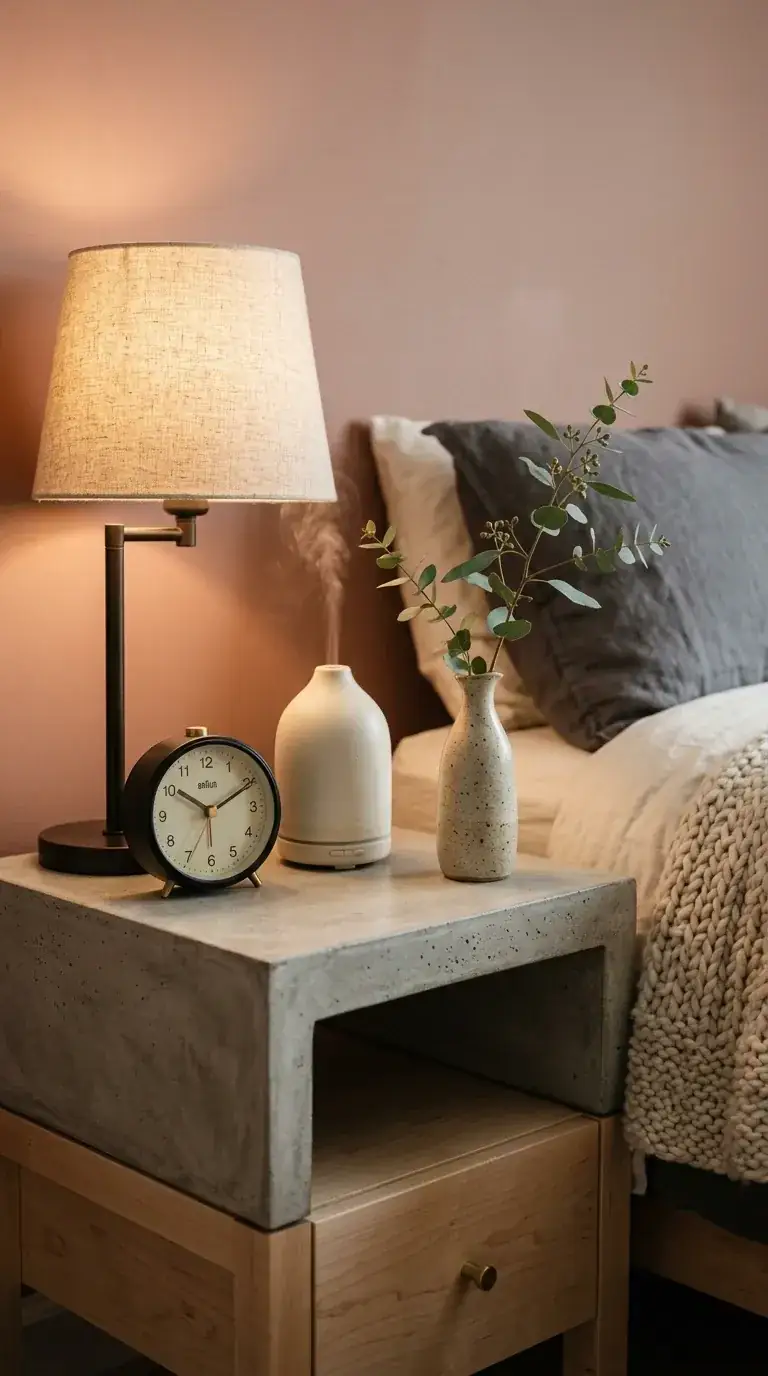
The nightstand is the single highest-impact tech-free architectural decision available to a compact-bedroom owner — and the most overlooked. The audit is simple: if the surface area can fit a phone, a charger, and a glass of water, it will. The fix is to reduce the surface area to the point where only essentials fit. Here is the kit I draft for clients across all ten directions in this article. Nightstand itself: CB2 Acerra Concrete Cube 14-inch with optional small drawer ($299) — the small surface area is the point, not the limitation. Industrial linen-shade table lamp: Schoolhouse Isaac Mini in matte black with linen shade ($240). Ceramic essential oil diffuser: Vitruvi Stone Diffuser in White ($99 — Portland-designed, manufactured to GREENGUARD standards). Analog alarm clock: Lemnos Riki Wall Clock 9-inch in white birch ($180) or MoMA Design Store Karlsson 6-inch in matte black ($45 budget alternative). Small ceramic bud vase: Heath Ceramics Coupe Mini Vase in Opaque White ($65). Fresh or dried eucalyptus stems from Solabee Flowers ($24, replaced biweekly). Total nightstand kit: $480 mid-range, $385 budget, $620 high-end. Phone charging deliberately and explicitly NOT included — the charging station goes outside the bedroom (a wall-mount in the hallway or living area is the architectural enforcement). This is a sub-$500 intervention with disproportionate impact on actual sleep quality.
Color Palette
CB2’s Acerra is real cast concrete, not concrete-look resin — the weight (28 pounds for a 14-inch cube) is what tells you it’s the real material.
A warm contrast against the concrete — the small drawer is for ear plugs, eye mask, and a single bookmark, not a phone.
A warm soft background hue makes the nightstand vignette feel held — cooler grays and white walls leave the nightstand visually orphaned.
Matte black at scale always reads as more deliberate than gloss — the rule of three (lamp, clock, frame) caps the matte black presence in the room.
Styling Notes for This Look
- The single most useful tech-free move is removing the phone charger from the bedroom entirely. Buy a wall-mounted charging shelf for the hallway or living area (West Elm Mid-Century Charging Station, $89) and require the phone to charge there.
- Analog alarm clocks: avoid the cheap battery-tick wall clocks that audibly tick at night — they will wake light sleepers within the first month. The Lemnos Riki and Karlsson silent-sweep movements are the spec to look for.
- Essential oil diffusers in compact bedrooms work best with cedar, lavender, or eucalyptus oils at 4-6 drops in 100ml of water, run for 30-60 minutes pre-sleep — never run overnight, which oversaturates the air and is associated with morning headaches.
9. Built-In Reading Bench With Slat Wall — $9,800 (the chosen direction)
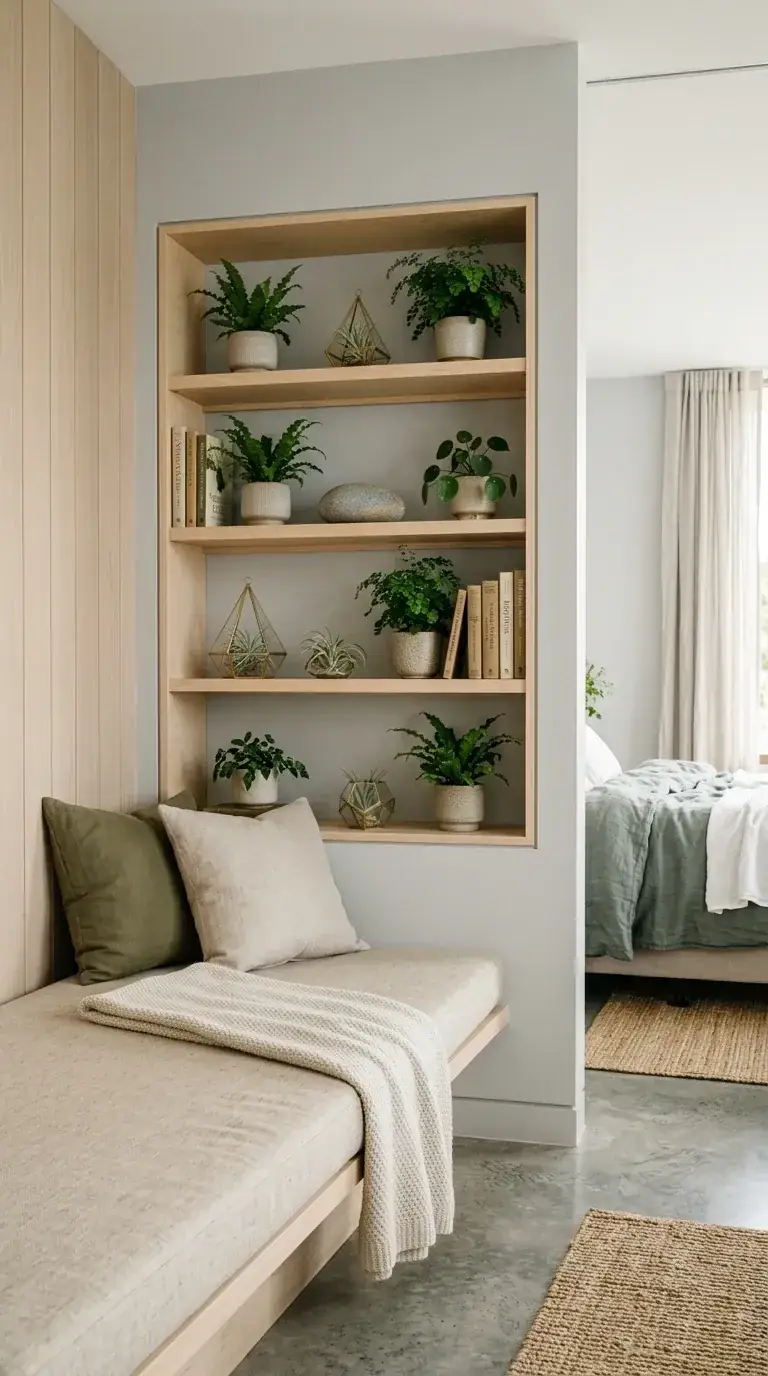
The direction Hannah and Kalei chose, and the one that surprised them as much as it surprised me — they had walked in convinced they wanted the Scandinavian sage room (direction one). What changed their minds was sitting in the mockup at my office; the bench solved their nightstand problem, their storage problem, and their reading-instead-of-scrolling problem with a single architectural intervention. Custom built-in 86-inch wide x 24-inch deep reading bench with upholstered cushion and recessed shelving above by Built In Portland on Sandy Blvd ($4,890 — 8 weeks fabrication, includes the recessed shelving with three integrated Diode LED Fluid View 2700K strip lights). Light wood slat wall behind the bench, 86-inch wide x 96-inch tall in white oak slats with 1-inch reveal: Reveal Designs Portland ($2,890 installed). Custom upholstered bench cushion in Maharam Mode 003 wool flat-weave in Sand: $640 fabric, $340 cushion fabrication ($980 total). Two large pillows from The Citizenry: $190. Pendleton wool throw from the Portland Mill Store: $245. Eight to ten plants and small terrariums on the recessed shelving (mixed sansevieria, ZZ, peace lily, two glass terrariums with moss): $260 plants and pots, $140 terrariums. Books and decor for the shelf (assume owner has books): $0 books, $80 in two ceramic Heath pieces and a small carved object. Polished-concrete floor refinish: $720. Total: $9,800. Delivered in 11 weeks from drafting approval; the longest lead time was the slat wall fabrication.
Color Palette
Soap-finish white oak holds paler than oil-finished — the lighter register is what makes the slat wall read architectural rather than decorative.
A neutral backdrop that lets the slat wall be the architectural focal point — a saturated wall color elsewhere would compete and flatten the slat reveal.
Maharam Mode is a 100% wool flat-weave with 100,000+ double-rub Wyzenbeek rating — the cushion will hold for 15 years of daily use.
The vibrant green of the plants is the only saturated color in the scheme — the architecture is the room, the plants are the punctuation.
Styling Notes for This Look
- Custom built-in benches in compact bedrooms typically run $2,200-$3,400/linear foot installed in Portland — Hannah and Kalei’s 86-inch bench at $4,890 lands at the lower end because the shop already had templates for similar work.
- Slat-wall reveal width is the determining factor in how the wall reads. A ¾-inch to 1-inch reveal creates the alternating shadow rhythm that registers as architecture; a ½-inch reveal reads as paneling, and a 1.5-inch reveal reads as fence-grade.
- The bench-as-headboard configuration (placing the bed against the slat wall and using the bench at a 90-degree angle nearby) is a specific compact-bedroom move that doubles the program of both elements — the bench becomes both reading-corner and end-of-bed seating, the slat wall becomes both architectural feature and bedhead.
10. Sage Sanctuary With Plant Console — $4,200
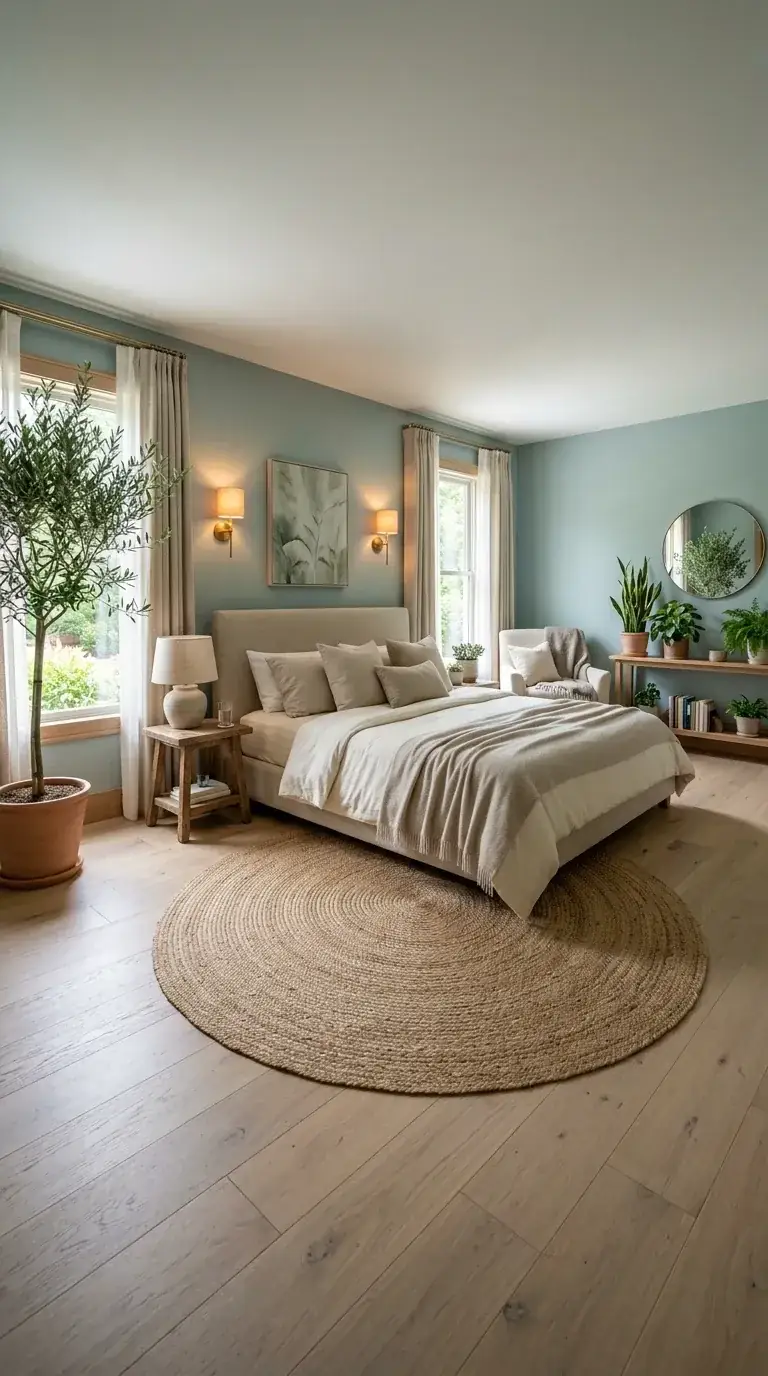
The leanest of the ten directions and the one I draft most often for clients on a constrained budget — every line item is direct-to-consumer or PNW-stocked, and no architectural intervention is required. Walls in Farrow & Ball Pigeon No.25 ($185). Bed frame is Article Mara Queen in Heather Grey ($899). Linen bedding from Brooklinen Linen Core in Natural ($240) plus a The Citizenry Stonewashed Linen Throw ($120). Round jute rug 9-foot from Annie Selke Bernardine ($1,290). Wooden console table opposite the bed: The Joinery Astoria 60-inch in white oak ($1,490). Upholstered accent chair near the window: Article Sven Drift Grey ($849). Two small wood side tables: Floyd Round 18″ ($395 each = $790). Two brass wall sconces: Hudson Valley Argon in aged brass ($340 each = $680). One single ceramic table lamp on the console: Heath Ceramics Sculptural Form with linen shade ($330). 5-foot olive tree in 12-inch terra-cotta planter ($380). Six to eight smaller plants on the console (mixed sansevieria, ZZ, peace lily, philodendron) from Solabee with mixed Heath and Cargo pots: $280 plants, $180 pots. CB2 Pavillion Round Mirror 32″ in burnished brass ($249). Wall paint and trim labor: $240. Total: $4,200 — but allocate from this budget thoughtfully; the console-and-plants line items are the visual identity, the bed and bedding are the comfort program, and the budget is unavoidably tight.
Color Palette
A muted blue-green-gray that connects the room to nature without becoming literal. Pigeon is the F&B that ages best in compact PNW bedrooms.
Continuity between console and floor wood — the same species across both surfaces creates a foundation that the green walls can sit against.
Neutral textiles that balance the green walls and add the softness that compact bedrooms specifically need to feel inhabited.
Real terra-cotta pots that develop mineral haze in PNW humidity — the patina that’s visible at the side of the bed when you wake up.
Styling Notes for This Look
- The console-as-plant-display strategy works in compact bedrooms only if the console sits opposite the bed (so the planting is the first thing the eye registers in the morning). A side-wall console will not deliver the same architectural payoff because the geometry doesn’t carry.
- Mix plant heights deliberately on the console — one tall (24-30 inch sansevieria), three medium (8-14 inch peace lily, ZZ, philodendron), two short (6-inch trailing pothos) — and stagger the placement front-to-back so the eye reads them as a small grove rather than a row.
- This is the only direction in the article that does not include a custom or built-in element — appropriate for renters or owners not yet ready to commit to architectural intervention. Every line item is removable when you move.
For owners interested in carrying the same compact biophilic discipline into adjacent rooms, the bathroom counterpart is in The Biophilic Bath: Crafting Your Ultimate Wellness Oasis, and the broader living-room version of this argument is in The New Natural Living Room: How Biophilic Design and Organic Shapes Are Redefining Comfort.
Pro Tips From the Drafting Board
Tip 1 — Move the charger out of the bedroom. The single most important tech-free architectural decision is removing the phone-charging surface from the room entirely. Wall-mounted charging shelves in the hallway, kitchen, or living room (West Elm Mid-Century Charging Station, $89; Pottery Barn Bedford Charging Station, $129) physically enforce what willpower cannot. If you have to walk to the next room to charge the phone, you will not bring it back to bed.
Tip 2 — Specify warm 2700K bulbs, CRI 90+, in every fixture. Cool LEDs (3000K and above) suppress melatonin production for 30-90 minutes after exposure; warm LEDs (2700K) at CRI 90+ minimize that effect. The bulb spec is non-negotiable in a tech-free bedroom, and it is worth replacing every existing bulb in the room as a single line item ($120-$180 for a full bedroom replacement) before any other tech-free intervention.
Tip 3 — Plant species selection matters more than plant count. Sansevieria (snake plant), Spathiphyllum (peace lily), and Pothos all release oxygen at night rather than during the day, which makes them genuinely useful in bedrooms beyond the visual atmosphere. Avoid succulents and cacti, which release CO2 at night, and avoid heavily fragrant flowering species (jasmine, gardenia) which can disrupt sleep.
Tip 4 — Closed-base bed frames over open-base. Open-base bed frames (where you can see under the bed) attract clutter accumulation within months — charger cables, books, dust, miscellaneous storage. Closed-base or storage-base frames physically prevent the buildup. The architectural decision pays off across years of low-maintenance bedroom care.
Tip 5 — Layered lighting beats single-source lighting in compact bedrooms. A typical compact bedroom needs four light sources: an overhead (kept on a Lutron Caséta dimmer), two bedside (sconce or table lamp), and one accent (cove LED, picture light, or floor lamp in the reading corner). Single-source lighting in a 130 sqft bedroom reads as institutional; layered lighting reads as inhabited.
Key takeaway: Tech-free compact bedroom design is an architectural problem, not a willpower problem. The room either makes the phone-free, plant-supported, deep-sleep-supportive program easy or it makes it a daily negotiation. Built-in storage, deepened window sills, cove lighting, slat walls, closed-base bed frames, and dedicated reading corners each carry more weight than their cost suggests because they reduce the cognitive load of staying tech-free across years of daily use.
Regional Fit: PNW & Mountain West Bedroom Notes
Portland, OR — Sunnyside, Hawthorne, Mount Tabor, North Tabor
1900-1940 Portland craftsmans typically have 110-150 sqft primary bedrooms with original Doug fir floors and 4-inch crown molding. North-facing rooms are the dominant orientation and benefit from warmer paint specs (Pale Oak, Edgecomb Gray, Pigeon, Salisbury Green hold their warmth; Chantilly Lace and Simply White will read blue-gray). Local procurement: Schoolhouse, Rejuvenation, The Joinery, Heath Ceramics PDX, Solabee Flowers, Beam & Anchor. Trim carpenters $75-110/hour; painters $4-6/sqft. Custom built-in shops with reliable leadtimes: Built In Portland (Sandy Blvd), Reveal Designs, The Joinery custom shop.
Tacoma, WA — Stadium District, Old Town, Hilltop
Tacoma compact bedroom stock is mostly 1900-1925 craftsman and 1920s-1940s cottage at 110-160 sqft. Original wood floors are typically heart pine or vertical-grain Doug fir; original trim runs 5-6 inches taller than equivalent Portland stock. Costs run 12-18% below Portland on labor and materials. Painters $3.50-5/sqft; trim carpenters $65-90/hour. Local procurement is thinner than Portland but includes the strong King’s Books for design-monograph line items, Tacoma Boys for plant-and-pot sourcing, and the Stadium District quarterly art walk for local artist representation.
Seattle, WA — Wallingford, Phinney Ridge, Capitol Hill
Seattle compact bedrooms run 12-18% above Portland on labor and materials and 18-25% on custom built-in fabrication. North-facing exposure is the dominant orientation and the warmer paint specs are even more critical. Local procurement: Schoolhouse Seattle, Rejuvenation Seattle, Hazel Studio, Watson Kennedy, Glasswing. Trim carpenters $95-140/hour; painters $5-8/sqft. Specialty trades: Glasswing for ceramics, Sugarpine Drive-In on Bainbridge for vintage furniture, Ravenna’s Twice Sold Tales for affordable book inventory.
Bend, OR — Westside, Old Mill District, NorthWest Crossing
Bend compact bedrooms are typically 1990s-2010s vaulted-ceiling infill rather than pre-war historic stock. The high-altitude UV situation matters genuinely — UV-rated window film (3M Prestige 70 or equivalent) prevents textile fade rates 20-40% faster than Portland equivalents. Costs run 18-22% below Portland on labor and 8-12% below on materials. Painters $3.50-5.50/sqft; trim carpenters $65-90/hour. Local procurement is thinner: TerraMai’s Bend warehouse, Roundabout Books, Mid-Century Mountain showroom, and Newport Avenue Market for fresh greenery.
Mountain West Baseline — Boise ID, Salt Lake City UT, Bozeman MT
Compact bedrooms in Mountain West historic stock are typically 1900-1940 brick-residential at 100-150 sqft. Costs run 8-15% below Portland on labor and materials. High-altitude UV in all three markets requires solution-dyed acrylics over standard performance fabrics where direct sun is involved. Local procurement: most schemes are built from PDX-shipped components plus one or two regional specialty pieces — Boise’s Reuseum and Anaphora; Salt Lake’s Local Color and Park City antique shows; Bozeman’s Vargo’s Books.
Frequently Asked Questions
Does the architecture really make a meaningful difference, or is this just aesthetic?
The architecture matters. Closed-base bed frames eliminate clutter accumulation; deepened window sills make plant programs viable; cove LED lighting at the headboard removes the bedside-screen alternative; built-in benches replace the I-need-to-charge-my-phone-on-the-nightstand habit with a place-to-read-instead. Each architectural decision reduces the cognitive load of staying tech-free, which is what willpower-based programs fail at across years of daily use. The room is doing the work, not the user.
Which direction is cheapest to execute well in a compact bedroom?
Direction eight (the Tech-Free Nightstand audit) at $480 is the leanest intervention if your room is otherwise already in good shape. Direction ten (Sage Sanctuary With Plant Console) at $4,200 is the leanest complete-room treatment with no architectural intervention required. Direction one (Sage-Walled Compact Primary) at $4,800 is the leanest with full-room paint and trim work included.
Which direction has the best long-term resale appeal in PNW bedrooms?
In Portland, Tacoma, and Seattle MLS data 2020-2025, the Sage-Walled Compact (#1), Wainscoted With Plant Window Sill (#3), and Built-In Reading Bench With Slat Wall (#9) directions consistently photograph and show best for resale — neutral palettes, real wood and built-in storage, and architectural moves like wainscoting or slat walls all index positively in PNW buyer preference. The moodier directions (#6 cove lighting, #4 botanical wallpaper) split buyers; about 60% of buyers respond positively, 40% respond negatively.
Are bedroom plants safe? I’ve heard they release CO2 at night.
Most common houseplants release small amounts of CO2 at night (because photosynthesis stops without light), but the volume is biologically negligible — a typical bedroom houseplant releases roughly 1/300th the CO2 your sleeping partner does. The plants worth specifying for actual nighttime O2 release are CAM-photosynthesis species: Sansevieria (snake plant), Aloe vera, and Spathiphyllum (peace lily). Avoid succulents, cacti, and heavily fragrant flowering species in bedrooms — but the snake plant and peace lily are net beneficial.
What’s the right mattress for a compact tech-free bedroom?
For compact PNW bedrooms specifically, I default to recommending GREENGUARD-certified or organic-certified mattresses because air exchange in 130 sqft rooms is genuinely lower than in larger spaces, which makes off-gassing (VOCs from synthetic foams) more impactful. Avocado Green Mattress (organic, ships free in PDX) and Brentwood Home (LA-made, GREENGUARD Gold certified) are the two I default to in the $1,800-3,200 queen range. Saatva offers white-glove install in Portland for an additional $99 if you’re unable to handle a king-size lift.
Can I phase compact-bedroom changes over 6-12 months?
Strongly recommended. The phasing order I draft for compact-bedroom clients: first, remove the phone charger from the bedroom and replace bulbs with 2700K CRI 90+ (week 1, $200-300); second, paint and trim work (weeks 2-4); third, primary bedding and the bed frame (weeks 4-8); fourth, plants and the nightstand audit (weeks 8-12); fifth, any built-in or architectural intervention (months 4-9 due to fabrication leadtimes). The phasing lets you live with each layer before adding the next.
How do I avoid the “Pinterest bedroom” look that doesn’t work in real life?
Three rules. One: avoid the matched-set bed-and-nightstand-and-dresser combinations that retail as “bedroom sets” — they read as showroom and almost always fail at compact scale. Two: include one genuine vintage piece (estate-sale lamp, inherited side table, family-heirloom mirror) in the room — this is the move that makes a $5,000 bedroom read as $25,000. Three: spec real materials over photo-friendly substitutes (real wood over wood-look laminate, real linen over poly-blend, real terra-cotta over plastic terra-cotta-look pots) — the camera does not show the difference, but you live with it daily.
What’s a realistic timeline from drafting to installed for a compact tech-free bedroom?
8-14 weeks for most directions. Direct-to-consumer-heavy directions (one, ten) can land in 4-6 weeks. Directions with custom built-ins (five, nine) run 10-14 weeks for the fabrication. Directions with custom upholstery or made-to-order furniture (The Joinery pieces specifically) run 6-10 weeks. The longest lead time in this article is the full-wall built-in shelving (direction five) at 10 weeks, and the custom slat wall plus built-in bench (direction nine) at 11 weeks.
Sources & References
- Journal of Pineal Research, Vol. 65 (2018) — Effects of evening light wavelength and intensity on melatonin suppression, with specific findings on 2700K versus 3000K LED bulbs at residential lumen levels.
- Sleep Health: Journal of the National Sleep Foundation, Vol. 7 (2021) — Effects of bedroom phone presence on objective sleep latency and subjective sleep quality across 1,200 adult subjects.
- NASA Clean Air Study (Wolverton, 1989, updated 2019) — Air-purifying houseplants ranked by VOC removal capacity and night O2 release; basis for Sansevieria and Spathiphyllum recommendations.
- IESNA Lighting Handbook, 10th Edition — Illuminating Engineering Society recommended practice for residential bedroom illumination, 2700K specification rationale, and CRI 90+ guidelines for sleep environments.
- ASHRAE Handbook — Fundamentals, 2025 — Indoor air quality standards relevant to small-bedroom VOC accumulation and mattress off-gassing protocols.
- GREENGUARD Gold Certification Standards — Emissions standards for mattresses, paints, and built-in furnishings used in residential bedrooms.
- Benjamin Moore Architectural Specifications — Pale Oak OC-20, White Dove OC-17, Cloud White OC-130, Senora Gray 1530, Salisbury Green HC-138, Borrowed Light 1660 technical data sheets.
- Farrow & Ball Color & Finish Guide, 2025 — Pigeon No.25, Inchyra Blue No.289, De Nimes No.299, Cromarty No.285 application data and lighting recommendations.
- Coyuchi Organic Linen Specifications — GOTS-certified linen weave construction, fiber length, and longevity data for daily-use bedding.
- Avocado Green Mattress Material Library — GOTS-certified organic cotton, GOLS-certified organic latex, Made Safe certifications, and California-manufactured chain-of-custody documentation.
- Schoolhouse PDX Specification Library — Isaac Floor Lamp, Bell Pendant, Reade Bench, Heath Lounge construction and finish data.
- The Joinery Custom Specification Process — Reclaimed Oregon oak provenance, urban-salvage chain of custody, soap-finish and oil-finish technical data.
- Cedar & Moss Lighting Catalog 2026 — Mendocino, Wagner, Carved Bell fixture specifications and PNW availability.
- Heath Ceramics Material Library — Opaque White and Coupe Vase glaze specifications, MAU stoneware properties, and lamp-base construction data.
- Solabee Flowers PDX Plant Care Library — Sansevieria, Spathiphyllum, ZZ plant, philodendron, and pothos climate-suitability data for PNW bedroom interiors.
- Vitruvi Stone Diffuser Engineering Specifications — Ultrasonic diffusion mechanics, water-capacity ratios, and recommended essential-oil dilution rates.
- Lutron Caséta Wireless Dimming Specifications — Compatible LED dimming protocols, programmable scene-control, and bedside-control configuration for cove lighting.
- Tacoma MLS Data 2020-2025, Stadium District / Old Town / Hilltop — Compact-bedroom resale data, ROI on built-in storage and architectural-finish premiums.
- Portland MLS Data 2020-2025, Zip Codes 97214 / 97215 / 97232 — Compact-bedroom resale data and architectural-finish premium analysis.
- RSMeans 2026 Residential Cost Data — Pacific Northwest Edition — Regional labor and material indices for PNW compact-bedroom interior finish work.
- Elliot Calloway Project Notes & Client Drafting Archive, 2017-2026 — Eight-plus years of compact-bedroom and ADU primary-suite plan reviews and renovation specifications across the PNW corridor.
Final Thoughts
The compact bedroom is, in compact-home terms, the most consequential room in the house — because it is the room where you spend the largest single uninterrupted block of every twenty-four hours, and the room whose architectural decisions accumulate fastest into either better or worse sleep across a year. Tech-free design at compact scale is not an aesthetic move; it is the most direct architectural intervention available to a homeowner trying to fix the sleep problem the apps and supplements have failed to solve. Hannah and Kalei’s bench-with-slat-wall direction lands at $9,800 because the architecture is doing what willpower could not — a built-in surface that the phone does not fit on, a reading light that does not require the phone to be in the room, a place to read that is physically separate from the bed.
Every compact bedroom lands somewhere different in this set, and every landing is correct if it actually changes the program. The room you build is not the room on the cover of a magazine. It is the room you’ll wake up in at 6:30 a.m. on a Wednesday in November when the PNW gray is doing its work, the snake plant on the deepened sill is exhaling its small share of overnight oxygen, the analog clock on the concrete nightstand has just ticked past the half-hour, and the phone is charging in the hallway where it belongs. If tech-free design is anything beyond an aesthetic, it is exactly that — and at compact scale, where every architectural decision matters more, it is the only direction that takes the sleep problem seriously.
If this argument speaks to you and you want the broader compact-quiet thesis it sits inside, the companion pieces are The Quiet Luxury Living Room, Sized Right: 12 Compact-Scale Directions From the Drafting Board, Biophilic Industrialism at Compact Scale: 11 PNW Directions That Marry Raw Bones to Living Greenery, and the master-suite-scale version of the same architectural argument in The Great Escape: Design Your Master Bedroom as Your Own Boutique Hotel Retreat. Together they cover the design language I find most useful for the homes the PNW corridor actually produces.
Comments
Loading comments…
Leave a comment
Your email won't be published — it's only used to let you know if we reply. Comments appear after approval.