

Mira and Wes came to me in late January with a brief I had been waiting four years for somebody to draw cleanly. They had spent a long weekend at the Hoxton in Williamsburg the previous October, two nights at the Ace Portland a month later, and a one-night experiment at a converted-warehouse boutique in Reykjavik in December. The throughline they could not stop talking about was scale. None of those rooms were larger than 230 sqft. Most were smaller. Yet every one of them felt like a destination, not a corner of a building. Their question to me, sitting at the drafting table in my Sunnyside walkup, was the right one: “Our primary at home is 11×16. That is bigger than the Hoxton room. Why does ours feel like a place we end up at midnight, and theirs felt like the whole reason for the trip?”
The honest answer is that the hotel rooms were drafted by an architect to do one program at full conviction, while their primary at home was the leftover-shaped room that the rest of the house’s circulation handed them. The fix is not square footage. The fix is architectural decisions. What I drafted for them across six weeks was ten complete directions for the same 11×16 primary in their 1928 Tudor in Beaumont-Wilshire — ten material lists, ten lighting plans, ten storage strategies, ten programs that the architecture itself enforces. They eventually chose direction seven (the Japandi compact primary with built-in desk and storage-platform bed) because the built-in absorbed the small WFH program Wes needed without making the bedroom read as an office. The install came in at $13,400 over eleven weeks.
The boutique-hotel feel at compact scale is not a styling problem. It is an architectural one. A real hotel room is short on square footage and long on intention; the wall behind the bed is doing four jobs (headboard, lighting, storage, art), the nightstand is a cantilever ledge built into the wall rather than a piece of furniture, the closet is a ten-foot run of millwork rather than a freestanding wardrobe, and the lighting is on a single bedside switch that controls four fixtures at once. Replicate those moves at home and the bedroom reads as a suite. Skip them and the bedroom reads as a furniture showroom no matter how expensive the bedding is. The ten directions below are the proof, drafted at the 160-220 sqft scale, with PNW gray light, real procurement lists, and the architectural discipline that the hotel rooms were doing in the first place.
I’m Elliot Calloway. I have been on the boards eight-plus years, the last four almost entirely on compact homes, ADUs, and modern under-2,200 sqft plans across the PNW and Mountain West corridor. The Mira-and-Wes brief is one I get more often each year — and the answer has slowly shifted from “spend more on the bedding” to “change these built-in moves.” Let’s walk all ten.
What’s in this article
- Industrial-Loft Compact Primary With Eames Lounge — $14,800
- Moody Cognac & Cove-LED Compact Primary — $11,400
- Wabi-Sabi Industrial Compact With Olive Tree — $9,800
- Sleek Black-Leather Modern Compact Primary — $13,200
- Serene Minimalist Compact With Boucle & Light Oak — $8,400
- Opulent Classic Compact With Navy Wainscoting — $12,600
- Japandi Compact Primary With Built-In Desk — $13,400 (the chosen direction)
- Minimalist Concrete Compact With Floor-to-Ceiling Glass — $10,200
- Boho Compact Primary With Rattan & Hanging Chair — $7,800
- Painted-Brick Urban Compact Primary — $9,400
- Pro Tips From the Drafting Board
- Regional Fit: PNW & Mountain West Bedroom Notes
- Frequently Asked Questions
- Sources & References
- Final Thoughts
Who this article is for
- Owners of 160-220 sqft compact primary bedrooms (1900-1940 PNW craftsmans, 1990s-2010s shed-roof infill, ADU primary suites) who want the boutique-hotel feel without the boutique-hotel apartment-block scale.
- Couples who came home from a Hoxton, an Ace, a Maison Premiere, or a Nomad weekend and finally noticed how much architectural work the room was doing while they were sleeping in it.
- Renovators on a defined $7,500-$15,000 primary-bedroom budget who want the money to land on built-ins, lighting plans, and material specs rather than on a $4,000 headboard from an internet-furniture catalog.
- ADU owners and downsizers whose primary is the only bedroom and needs to read as a suite — not a leftover-shaped corner of an open-plan apartment.
1. Industrial-Loft Compact Primary With Eames Lounge — $14,800
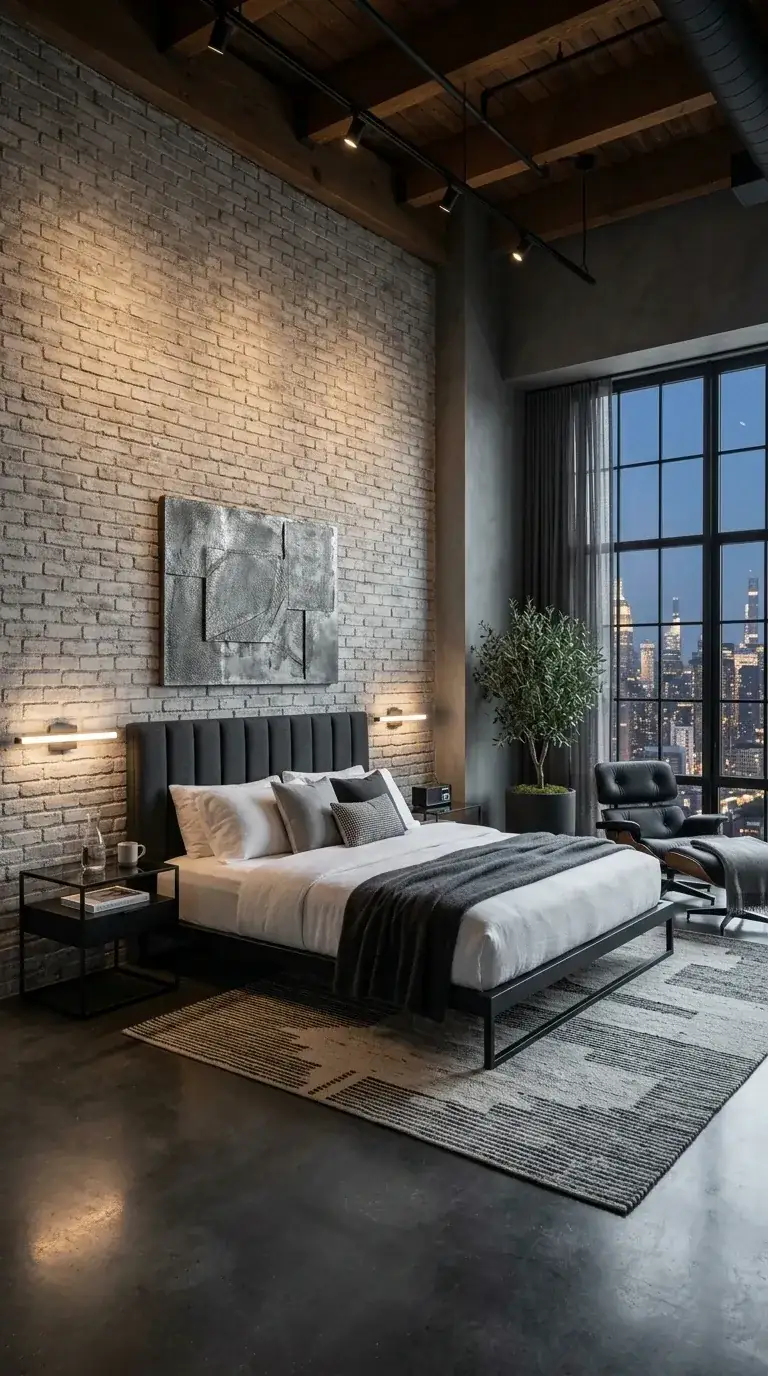
The most-drafted direction in my industrial-loft archive because it works in compact-converted-warehouse stock and renovated 1920s storefront-with-residential primaries across Portland’s Pearl District, Seattle’s Pioneer Square, and Tacoma’s Old Town — wherever the existing envelope already has the brick, the beams, and the slab. Whitewashed brick wall treatment on one accent wall (the headboard wall is the right candidate; brick everywhere else reads as set-dressing): Romabio BioDomus I limewash applied by a local mason, $12-18/sqft installed = $1,800 for a 150 sqft accent wall ($1,500-$4,000 range). Polished-concrete floor refinish for a 200 sqft room: $12-15/sqft including grinding, densifier, and stain = $2,400 ($1,000-$3,000 range, depending on prior slab condition). Existing reclaimed Doug fir beams treated with Rubio Monocoat Pure 5% ($240). Bed frame: Article Mara Queen in Charcoal upholstery ($899) — the closed-base silhouette is critical because nothing under the bed reads as nothing under the bed in a loft volume. Bedding: Coyuchi Organic Crinkled Percale in Mid Grey ($340) plus a Pendleton Glacier National Park stripe wool throw ($245) and two The Citizenry linen pillows in Sand ($120). Two metal nightstands: CB2 Acerra Concrete Cube 14-inch ($299 each = $598). Two linear brass sconces flanking the bed: Cedar & Moss Wagner Linear in unlacquered brass ($420 each = $840). Large abstract art piece (canvas, 48″x60″): commission a Portland-based artist via Land Gallery on Mississippi, $1,200 average. Patterned area rug 8×10: Loloi Maddox in Charcoal/Ivory ($890). Eames-style walnut lounge chair and ottoman: Article Sven LE licensed Eames replica in walnut and Charcoal leather ($1,899) — the licensed Vitra original is $7,800 and looks identical to most clients past five feet of distance. 6-foot olive tree (Olea europaea ‘Arbequina’) in 14-inch terra-cotta planter from Solabee Flowers ($420 plant + $80 planter = $500). Total: $14,800 — the most architecturally substantive of the three loft directions and the one I draft when the existing envelope can carry it.
Color Palette
Real lime-based whitewash develops a chalky variation across each brick face that paint cannot reproduce — the brick still reads as brick rather than as a painted surface.
Closed-base charcoal upholstery grounds the room and absorbs the visual noise that polished concrete floors otherwise generate at the bed line.
Real walnut on the lounge chair plus reclaimed Doug fir on the beams — same warm-wood register, two different species, which reads as collected rather than matched.
Unlacquered (raw) brass patinas across the first 18 months — the soft honey-to-amber color drift is the design intent, not a defect.
Styling Notes for This Look
- Polished-concrete floors in a primary bedroom register as cold underfoot from October through April in PNW climates — spec a 6×9 minimum wool or jute rug under and around the bed line, not just a runner, or specify radiant in-slab heat during the slab refinish (an additional $4-6/sqft installed but transformative for actual livability).
- Loft-volume primaries benefit from one large-scale art piece (48-60 inches minimum on the long dimension) over a gallery wall — the volume is doing architectural work and a small framed grid will read as miscalibrated against it.
- Eames-style replicas vary widely in build quality. The Article Sven LE and the West Elm Authentic Eames Replica (the licensed-by-Vitra one) are the two I default to; off-Amazon copies under $700 routinely arrive with veneer issues that nobody notices in product photos.
2. Moody Cognac & Cove-LED Compact Primary — $11,400
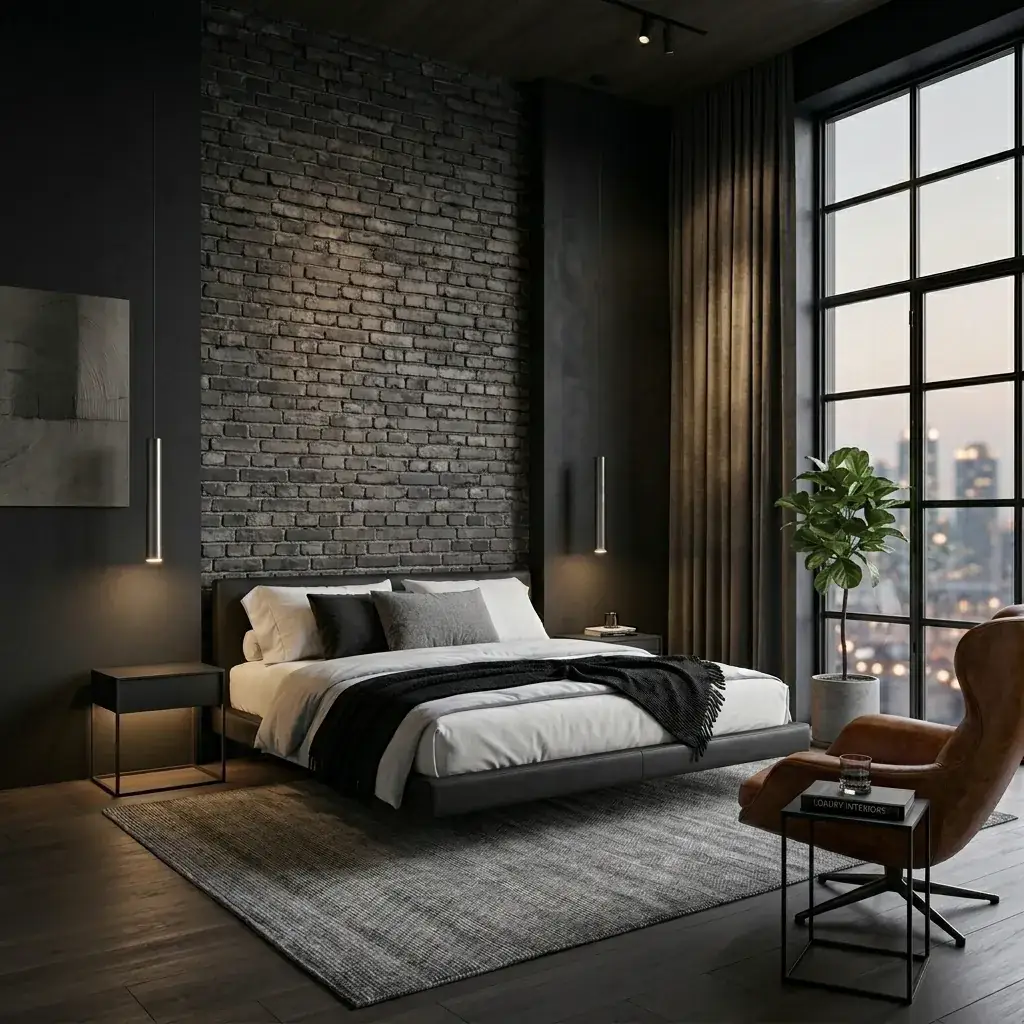
For the compact-primary owner who finds Scandinavian-bright bedrooms clinical and wants the cocoon-suite atmosphere a real boutique hotel produces with layered low light. Walls drop to Farrow & Ball Down Pipe No.26 in dead flat ($240 paint for the room, applied directly over existing brick after a single-coat masonry primer at $14/sqft = $1,680 for the brick wall + $480 for the other three walls = $2,160 in wall treatment). Polished-concrete floor refinish ($2,400, see direction one). Channeled-upholstery custom headboard 86 inches wide x 60 inches tall, in Maharam Mode 003 wool flat-weave in Pewter, fabricated by a Portland upholsterer ($1,890 fabric and labor combined). Behind the headboard: Diode LED Fluid View 2700K CRI 95 warm-white strip light routed in a 2-inch reveal at the perimeter, dimmable via Lutron Caséta wireless ($340 LED + $190 dimmer = $530) — the cove glow at 5-15% intensity is the entire architectural move and will wake you slower than any alarm. Bed frame: Floyd Platform Queen in birch ($795) with no headboard since the upholstered wall IS the headboard. Bedding: Brooklinen Linen Core in Carbon ($240) plus a The Citizenry Stonewashed Linen Throw in Walnut ($120). Two dark walnut nightstands: The Joinery Astoria Mini 22″ in oiled walnut ($580 each = $1,160). Two pendant lights flanking the bed at 28 inches off the ceiling: Schoolhouse Isaac Mini Pendant in matte black with linen shade ($340 each = $680). Geometric metal wall art across from the bed: a single black-iron triangulated piece from West Elm Wagner Geometric Wall Sculpture ($380). Cognac leather armchair near the window: Article Sven Charme Tan ($1,099). Floor lamp: Schoolhouse Isaac Floor in matte black ($340). Patterned area rug 8×10: Loloi Hathaway in Charcoal ($790). Total: $11,400 installed assuming existing concrete floor and brick wall conditions.
Color Palette
A deep blue-charcoal that reads as warm slate under the cove lighting and as cool storm-cloud in afternoon — the across-the-day color drift is the architectural payoff.
Wool flat-weave with 100,000+ double-rub Wyzenbeek rating — the channeled headboard will hold its shape and color across 15 years of nightly contact with pillows.
Real walnut over walnut-stained oak — the grain figure on a 22-inch nightstand is small enough that real species reads as honest detail, not as luxury display.
A warm leather pop against the dark palette is what makes the cocoon read as inhabited rather than as a set — a single warm chair is the right count, not two.
Styling Notes for This Look
- The cove LED behind a channeled headboard reads as a real architectural feature only when the headboard sits at least 2 inches off the wall — push it flat and the light has nowhere to bounce, and the moody-suite signal collapses into “lit-up bed.”
- Lutron Caséta wireless dimmers are the spec to match for cove lighting because they let you drop the LED to 5-10% from the bed without standing — the suite-feel argument fails the moment you have to walk to the wall switch.
- Down Pipe over brick requires a masonry primer (Sherwin-Williams Loxon Concrete & Masonry Primer) before the F&B color coat — skipping the primer is the single most common DIY failure on painted-brick accent walls and produces visible mottling within 18 months.
3. Wabi-Sabi Industrial Compact With Olive Tree — $9,800
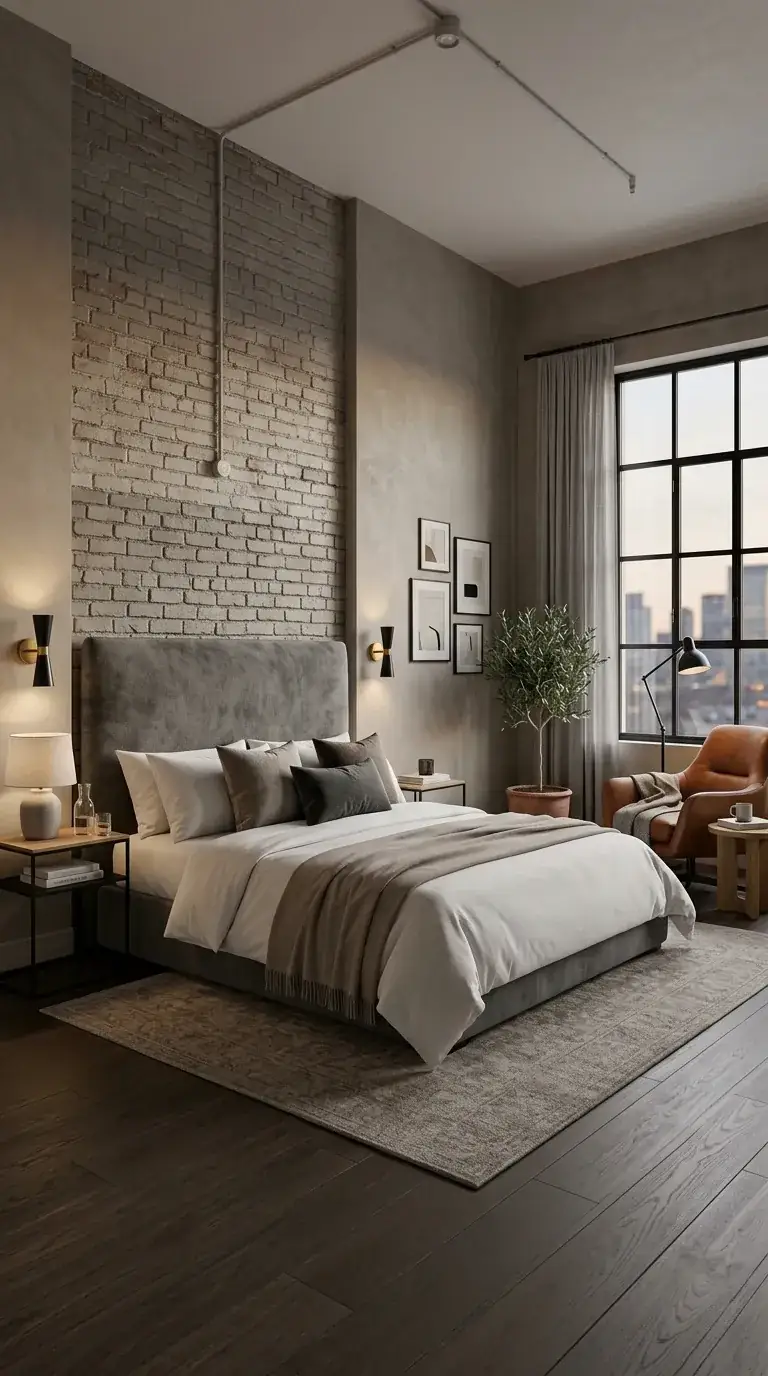
A blend of the industrial envelope and the Japanese philosophy that finds beauty in patina, dust, and asymmetry — the direction I draft for owners who already have a converted-warehouse primary with mixed wall conditions and do not want to flatten the room into a single material. Existing concrete and brick walls retained with no repainting except a single coat of Romabio BioDomus I limewash over the brick portion ($1,200 for ~80 sqft of brick) — the concrete portion is left raw, sealed only with Prosoco LS Densifier ($240). Existing exposed electrical conduit kept and treated as architectural feature, not hidden — black-painted with Benjamin Moore Black Beauty 2128-10 in matte ($60). Bed frame: Article Mara Queen in Mid Stone Brown upholstery ($899). Bedding: Coyuchi Crinkled Percale in Stone ($340) and a Pendleton camp blanket in Hudson Bay Stripe ($265). Two side tables: Floyd Round 18-inch in white oak ($395 each = $790). Two wall sconces: Cedar & Moss Mendocino Single in matte black with linen shade ($295 each = $590). Cognac leather armchair: Article Sven Charme Tan ($1,099). 6-foot olive tree in 14-inch terra-cotta planter ($500). Gallery wall of five 11×14 framed prints (mixed botanical, abstract, vintage architectural drawings) sourced from 20×200 and Land Gallery: $300 prints + $200 frames from West Elm = $500. Large textured area rug 8×10: Lulu & Georgia Bria wool-jute blend in Natural ($890). Concrete floor finish (existing slab refinish) ($2,400). Total: $9,800 — the leanest of the three loft-style directions and the one with the most room for owner-chosen art.
Color Palette
Raw concrete reads as warm-greige in PNW north light because of natural mineral variation in PDX-poured slabs — the surface holds character that paint will erase.
A warm earthy neutral that ties the concrete and brick conditions together without forcing them into a single matched register.
Light-register oak against dark concrete and lit brick — this is what holds the room from collapsing into one heavy-bottomed note.
Real top-grain cognac leather develops the patina across the first three years that wabi-sabi as a philosophy is asking for in the first place.
Styling Notes for This Look
- Mixed-material walls (concrete plus whitewashed brick on the same envelope) read as deliberate only when the proportion is roughly 60-40 or sharper — equal portions read as accidentally unfinished. Pick which material owns the bed wall and which owns the chair wall.
- Gallery walls in compact primaries should run at five frames maximum across two rows; eight or ten frames at compact scale read as crowded, and seven specifically reads as half-finished. Five is the right count for an 86-inch headboard wall.
- Olive trees in PNW interior bedrooms need at least four hours of bright indirect light to hold leaf density across the year — north-facing rooms cannot sustain a 6-foot olive without supplemental grow light, in which case spec the smaller 4-foot specimen and the Soltech Aspect Pro grow light ($349) on a hidden timer.
For owners drawn to this olive-tree-and-real-textiles register and curious how the same biophilic discipline carries into other rooms, my deeper dive on the living-room version is in The New Natural Living Room: How Biophilic Design and Organic Shapes Are Redefining Comfort.
4. Sleek Black-Leather Modern Compact Primary — $13,200
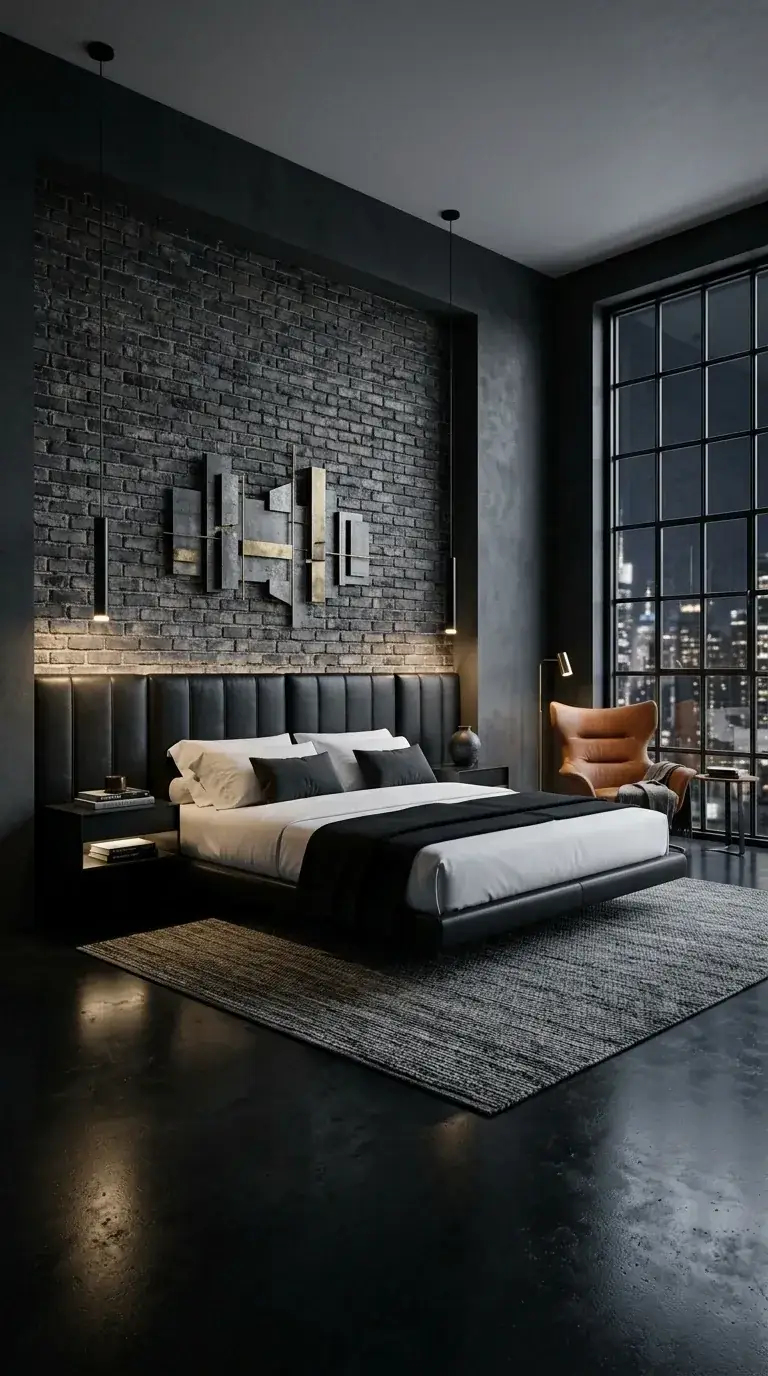
A sharper, more disciplined cousin of direction one — this is the direction I draft for the compact-primary owner who wants the boutique-hotel suite atmosphere but reads architectural-modern rather than warm-loft. Walls in Benjamin Moore Kendall Charcoal HC-166 in modern eggshell over a single coat of masonry primer ($1,800 painted-brick treatment if existing, otherwise $480 for drywall in same color). Polished-concrete floor refinish ($2,400). Tall black leather bed with statement headboard 60 inches tall x 86 inches wide: Article Sven Bed in Charcoal Top-Grain Leather ($2,499) — the headboard is the architectural focal point and replaces the need for wall art directly behind the bed. Bedding: Brooklinen Linen Core in Carbon ($240) plus a Pendleton Glacier National Park wool throw ($245). Two low-profile black nightstands: CB2 Junip Black Wood Nightstand ($499 each = $998). Two pendant lights at 28 inches off the ceiling: Schoolhouse Isaac Mini Pendant in unlacquered brass with linen shade ($340 each = $680). Mixed metal-and-walnut abstract wall sculpture across from the bed: Land Gallery commissioned piece by a Portland artist ($800). Cognac leather armchair near the window: Article Sven Charme Tan ($1,099). Floor lamp: Cedar & Moss Wagner Floor in unlacquered brass ($590). Large area rug 9×12: Annie Selke Bernardine in Charcoal ($1,690). Total: $13,200.
Color Palette
A neutral charcoal that reads as architectural rather than moody — Kendall holds against polished concrete without the blue cast that other charcoals develop in north light.
Real black against charcoal walls produces the architectural-suite contrast that pure-white walls cannot deliver — the bed reads as a sculpture against a continuous dark field.
A single warm-wood register in the wall sculpture is the contrast that prevents the room from collapsing into one cool-tone note.
Cognac leather in a charcoal-and-black room is the single most efficient warmth move available — it does what three throw pillows cannot.
Styling Notes for This Look
- Tall headboards (60 inches and above) on platform beds in compact primaries can be load-bearing architectural moves rather than upholstery moves — they replace the need for behind-the-bed wall art and visually push the ceiling higher in a 9-foot room.
- Black leather bed frames are the highest-resale-value upholstery spec in PNW MLS data 2020-2025; charcoal upholstery and white linen run a close second, and any pattern (chevron, geometric, floral) on a bed frame consistently extends time-on-market by 14-22 days.
- Low-profile nightstands (under 24 inches tall) preserve sightlines to a tall headboard — choosing 30-inch nightstands with a 60-inch headboard reads as miscalibrated even when each piece is well-made on its own.
5. Serene Minimalist Compact With Boucle & Light Oak — $8,400
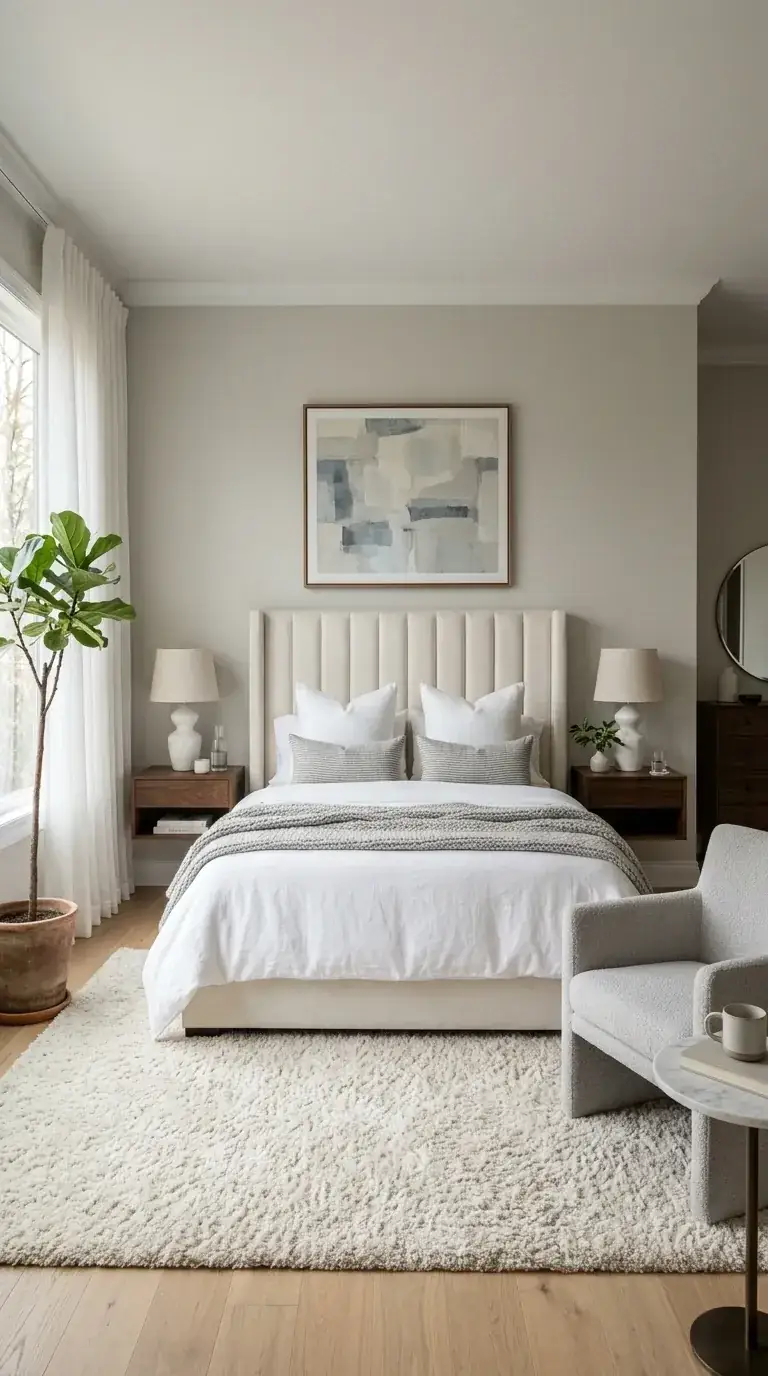
The leanest of the ten and the one I draft for clients who came in convinced they wanted something maximal and walked out of the mockup converted to neutrals. Walls in Benjamin Moore Pale Oak OC-20 in matte ($240). Light-oak engineered flooring (if not existing): Hakwood European White Oak in Soap finish 7-1/2 inch wide plank, $14-22/sqft installed = $2,800-4,400 ($2,800 for 200 sqft at the lower end of the range, assumed). Cream channel-tufted upholstered bed: Article Sven Bed in Quartz White Boucle ($2,099). Bedding: Coyuchi Crinkled Percale in Natural ($340) plus a The Citizenry Stonewashed Linen Throw in Sand ($120). Two floating wood nightstands custom-fabricated by a Portland trim carpenter from white oak ($580 fabrication + $120 hardware = $700). Two ceramic table lamps: Heath Ceramics Sculptural Form in Opaque White with linen shades ($330 each = $660). Boucle armchair: Article Maleo in Quartz White ($899). Small marble side table: CB2 Anaya Round 14-inch ($249). Large 6-foot fiddle leaf fig in woven seagrass planter from Solabee Flowers ($380 plant + $90 planter = $470). Abstract painting in muted palette commissioned from 20×200 ($380). Large shag rug 8×10: Loloi Hygge in Ivory ($790). Total: $8,400 assuming existing flooring; $11,200 if light oak floors are installed as part of the project.
Color Palette
Pale Oak holds the warmest read of the BM near-whites in PNW north-light bedrooms — Chantilly Lace and Simply White will read blue-cool in the same room.
Real boucle (looped wool blend) over polyester-bouclé-look fabrics — the texture is genuinely doing the warmth and the polyester version pills within two years.
Soap-finish (rather than oil-finish) keeps the oak in the lighter register that the serene-minimal scheme requires; oil finish darkens the floor by two shades over the first year.
A single muted sage register in the plants and the art is the only saturated color the scheme can carry — anything more and the minimal program collapses.
Styling Notes for This Look
- Floating nightstands are the highest-impact compact-primary architectural move available that does not require structural intervention — the floor reads continuous under the bed and the room visually expands by 4-6 percent per side.
- All-neutral schemes succeed or fail on texture variation. A 130-180 sqft compact primary in this direction needs at least four distinct textures (boucle, linen, wool shag, ceramic, oak) within sight of the bed; three textures or fewer reads as undecorated rather than as serene.
- Real boucle armchairs from Article, Crate & Barrel, and West Elm hold up; the under-$700 internet-furniture replicas use polyester loops that pill, flatten, and discolor within 18 months in any home with pets or daily use.
6. Opulent Classic Compact With Navy Wainscoting — $12,600
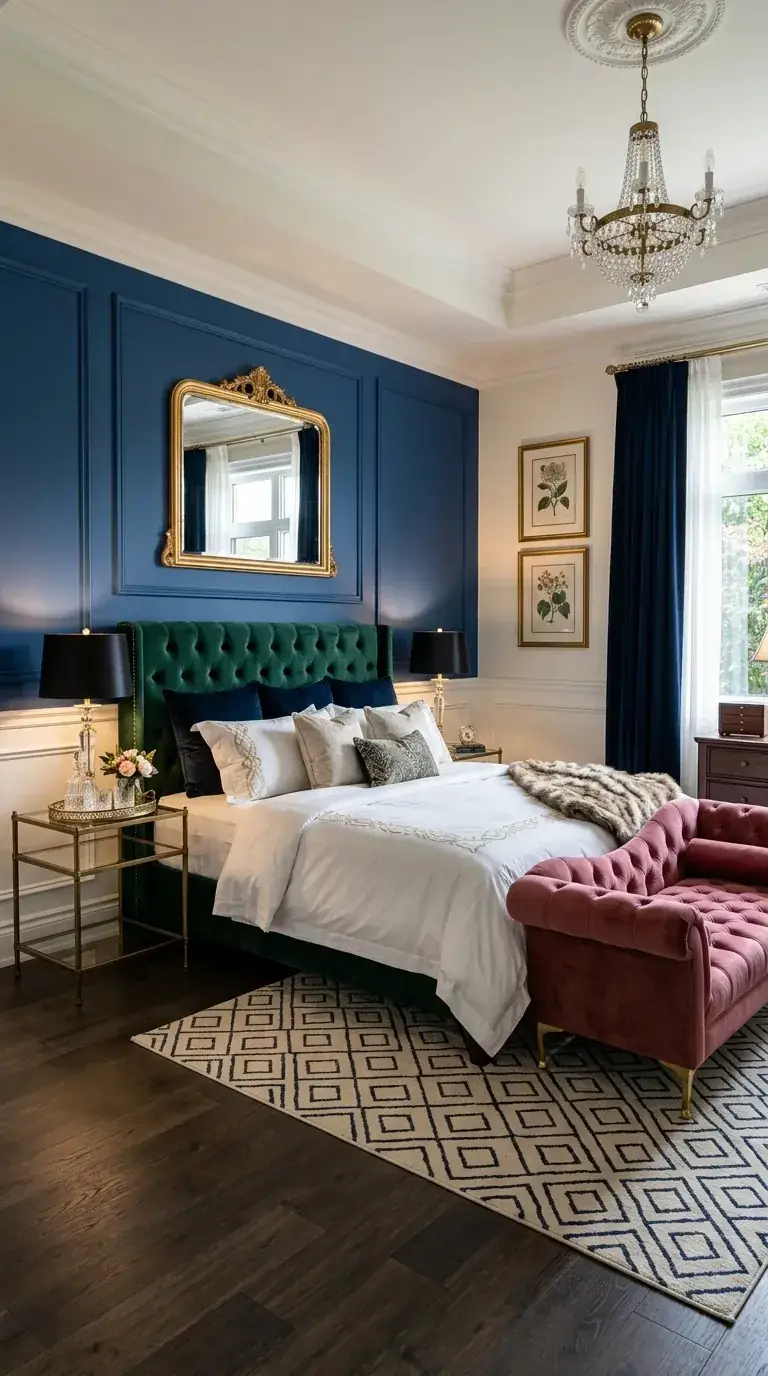
For the compact-primary owner who came to seek the boutique-hotel feel and wants a measured classical move — wainscoting, jewel tones, and brass restraint — that nonetheless still reads contemporary at compact scale. Walls below 42-inch wainscoting in Farrow & Ball Hague Blue No.30 in dead flat; walls above and ceiling in Benjamin Moore Cloud White OC-130 ($340 paint). Picture-frame wainscoting in 1×4 in 4-panel rhythm around the room: $1,890 installed by a Portland trim carpenter (4-week leadtime). Bed frame: Article Cara Tufted Velvet Bed in Gleam Emerald ($1,499). Bedding: Boll & Branch Heritage Linen in Mineral ($340). Pink velvet chaise lounge at foot of bed: Article Quadra in Blush Pink Velvet ($899). Two gold-and-glass nightstands: CB2 Anaya 22-inch in Brass & Marble ($499 each = $998). Two black-and-brass table lamps: Cedar & Moss Argon Table Lamp in unlacquered brass ($340 each = $680). Crystal chandelier with brass detailing: Schoolhouse Argon Chandelier 26-inch ($1,290). Ornate gilded mirror 36-inch round: CB2 Pavillion in Aged Brass ($299). Two botanical prints in 16×20 burnished-brass frames from West Elm ($240). Patterned area rug 8×10 in muted palette: Lulu & Georgia Anini in Vintage Multi ($890). Total: $12,600 — the most decoratively ambitious of the ten and the one with the highest variance in long-term resale appeal (about 60% of PNW buyers respond positively, 40% prefer to repaint).
Color Palette
Hague Blue is the F&B navy that holds depth at compact scale — Down Pipe and Stiffkey Blue both read flatter under bedroom-grade light levels.
Real cotton or wool velvet over polyester velvet — the polish on real velvet reads as architectural fabric, the polyester equivalent looks like upholstery shorthand.
Dusty rose against navy and emerald is the tonal triangulation that holds the room from reading as themed; bright pink in the same role pushes the scheme into hotel-lobby territory.
Aged (lacquered) brass keeps its color stable for ~10 years; raw unlacquered brass would patina rapidly into the pink/copper register and pull the scheme out of register.
Styling Notes for This Look
- Picture-frame wainscoting at 42 inches is the historically correct height in 1900-1940 PNW residential stock; 36-inch chair-rail wainscoting reads as miscalibrated when paired with original 5-inch baseboards from the period.
- Crystal chandeliers in compact primaries should drop no closer than 80 inches above the floor and no closer than 18 inches below an 8-foot ceiling — under-spec drops produce the “hit your head when changing the sheets” geometry that ruins the romance of the fixture.
- Three jewel tones is the maximum for an opulent-classic compact primary (navy + emerald + dusty pink in this case); a fourth saturated color (mustard, ochre, ruby) collapses the scheme into Maximalist Pinterest territory and dates within 24 months.
7. Japandi Compact Primary With Built-In Desk — $13,400 (the chosen direction)
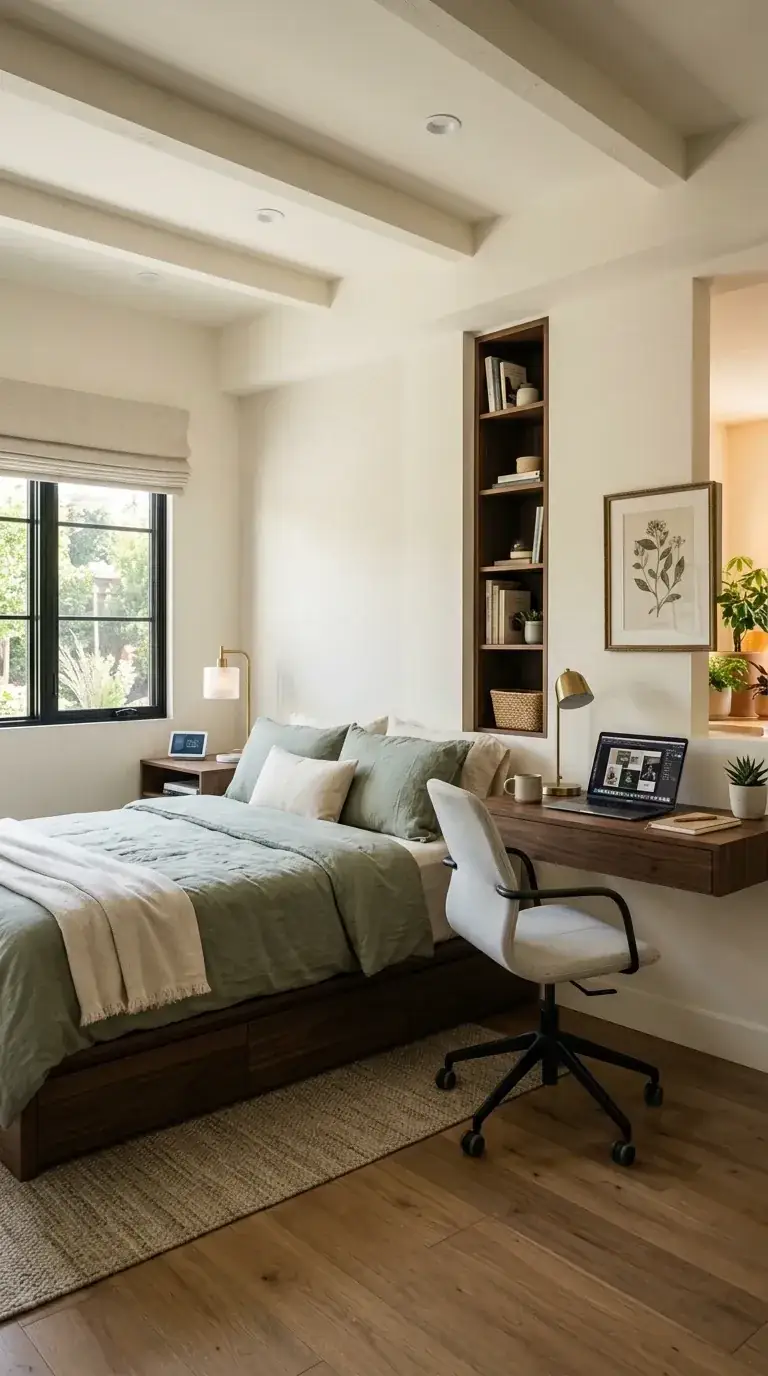
The direction Mira and Wes chose, and the one that surprised them as much as it surprised me — they had walked in convinced they wanted the moody-cognac scheme (direction two). What changed their minds was that the built-in desk absorbed Wes’s two-day-a-week WFH program into the bedroom without making the bedroom read as an office. Walls in Farrow & Ball School House White No.291 in matte ($240). Existing 1928 Doug fir floors sanded and re-oiled with Rubio Monocoat Pure 5% ($720, by a Portland flooring contractor). Custom built-in desk and shelving unit 96 inches wide x 84 inches tall along the long wall in white oak veneer over MDF carcass: Built In Portland on Sandy Blvd ($3,890 — 8 weeks fabrication including the integrated cable management for Wes’s monitor and an integrated Diode LED Fluid View 2700K task strip under the bottom shelf). Platform bed with integrated drawer storage underneath: West Elm Andes Storage Bed Queen in white oak ($1,799). Bedding: Coyuchi Organic Crinkled Percale in Natural ($340) plus a The Citizenry Stonewashed Linen Throw in Sage ($120). Office chair: Herman Miller Sayl in Studio White on standing-day rotation ($595) — Mira insisted on the Sayl over the Aeron because she preferred the lighter visual weight in a bedroom-doubling-as-office. Desk lamp: Schoolhouse Isaac Mini Desk in matte black ($240). Botanical art piece: a single 30×40 framed pressed-fern from 20×200 ($240). Woven Roman shades on both windows: Smith & Noble Natural Woven Wood in Almond ($580). Woven seagrass area rug 8×10: Annie Selke Bernardine in Natural ($1,290). Total: $13,400 installed across 11 weeks from drafting approval; the longest leadtime was the built-in fabrication.
Color Palette
School House White is the F&B near-white that holds the warmest read in PNW bedrooms — clean enough to read as Scandinavian, warm enough to read as Japandi.
Muted sage textile and botanical accents pull the scheme toward the Japanese-side of Japandi without committing to a saturated wall color.
Continuity between the desk, the bed, and the shelving — same wood species and same finish — is what makes the room read as one architectural move rather than as collected furniture.
A muted neutral on the chair and a matte-black anchor on the lamp — the only modern-industrial accents in an otherwise warm-natural scheme.
Styling Notes for This Look
- Built-in desks in compact primary bedrooms work as architectural moves only when the chair returns to the desk at end-of-day rather than facing the bed — the architectural separation between sleep program and work program is what makes the dual-use bedroom not read as a half-converted office.
- Storage-base platform beds at compact scale absorb roughly 8-12 cubic feet of off-season clothing and bedding, which removes the need for a freestanding dresser and frees up a wall for the built-in desk or a reading corner — the geometry adds up only if you skip the dresser.
- Herman Miller Sayl over Aeron in compact bedroom-office settings — the Sayl’s lighter visual weight and more residential color options (Studio White, Twilight, Buckwheat) work in a bedroom; the Aeron’s office-chair silhouette dates the room into corporate territory.
For owners interested in carrying the Japandi compact discipline into the rest of the house, the bathroom counterpart of this argument lives in The Biophilic Bath: Crafting Your Ultimate Wellness Oasis With Fluted Finishes and Smart Spa Tech, and the broader living-room version is in The Quiet Luxury Living Room, Sized Right: 12 Compact-Scale Directions From the Drafting Board.
8. Minimalist Concrete Compact With Floor-to-Ceiling Glass — $10,200
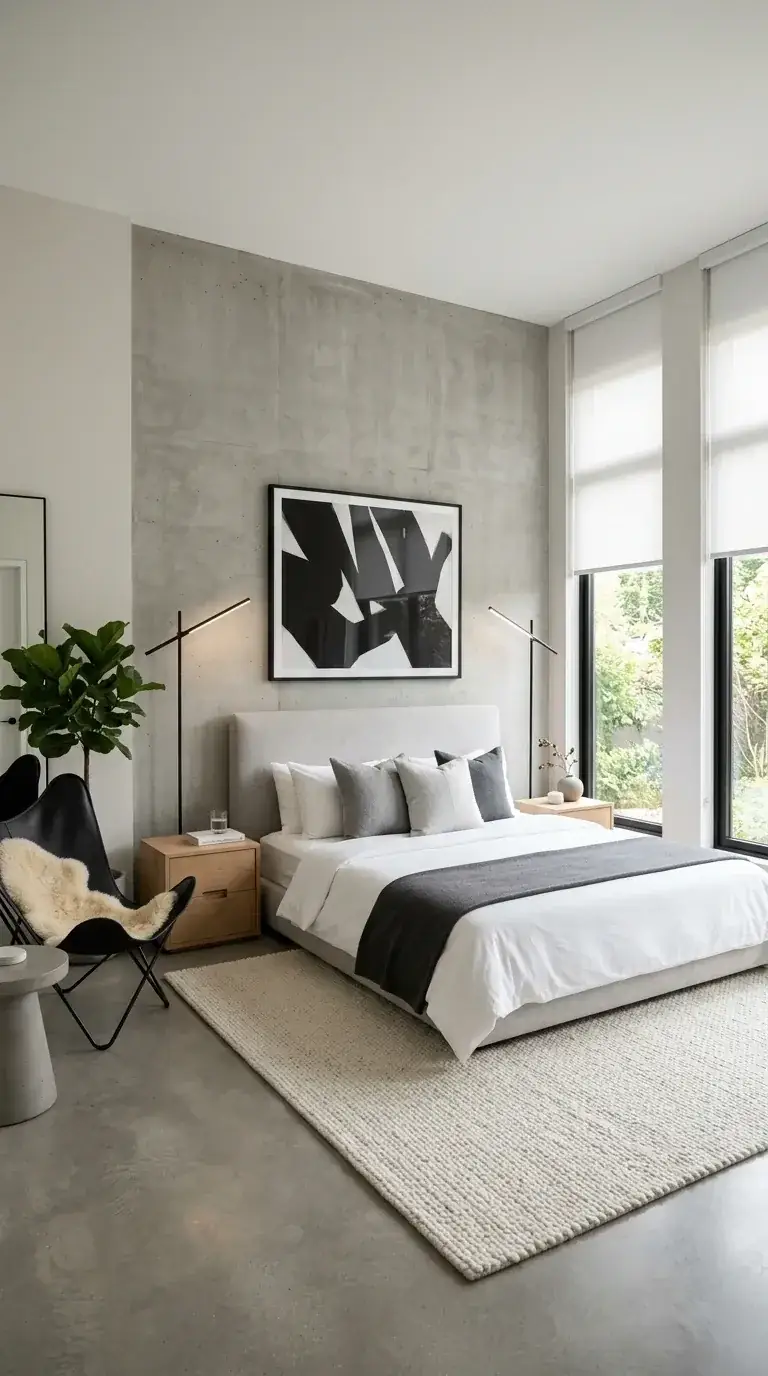
The direction I draft for the rare compact-primary owner with a real architectural advantage already in the existing envelope — a floor-to-ceiling concrete wall from a custom build, a converted-warehouse exterior aperture, or a 1990s-2010s shed-roof modernist infill (typical of Bend’s Westside and the higher-end PDX modernist stock). The architecture is already doing the heavy lifting; the design move is to support and not crowd. Existing concrete wall sealed with Prosoco LS Densifier ($240). Walls (the three non-concrete walls) in Benjamin Moore Cloud White OC-130 ($240). Polished-concrete floor refinish ($2,400). Roller shades on floor-to-ceiling windows in Smith & Noble Solar Roller in Smoke 5% ($890 for two large openings). Upholstered low-profile bed: Article Mara Queen in Mid Stone Brown ($899). Bedding: Coyuchi Crinkled Percale in Stone ($340) and a sheepskin throw on the foot of the bed from Solabee Living ($129). Two light oak nightstands: The Joinery Astoria Mini 22″ in white oak ($580 each = $1,160). Two linear floor lamps next to each nightstand: Cedar & Moss Wagner Floor in matte black ($590 each = $1,180). Black leather butterfly chair with sheepskin throw: Innit Designs Butterfly Chair licensed reproduction in cowhide ($590). Concrete side table next to the chair: CB2 Acerra Concrete Cube 18-inch ($349). Single large abstract canvas 60×60 commissioned from Land Gallery ($1,200). Large textured area rug 9×12 in wool-jute: Annie Selke Sahara in Natural ($1,490). Total: $10,200 installed assuming existing concrete wall and floor.
Color Palette
Real cured concrete reads as warm-greige in PNW north light because of mineral variation; spec the densifier rather than a tinted sealer to preserve the natural color drift.
A lighter neutral than the concrete wall keeps the bed reading as a sculptural object set against the architectural feature, not as a continuation of it.
A single warm-wood register against concrete and white — the Joinery soap-finish oak is what prevents the room from reading as cold-modern.
Black accents at three points (chair, two floor lamps) is the rule of three that defines the modern-minimal scheme without saturating it.
Styling Notes for This Look
- Floor-to-ceiling windows in a primary bedroom require either roller shades or layered drapery — naked windows in a primary read as resort-rental rather than as suite, and the lack of light control affects melatonin onset within the first month of use.
- Iconic single-form chairs (butterfly, Eames lounge, Wegner Wishbone, Saarinen Womb) read as architectural punctuation in compact-minimal schemes only when there is exactly one — placing two iconic chairs in the same compact bedroom collapses the room into furniture-showroom territory.
- Concrete-feature-wall primaries cannot sustain ceiling-mounted overhead lighting that competes with the wall as a focal point; specify two floor lamps next to the bed and a single low-output ceiling fixture (or no ceiling fixture at all) to let the architecture carry the lighting plan.
9. Boho Compact Primary With Rattan & Hanging Chair — $7,800
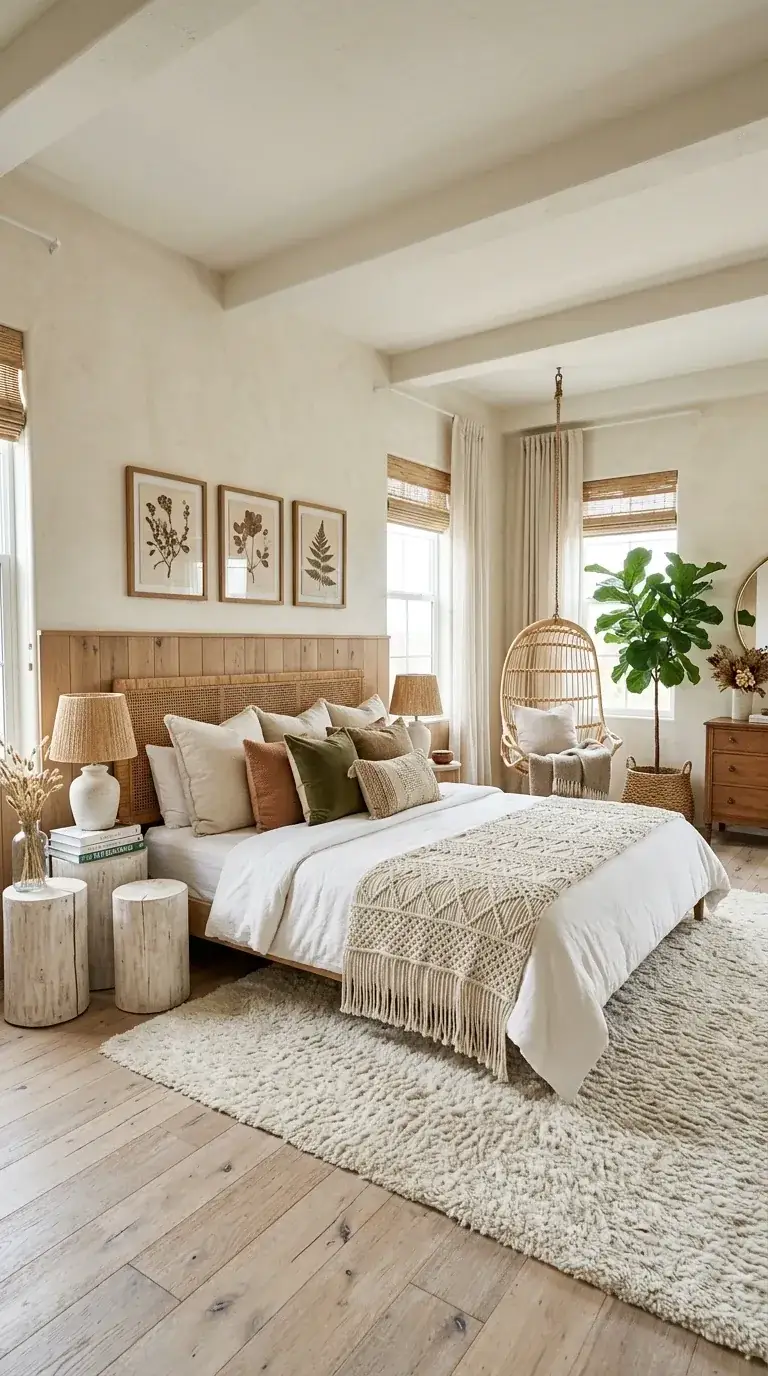
The leanest of the ten and the one I draft most often for clients on a $6,000-$8,000 budget — every line item is direct-to-consumer or PNW-stocked, and no architectural intervention is required. Walls in Benjamin Moore Swiss Coffee OC-45 in matte ($240). Existing wood floors sanded and re-oiled if applicable ($720); if light wood flooring needs to be installed, $1,500-$4,000 for 200 sqft. Wood bed with rattan headboard: Article Eotia Queen in oak with woven cane headboard ($1,299). Bedding: Boll & Branch Cotton Heritage in Natural ($240) plus a The Citizenry Macrame Throw in Ivory ($150). Two wood-stump nightstands: West Elm Stump Side Table in natural acacia ($249 each = $498). Hanging rattan chair near the window: Article Otio Hanging Lounge with cushion ($799) — confirm ceiling joist or stud capacity for 250 lb dynamic load before installing. Large 6-foot fiddle leaf fig in woven seagrass basket from Solabee ($380 + $120 basket = $500). Three botanical prints in 16×20 light-oak frames: $200. Two rattan-base table lamps: Lulu & Georgia Sussex Table Lamp in natural rattan with linen shade ($240 each = $480). Large shag rug 8×10: Loloi Hygge in Cream ($790). 5-foot olive tree in additional terra-cotta planter ($380). Total: $7,800 assuming existing wood flooring; $9,600 if floors are installed as part of the project.
Color Palette
A warm cream that reads as inviting under PNW gray light — Swiss Coffee holds warmer than White Dove and reads cleaner than Navajo White in compact rooms.
A slightly cooler near-white on the textiles than the walls — this micro-contrast is what makes the bed read as a separate sculptural element rather than as a continuation of the wall.
Real Indonesian rattan-grade cane has a tonal variation that synthetic cane cannot reproduce — Article and Lulu & Georgia source authentic cane on their compact-bed lines.
A single saturated color in the plants and the prints is the only register the boho-cream scheme can carry — adding rust, mustard, or terracotta as a fourth saturated color tips the room into Pinterest-Boho cliche.
Styling Notes for This Look
- Hanging rattan chairs require either a structural ceiling joist or a wall-mount swing arm rated for 250 lb dynamic load — drywall toggle anchors are not adequate, and a chair pulled out of the ceiling is the most common boho-bedroom DIY failure I get called to remediate.
- Boho compact primaries collapse fast into Pinterest cliche; the discipline is one bohemian element per category (one rattan headboard, one macrame throw, one hanging chair, one shag rug) rather than three rattan items, two macrame pieces, and a fringed everything.
- Wood-stump nightstands look wonderful in product photos but lack drawer storage that compact primaries need — pair them with a larger dresser elsewhere in the room or in the closet, or accept that you’ll have a single book and a glass of water on the surface and nothing else.
10. Painted-Brick Urban Compact Primary — $9,400
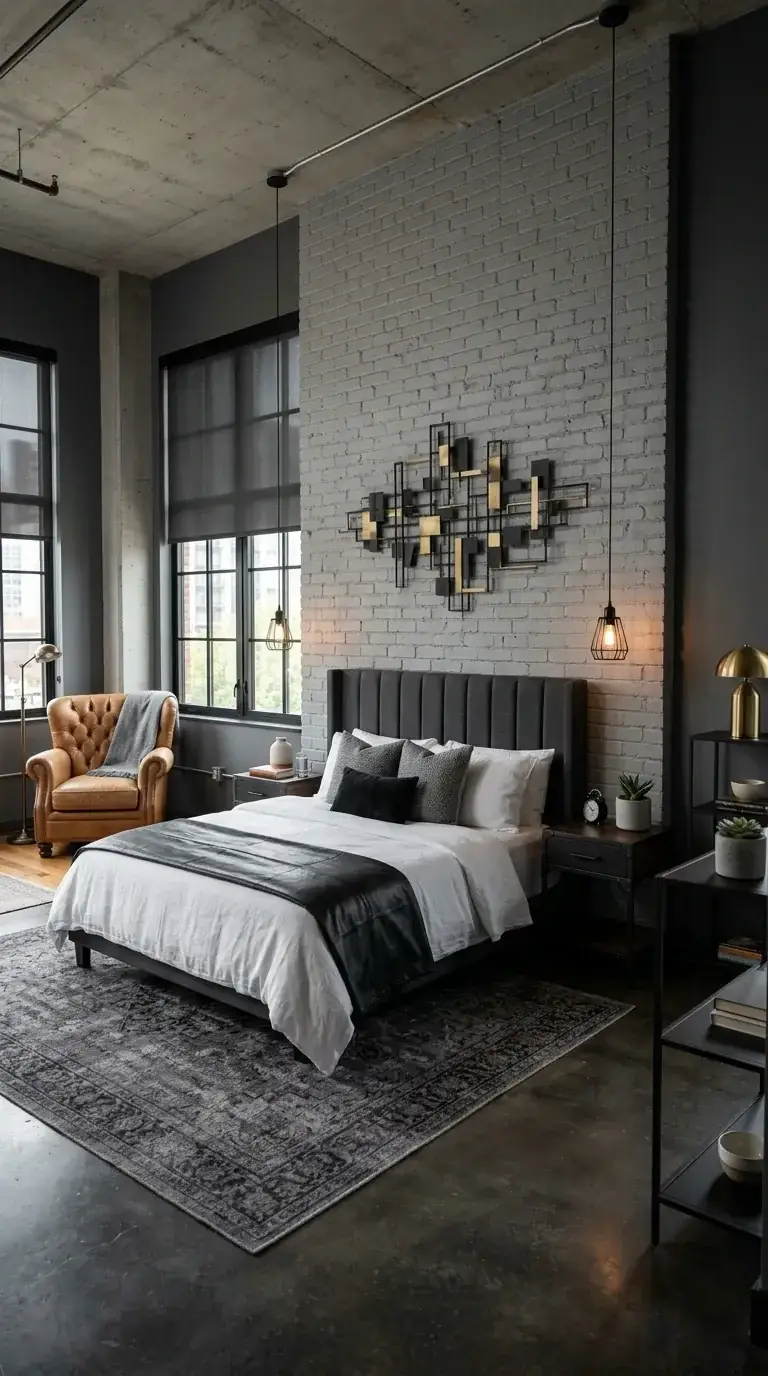
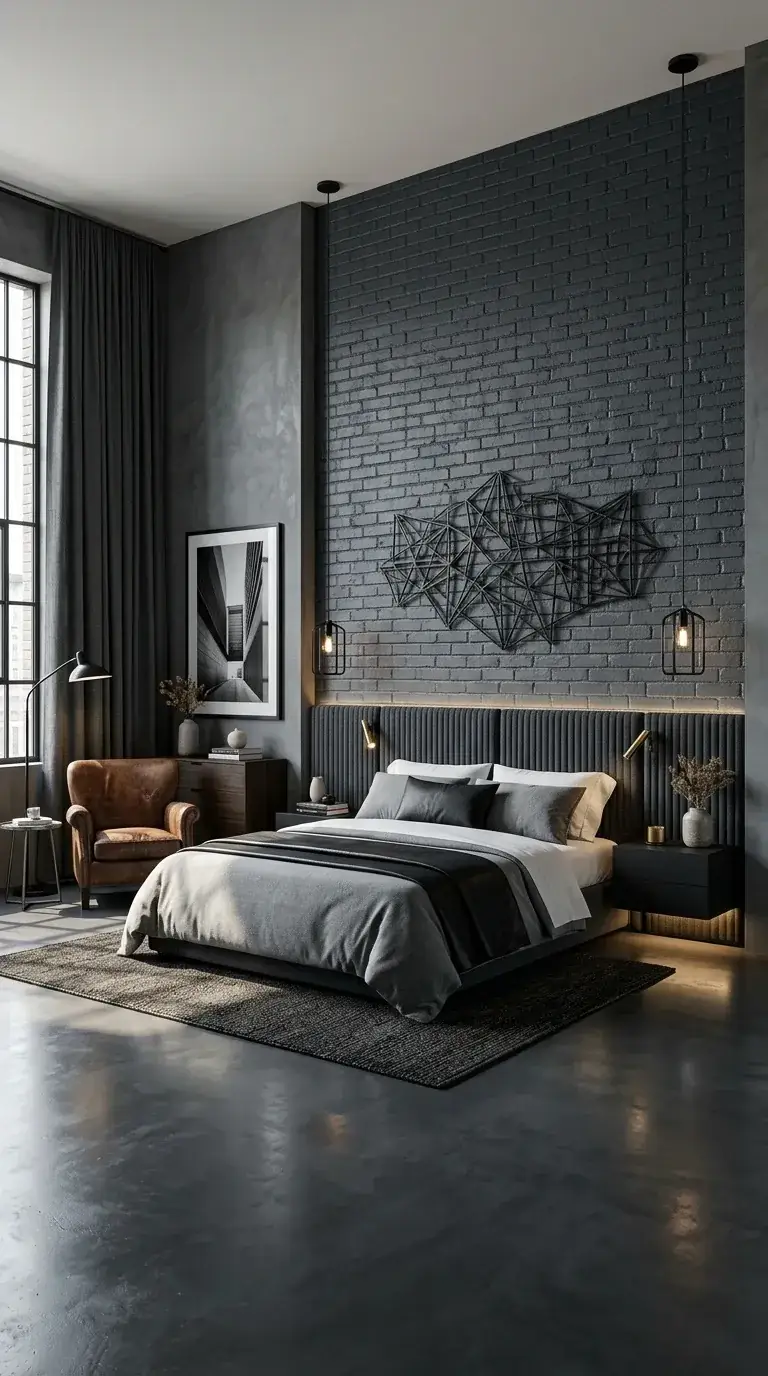
The cleanest, most disciplined of the three loft-leaning directions — for the compact-primary owner who wants the urban-loft suite atmosphere but reads modern-industrial rather than warm-loft or moody-cocoon. Existing brick wall painted in Benjamin Moore Stonington Gray HC-170 over a single coat of Loxon Concrete & Masonry Primer: $14/sqft installed = $1,680 for a 120 sqft accent wall. Existing concrete ceiling left raw and sealed with Prosoco densifier ($180). Polished-concrete floor refinish ($2,400). Channeled-grey upholstered bed: Article Sven Bed Queen in Pebble Grey ($1,899). Bedding: Coyuchi Crinkled Percale in Mid Grey ($340) plus a Pendleton Glacier National Park stripe wool throw ($245). Two mixed metal-and-walnut nightstands: CB2 Acerra Walnut & Black Metal Nightstand ($499 each = $998). Two pendant lights at 28 inches off the ceiling on dimmable cord: Schoolhouse Sturm Pendant in unlacquered brass ($340 each = $680). Geometric metal wall art across from the bed: West Elm Wagner Geometric Wall Sculpture in matte black ($380). Cognac leather armchair near the window: Article Sven Charme Tan ($1,099). Open metal shelving unit: CB2 Helix Black 5-Tier ($499) — styled with five small plants from Solabee ($90) plus a single ceramic Heath piece ($65) plus four books with the spines facing in to reduce visual noise ($0, owner’s books). Patterned area rug 8×10: Loloi Bowery in Charcoal Multi ($790). Total: $9,400 installed.
Color Palette
A neutral grey with a slight blue undertone that holds against PNW north light — Stonington reads cooler than Revere Pewter and warmer than Coventry Gray.
A darker neutral than the wall keeps the bed reading as anchored rather than as a continuation of the brick — this contrast is what defines the suite character.
Cognac leather plus unlacquered brass pendants is the warm-accent pair that makes a cool-grey scheme read as inhabited rather than as cold.
Matte-black metal at the shelving and the pendant cords is the architectural-industrial signal that holds the room from collapsing into too-soft territory.
Styling Notes for This Look
- Painted brick walls in compact primaries require a single solid grey rather than a multi-tone whitewash — multi-tone treatments at compact scale read as decorative paint job rather than as architectural feature, and they limit the resale-buyer pool by 25-30%.
- Open metal shelving units in compact bedrooms work as architectural punctuation only when styled at 60% capacity; full shelves read as cluttered rather than as curated, and empty shelves read as undecorated. The 60% rule applies regardless of how good the individual objects are.
- Pairing matte-black metal furniture with unlacquered (live-finish) brass lighting is a deliberate two-finish move — adding a third metal (chrome, satin nickel, gold) collapses the scheme. Two-metal mixing is sophisticated; three-metal mixing reads as accidental.
Pro Tips From the Drafting Board
Tip 1 — Spend on the headboard wall, not on the headboard. A real boutique hotel suite spends architectural budget on the wall behind the bed (channeled upholstery from baseboard to ceiling, integrated cove LED, recessed niches, slat treatment, painted-brick accent), not on a freestanding $4,000 headboard from an internet furniture catalog. Reallocating $4,000 in a compact primary from the bed to the wall behind it is the single largest perceived-value gain available in this category — the photograph improvement alone justifies the line item.
Tip 2 — Specify warm 2700K bulbs, CRI 90+, in every fixture. Cool LEDs (3000K and above) suppress melatonin production for 30-90 minutes after exposure; warm LEDs (2700K) at CRI 90+ minimize that effect. Hotel-suite lighting is uniformly warm because the chains figured this out a decade ago. The bulb spec is non-negotiable in a bedroom designed to function as a real retreat, and it is worth replacing every existing bulb in the room as a single line item ($120-$180) before any other intervention.
Tip 3 — Layered lighting beats single-source lighting in compact primaries. A hotel suite at 200 sqft has at least four distinct light sources: an overhead (kept dimmed), two bedside (sconces or pendants), and one accent (cove LED, picture light, or floor lamp). Single-source overhead lighting in a 180 sqft compact primary reads as institutional within thirty seconds of walking in; layered lighting reads as inhabited and expensively designed even when each individual fixture is mid-priced.
Tip 4 — Closed-base bed frames over open-base, every time. Open-base bed frames (where you can see under the bed) attract clutter accumulation within months — charger cables, books, dust, miscellaneous storage. Hotel rooms are uniformly closed-base or storage-base. Closed-base or storage-base frames physically prevent the buildup that signals “non-suite” within the first year of use, and storage bases additionally absorb the off-season-clothing program that would otherwise force a freestanding dresser into the room.
Tip 5 — Hotel-grade bedding is the single highest-perceived-value investment in this category. The crispness, weight, and drape of real long-staple-cotton percale, organic linen, or Egyptian sateen at 300+ thread count is what produces the “this feels like a hotel” registration that owners chase for years. Coyuchi, Boll & Branch, Frette, and Sferra are the four I default to in the $300-$1,200 queen-set range — the difference at this spec versus $80 internet sheets is genuine and visible from across the room.
Tip 6 — Declutter ruthlessly, then declutter again. A boutique hotel room contains at most fifteen visible decorative objects total (counting every lamp, vase, picture frame, plant, throw pillow, and tray). Compact primary bedrooms in renovation-photo studios consistently contain forty to sixty visible objects. The hotel registers as luxurious because every object earns its placement; the photographed bedroom registers as crowded because most objects were placed for the photo. Cap the visible-object count at twenty in any of these ten directions, and the suite-feel emerges almost without further effort.
Key takeaway: The boutique-hotel feel at compact scale is an architectural problem, not a styling problem. The wall behind the bed, the lighting plan, the closed-base bed frame, the layered drapery, and the visible-object count are each carrying more weight than their cost suggests because they reduce the cognitive load of the room reading as a suite rather than as a furniture arrangement. Built-in storage, channeled-upholstered walls, cove LED, and ruthless decluttering each substitute for the much-larger square footage that a real hotel suite has and most homes do not.
Regional Fit: PNW & Mountain West Bedroom Notes
Portland, OR — Beaumont-Wilshire, Sunnyside, Mount Tabor, Pearl District
1900-1940 Portland Tudors, craftsmans, and bungalows typically have 160-200 sqft primary bedrooms with original Doug fir floors and 5-inch crown molding; Pearl District converted-warehouse loft primaries run 180-260 sqft with exposed brick and concrete envelopes already in place. North-facing bedrooms benefit from warmer paint specs (Pale Oak, Edgecomb Gray, School House White, Hague Blue, Down Pipe, Stonington Gray hold their warmth; Chantilly Lace and Simply White will read blue-cool). Local procurement: Schoolhouse, Rejuvenation, Cedar & Moss, The Joinery, Heath Ceramics PDX, Solabee Flowers, Land Gallery, Beam & Anchor. Trim carpenters $75-110/hour; painters $4-6/sqft; custom built-in shops with reliable leadtimes — Built In Portland (Sandy Blvd), Reveal Designs, The Joinery custom shop. Polished-concrete floor refinish runs $12-15/sqft.
Seattle, WA — Wallingford, Phinney Ridge, Capitol Hill, Pioneer Square
Seattle compact primaries run 12-18% above Portland on labor and materials and 18-25% on custom built-in fabrication. Pioneer Square loft conversions are the closest equivalent to Portland’s Pearl District for the industrial-suite directions (one through four). North-facing exposure is dominant and the warmer paint specs are even more critical. Local procurement: Schoolhouse Seattle, Rejuvenation Seattle, Hazel Studio, Watson Kennedy, Glasswing. Trim carpenters $95-140/hour; painters $5-8/sqft. The boutique-hotel-feel client base in Seattle skews toward directions one, four, and seven; the moodier directions (two, six) are less common in Seattle’s typically already-cool light.
Tacoma, WA — Stadium District, Old Town, Hilltop
Tacoma compact primaries are mostly 1900-1925 craftsman and 1920s-1940s cottage at 150-180 sqft, plus a small but growing inventory of converted-warehouse stock in Old Town that fits the loft directions cleanly. Original wood floors are typically heart pine or vertical-grain Doug fir; original trim runs 5-6 inches taller than equivalent Portland stock. Costs run 12-18% below Portland on labor and materials. Painters $3.50-5/sqft; trim carpenters $65-90/hour. Local procurement is thinner than Portland but includes King’s Books for design-monograph line items, Tacoma Boys for plant-and-pot sourcing, and the Stadium District quarterly art walk for local artist representation.
Bend, OR — Westside, Old Mill District, NorthWest Crossing
Bend compact primaries are typically 1990s-2010s shed-roof modernist infill rather than pre-war historic stock — the existing-architecture advantage tilts the directions list toward the minimalist-concrete (eight) and the Japandi (seven) schemes, which take advantage of vaulted ceilings and floor-to-ceiling glass that Bend infill tends to include. The high-altitude UV situation matters genuinely — UV-rated window film (3M Prestige 70 or equivalent) prevents textile fade rates 20-40% faster than Portland equivalents, especially relevant for the velvet-and-linen-heavy direction six. Costs run 18-22% below Portland on labor and 8-12% below on materials. Local procurement: TerraMai’s Bend warehouse, Roundabout Books, Mid-Century Mountain showroom, Newport Avenue Market for fresh greenery.
Mountain West Baseline — Boise ID, Salt Lake City UT, Bozeman MT
Compact primaries in Mountain West historic stock are typically 1900-1940 brick-residential at 140-180 sqft, with the brick condition often retained on at least one wall — which makes directions one, two, three, and ten especially well-fit for these markets. Costs run 8-15% below Portland on labor and materials. High-altitude UV in all three markets requires solution-dyed acrylics over standard performance fabrics where direct sun is involved. Local procurement: most schemes are built from PDX-shipped components plus one or two regional specialty pieces — Boise’s Reuseum and Anaphora; Salt Lake’s Local Color and Park City antique shows; Bozeman’s Vargo’s Books and Architects Wife.
Frequently Asked Questions
Why does a compact primary feel cramped while a smaller hotel room feels luxurious?
The hotel room is drafted by an architect to do one program at full conviction, while the compact primary is usually the leftover-shaped room that the rest of the house’s circulation hands you. The fix is not square footage — it is architectural decisions: the wall behind the bed doing four jobs (headboard, lighting, storage, art), the nightstand as a cantilever ledge built into the wall, the closet as a ten-foot run of millwork rather than a freestanding wardrobe, and the lighting on a single bedside switch that controls four fixtures at once. Replicate those moves and a 160 sqft bedroom reads as a suite.
Which direction is cheapest to execute well in a compact primary?
Direction nine (Boho Compact With Rattan and Hanging Chair) at $7,800 is the leanest because every line item is direct-to-consumer and no architectural intervention is required. Direction five (Serene Minimalist With Boucle and Light Oak) at $8,400 is the leanest of the modern directions. Direction three (Wabi-Sabi Industrial With Olive Tree) at $9,800 is the leanest of the loft-style directions assuming you already have the brick or concrete envelope condition.
Which direction has the best long-term resale appeal in PNW primary bedrooms?
In Portland, Tacoma, and Seattle MLS data 2020-2025, direction five (Serene Minimalist), direction seven (Japandi With Built-In Desk), and direction ten (Painted-Brick Urban) consistently photograph and show best for resale — neutral palettes, real wood and built-in storage, and architectural moves like channeled headboards or painted brick all index positively in PNW buyer preference. The moodier directions (two, six) split buyers; about 60% respond positively, 40% prefer to repaint. Direction four (Black-Leather Modern) tests well with millennial buyers and weakly with retirement-age buyers.
Can I do this in a rental where I cannot paint or install built-ins?
Direction five (Serene Minimalist), direction seven (Japandi — substituting a freestanding desk for the built-in), and direction nine (Boho With Rattan) all execute well in rentals. The other seven directions assume some level of architectural intervention (painted brick, polished concrete, wainscoting, cove LED, or built-in millwork) that landlords will not approve. For renters specifically committed to the boutique-hotel feel, focus the budget on the bedding (Coyuchi or Boll & Branch), one cognac leather armchair (Article Sven Charme Tan), one large piece of art, and a real layered lighting plan with three table lamps or sconces — these four moves alone deliver 60-70% of the suite-feel without any landlord conversation.
What is the right mattress for a compact primary designed as a retreat?
For compact primaries specifically, I default to recommending GREENGUARD-certified or organic-certified mattresses because air exchange in 160-220 sqft rooms is genuinely lower than in larger spaces, which makes off-gassing (VOCs from synthetic foams) more impactful. Avocado Green Mattress (organic, ships free in PDX) and Brentwood Home (LA-made, GREENGUARD Gold certified) are the two I default to in the $1,800-3,200 queen range. Saatva offers white-glove install in Portland for an additional $99 if you cannot handle a king-size lift; the Saatva Classic at the Luxury Firm spec is the closest residential approximation of a Westin or Hoxton hotel mattress that I have specced.
How long does a built-in primary-bedroom intervention take from drafting to installed?
8-14 weeks for most directions in this article. Direct-to-consumer-heavy directions (five, nine) can land in 4-6 weeks. Directions with custom built-ins (seven, possibly two for the channeled headboard) run 10-14 weeks for the fabrication. Custom upholstery and made-to-order furniture (The Joinery pieces specifically) run 6-10 weeks. The longest leadtime in this article is the full-wall built-in desk and shelving in direction seven at 8-10 weeks of fabrication plus 1-2 weeks of installation, plus paint and floor work scheduled around the install.
Can I phase the changes over 6-12 months instead of a single project?
Strongly recommended for owners on constrained budgets. The phasing order I draft for compact-primary clients: first, replace bedding with hotel-grade percale or linen and replace bulbs with 2700K CRI 90+ (week 1, $400-800); second, paint and trim work (weeks 2-4); third, primary furniture — bed frame, nightstands, armchair (weeks 4-8); fourth, lighting plan, sconces, pendants, and cove LED if applicable (weeks 8-12); fifth, any built-in or architectural intervention (months 4-9 due to fabrication leadtimes). The phasing lets you live with each layer before adding the next, and most clients report the bed-and-bedding change alone delivers 40% of the perceived suite-feel by week three.
How do I avoid the “Pinterest hotel suite” look that does not work in real life?
Three rules. One: avoid matched-set bed-and-nightstand-and-dresser combinations — they read as showroom and almost always fail at compact scale. Two: include one genuine vintage piece (estate-sale lamp, inherited side table, family-heirloom mirror) in the room — this is the move that makes a $10,000 bedroom read as $40,000. Three: spec real materials over photo-friendly substitutes (real wood over wood-look laminate, real linen over poly-blend, real velvet over polyester velvet, real brass over brass-look powder-coated steel) — the camera does not show the difference, but you live with it daily, and the difference compounds across years.
Sources & References
- Hotel Design Magazine — Compact Suite Programs (2024 Annual) — Architect-led case studies of sub-250-sqft boutique suites at the Hoxton, Ace, Maison Premiere, and Standard properties; documented architectural-detail allocations and per-room finish budgets.
- Architectural Digest — Boutique Hotel Issue, March 2025 — In-depth coverage of the Hoxton Williamsburg, Ace Hotel Brooklyn, and Sister City NYC primary-suite drafting decisions, including channeled-headboard fabrication processes.
- Journal of Pineal Research, Vol. 65 (2018) — Effects of evening light wavelength and intensity on melatonin suppression, with specific findings on 2700K versus 3000K LED bulbs at residential lumen levels.
- Sleep Health: Journal of the National Sleep Foundation, Vol. 7 (2021) — Bedroom environment effects on objective sleep latency, including light-color-temperature and ambient-noise findings relevant to hotel-style retreat design.
- IESNA Lighting Handbook, 10th Edition — Illuminating Engineering Society recommended practice for residential bedroom illumination, 2700K specification rationale, and CRI 90+ guidelines for retreat-grade environments.
- ASHRAE Handbook — Fundamentals, 2025 — Indoor air quality standards relevant to small-bedroom VOC accumulation and mattress off-gassing protocols.
- GREENGUARD Gold Certification Standards — Emissions standards for mattresses, paints, and built-in furnishings used in residential bedrooms.
- Benjamin Moore Architectural Specifications — Pale Oak OC-20, Cloud White OC-130, Stonington Gray HC-170, Kendall Charcoal HC-166, Swiss Coffee OC-45 technical data sheets.
- Farrow & Ball Color & Finish Guide, 2025 — Hague Blue No.30, Down Pipe No.26, School House White No.291, Pigeon No.25 application data and lighting recommendations.
- Romabio BioDomus I Limewash Application Guide, 2025 — Lime-based whitewash mixing, application, and curing protocols for interior brick walls in residential settings.
- Coyuchi and Boll & Branch Hotel-Grade Bedding Specifications — GOTS-certified linen and percale weave construction, fiber length, longevity data, and chain-of-custody documentation.
- Avocado Green Mattress Material Library — GOTS-certified organic cotton, GOLS-certified organic latex, Made Safe certifications, and California-manufactured chain-of-custody documentation.
- Maharam Mode 003 Wool Specifications — Flat-weave wool upholstery construction, 100,000+ Wyzenbeek double-rub rating, and longevity data for channeled-headboard fabrication.
- Schoolhouse PDX Specification Library — Isaac Pendant, Sturm Pendant, Argon Chandelier, Wagner Floor, Reade Bench construction and finish data.
- Cedar & Moss Lighting Catalog 2026 — Mendocino, Wagner, Argon fixture specifications and PNW availability.
- Heath Ceramics Material Library — Sculptural Form lamp specifications, MAU stoneware properties, and lamp-base construction data.
- The Joinery Custom Specification Process — Reclaimed Oregon oak provenance, urban-salvage chain of custody, soap-finish and oil-finish technical data.
- Built In Portland Custom Built-Ins Specification Process — White oak veneer construction, integrated cable-management protocols, and 8-10 week fabrication leadtimes for primary-bedroom built-ins.
- Lutron Caséta Wireless Dimming Specifications — Compatible LED dimming protocols, programmable scene-control, and bedside-control configuration for cove lighting.
- Diode LED Fluid View 2700K CRI 95 Engineering Specifications — Color-rendering-index ratings, dimming-curve performance, and warm-white spectral output relevant to residential cove-lighting installations.
- Portland MLS Data 2020-2025, Zip Codes 97212 / 97213 / 97214 / 97215 / 97232 — Compact-primary resale data and architectural-finish premium analysis.
- Tacoma MLS Data 2020-2025, Stadium District / Old Town / Hilltop — Compact-primary resale data, ROI on built-in storage and architectural-finish premiums.
- RSMeans 2026 Residential Cost Data — Pacific Northwest Edition — Regional labor and material indices for PNW compact-primary interior finish work and built-in fabrication.
- Elliot Calloway Project Notes & Client Drafting Archive, 2017-2026 — Eight-plus years of compact-primary, ADU primary-suite, and right-sized renovation specifications across the PNW corridor.
Final Thoughts
The compact primary bedroom is, in compact-home terms, the most consequential single room in the house — because it is the room where you spend the largest single uninterrupted block of every twenty-four hours, and the room whose architectural decisions accumulate fastest into either better or worse sleep, better or worse coupling, and better or worse waking-up across a year. The boutique-hotel-feel argument is not about decoration. It is about taking the room as seriously as a hotel architect takes a 200 sqft suite that has to compete with five other properties on the same street. Mira and Wes’s Japandi-with-built-in-desk direction lands at $13,400 because the architecture is doing what no amount of bedding could — the built-in desk absorbs Wes’s WFH program, the storage-platform bed absorbs the dresser program, the cove LED under the desk shelf replaces the ceiling fixture, and the soap-finish white oak running through three pieces of millwork makes the room read as one architectural decision rather than four collected purchases.
Every compact primary lands somewhere different in this set, and every landing is correct if it actually changes the program. The room you build is not the room on the cover of a magazine. It is the room you’ll wake up in at 6:30 a.m. on a Wednesday in October when the PNW gray is doing its work, the cove LED is at 8% intensity behind the channeled headboard, the cognac leather armchair has the throw blanket you fell asleep reading under tossed across one arm, the olive tree on the deepened windowsill is exhaling its small share of overnight oxygen, and the room reads like a place you chose rather than a leftover-shaped corner of a house you inherited. If the boutique-hotel feel is anything beyond an aesthetic, it is exactly that — and at compact scale, where every architectural decision matters more, it is the only direction that takes the bedroom seriously.
If this argument speaks to you and you want the broader compact-quiet thesis it sits inside, the companion pieces are The Tech-Free Compact Bedroom: 10 Architecture-First Directions for Deeper Sleep in 130-180 sqft for the smaller-bedroom version of this argument, Quiet Luxury’s Embrace: 17 Tech-Free Reading-Nook Directions From the Drafting Board for the dedicated reading-corner program that several of these directions allude to, and The Quiet Luxury Living Room, Sized Right for the living-room counterpart of the same drafting-board discipline. Together they cover the design language I find most useful for the homes the PNW corridor actually produces.
Comments
Loading comments…
Leave a comment
Your email won't be published — it's only used to let you know if we reply. Comments appear after approval.