
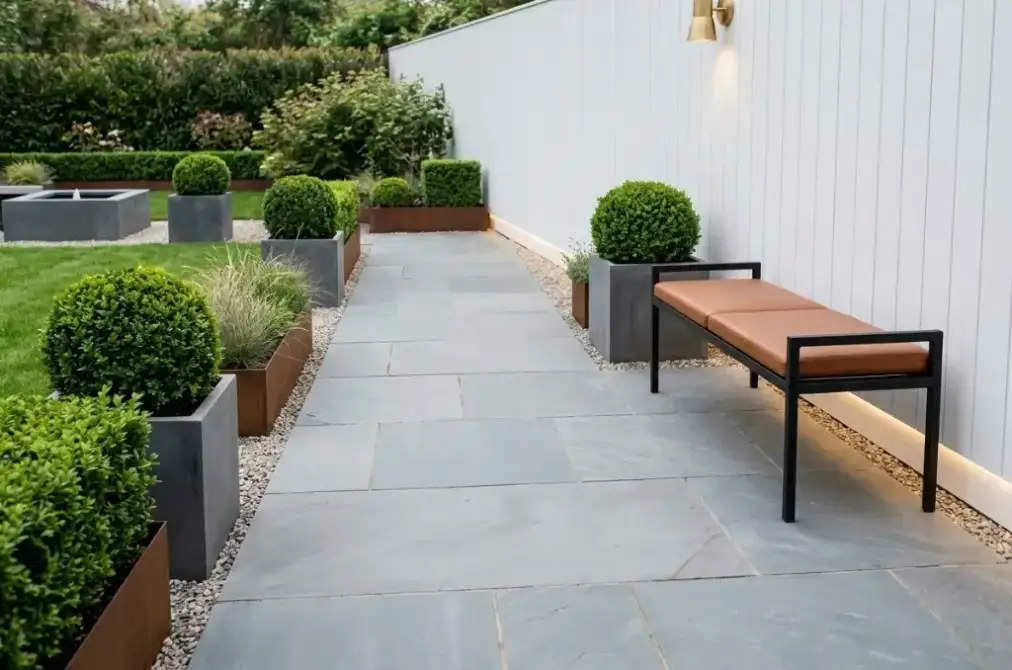

The "before" is the kind of neglected side-return most of us have hidden somewhere: a cracked, sunken slab of concrete swallowed by weeds, flanked by a rotting grey timber fence, a toppled terracotta pot, a rusting metal chair, and edging that has corroded into flakes. It is dark, damp, and easy to write off as dead space. And yet it is also pure potential — a long, private ribbon of garden just waiting for a path worth walking. So instead of settling on one fix, we ran that exact same crumbling walkway through twelve complete designs — from crisp modern bluestone and Japanese zen gravel to English rose romance, Mediterranean tile, mid-century tropical, and a candlelit Moroccan riad. Every image below is a true before-and-after of the same narrow path. Treat them as a planning tool: find the mood that fits your climate, your light, and the way you live, then steal the specific moves that make it work. If you enjoy this one-space-many-ways format, see how we brought a gloomy concrete courtyard to life and reimagined eleven neglected backyards as outdoor rooms.
What’s Inside
- Modern Bluestone Minimalist
- Warm Contemporary with Hidden Light
- Japandi Moss Garden
- Japanese Zen Dry Garden
- English Lavender Cottage
- Mediterranean Dry Garden
- Modern Formal Parterre
- Coastal Native Boardwalk
- Mediterranean Azulejo Courtyard
- Mid-Century Modern Tropical
- English Rose Garden
- Moonlit Moroccan Riad
- Pro Tips & Advice
- Final Result & Atmosphere
- Conclusion
- Frequently Asked Questions
- Sources & Further Reading
1. Modern Bluestone Minimalist
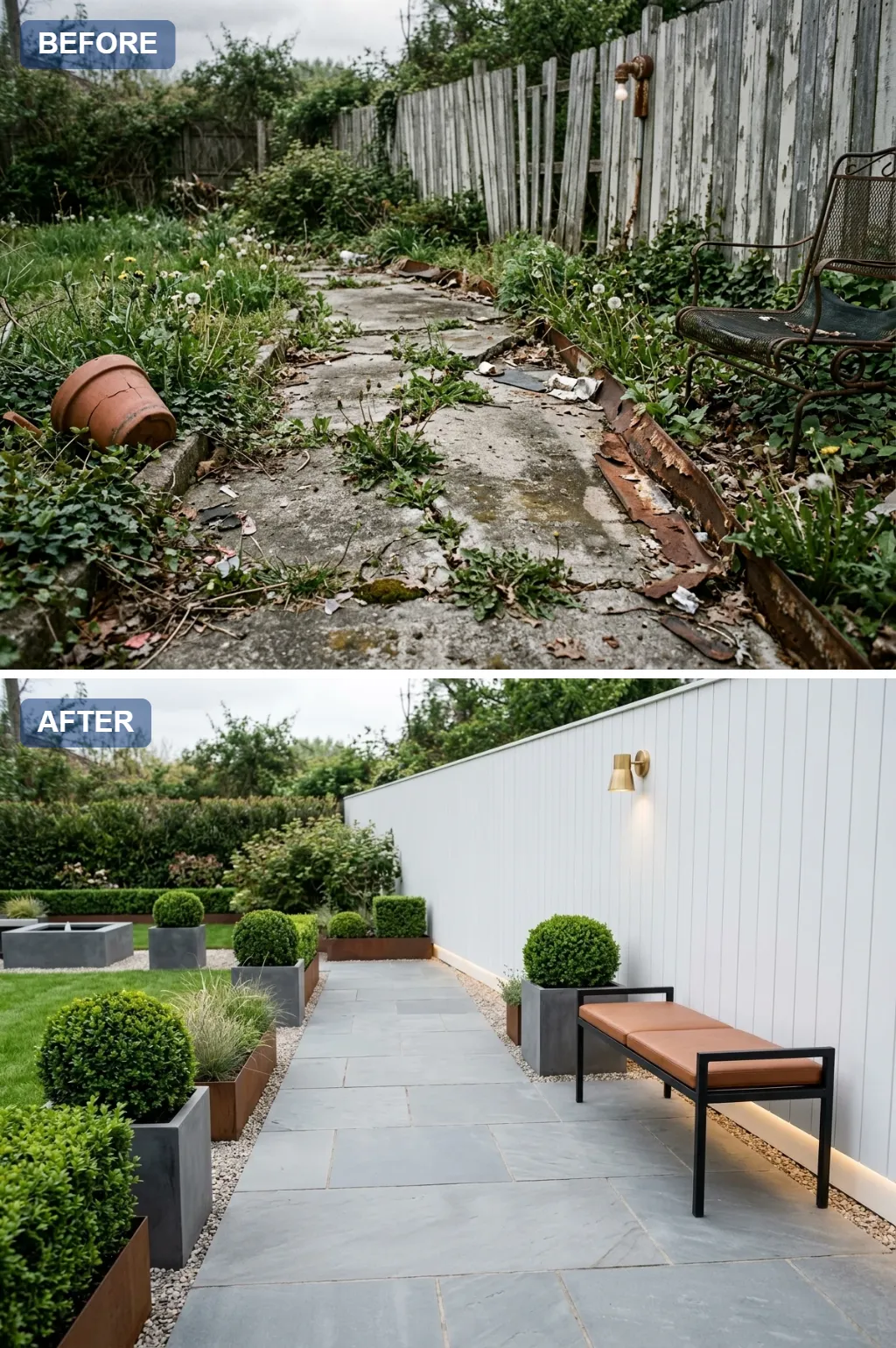
The cleanest, most contemporary direction — and the one that makes the cracked slab look like it was never there. Large-format grey bluestone pavers are laid in a crisp running bond and edged with a slim band of pale gravel, so the walk reads calm and architectural. The rotten timber fence is replaced by a smooth white vertical-slat screen that bounces light down the narrow side-return, and clipped boxwood balls in raw-concrete and corten planters march along the border in perfect repetition. A black powder-coated steel bench with a single cognac-leather cushion gives you a reason to pause, a discreet brass sconce warms the wall, and a hidden LED strip grazes the ground beneath the bench and planters so the whole run glows softly after dark.
Color Palette
Cool honed stone in a crisp running bond
Vertical slats that bounce light down the path
Clipped spheres repeated for quiet rhythm
A warm cushion against the black steel bench
Inspiration Tips for Similar Spaces
- Repetition is the whole trick: a row of identical clipped boxwood balls in matching planters turns a plain side-return into something that looks professionally designed, for very little money.
- Clad a tired boundary fence in a pale, uniform colour — it instantly widens a narrow path, reflects light into a dark corridor, and gives every plant a clean backdrop.
2. Warm Contemporary with Hidden Light
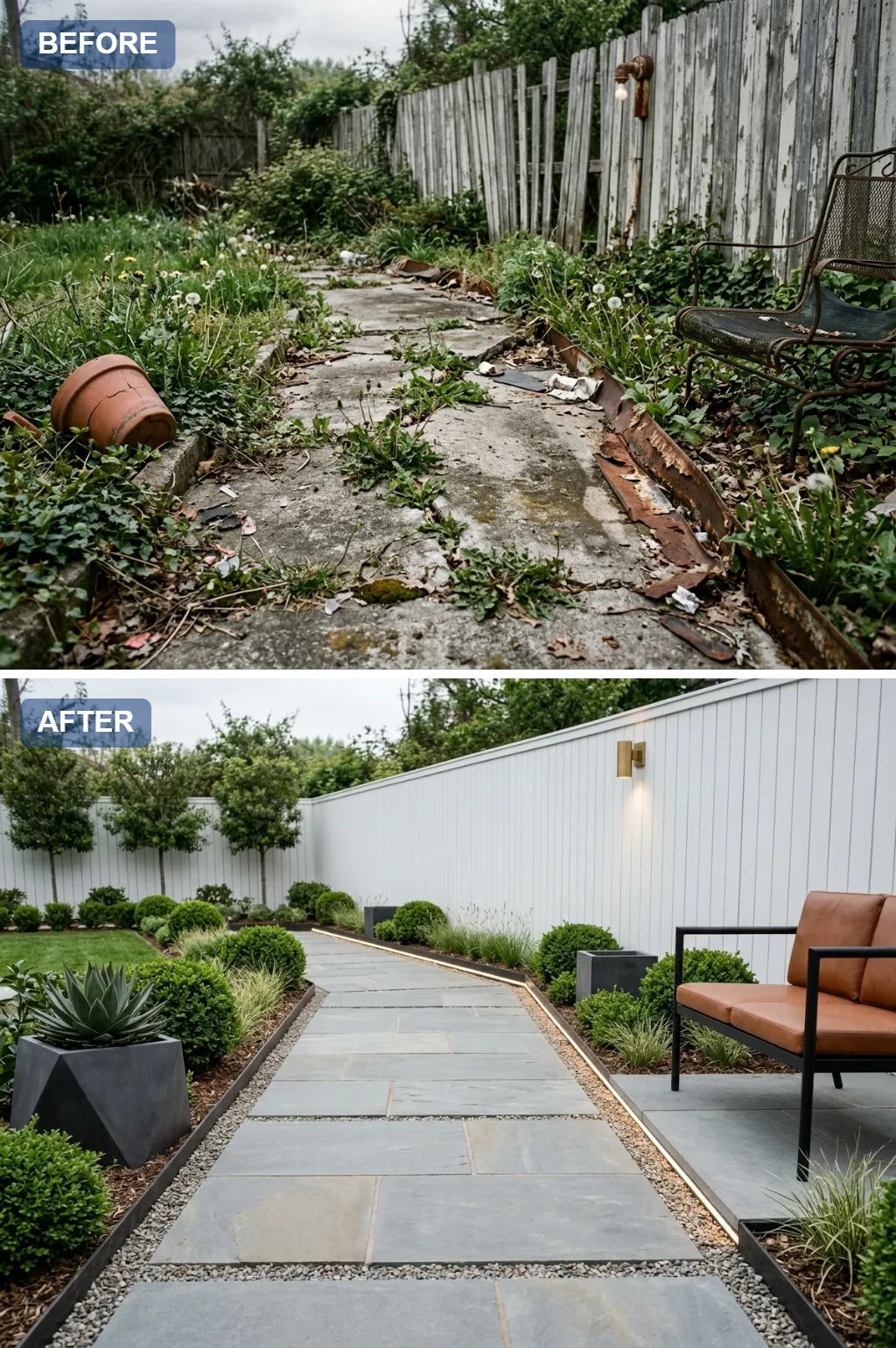
A slightly warmer, more planted cousin of the first scheme. The same grey bluestone slabs run the length of the path, but here they are separated by narrow ribbons of pale gravel and lit along both edges by a recessed LED strip that draws a glowing line into the distance. A sculptural faceted-concrete planter holds a spiky agave as a living piece of art, standard and pleached trees give privacy above the white slat fence, and boxwood and feather grasses soften the base. Instead of a bench, a low cognac-leather sofa on a slim black frame turns the end of the walk into a proper outdoor seat — the kind of spot you carry a coffee to on a Saturday morning.
Color Palette
Large slabs split by ribbons of gravel
A soft margin that frames every paver
A recessed strip drawing a line of light
A low cognac sofa on a black steel frame
Inspiration Tips for Similar Spaces
- Run a recessed LED strip along the very edge of a path rather than up on posts — the light washes the ground, guides your step, and looks architectural without a single visible fixture.
- One sculptural specimen plant (an agave, a phormium) in a faceted planter does more for a modern garden than a dozen small pots; give it space and let it be the focal point.
3. Japandi Moss Garden
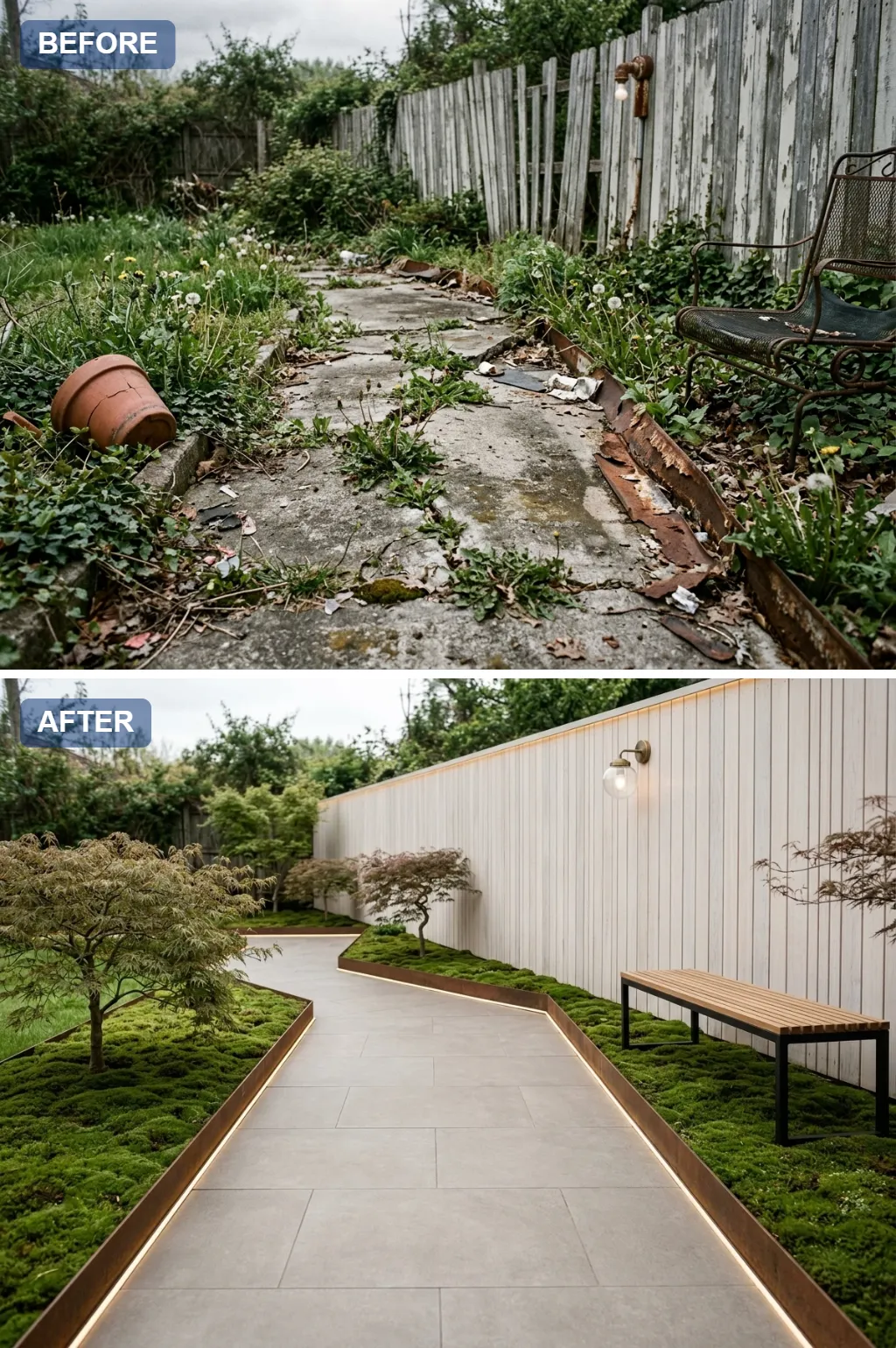
Serene, green, and quietly luxurious. Large pale-grey porcelain pavers float up the centre of the path, edged on both sides by weathering corten steel with a hidden LED strip tucked beneath the lip — a warm line of light that seems to make the walkway hover. Instead of lawn, a soft carpet of moss rolls out on either side, punctuated by delicate Japanese maples whose fine foliage filters the light. A whitewashed timber slat fence keeps the backdrop calm, a brass globe sconce adds a small warm note, and a minimalist slatted-wood bench on a black frame gives you a place to sit and do absolutely nothing. It is the most restful walk of the twelve.
Color Palette
Large soft-grey slabs, matte and calm
Warm rusted edges hiding an LED strip
A living carpet in place of thirsty lawn
The fine foliage of a Japanese maple
Inspiration Tips for Similar Spaces
- Corten (weathering) steel edging is the Japandi secret weapon — its warm rust tone flatters both grey stone and green planting, and it needs zero maintenance as it patinas.
- If your side-return is shaded and damp, lean into it: moss thrives where grass sulks, giving lush, low-water green with almost no mowing or upkeep.
4. Japanese Zen Dry Garden
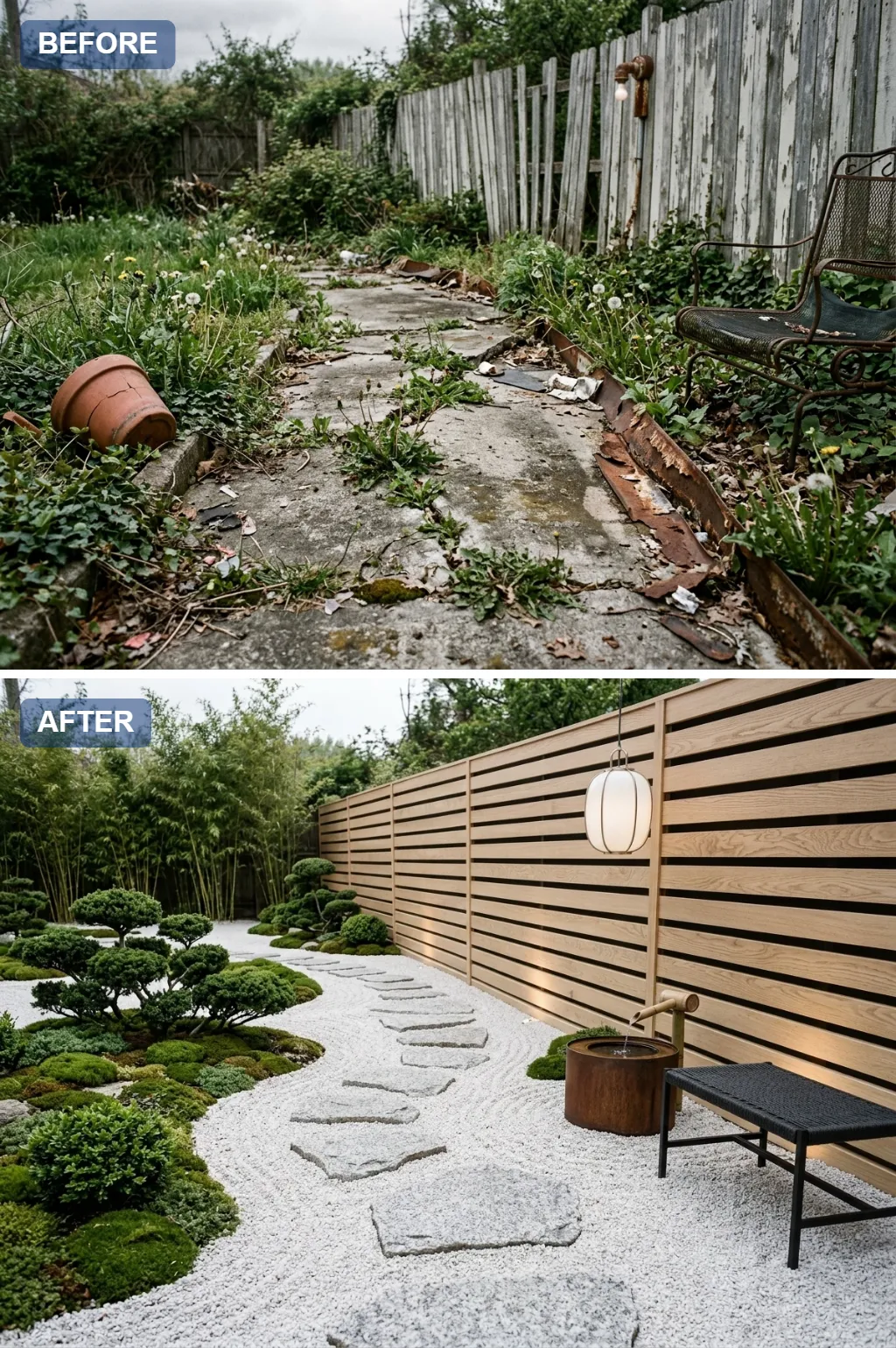
The boldest reinvention of the plot — a true karesansui, or dry landscape. Rather than paving the whole path, this version rakes a sea of white gravel around irregular natural-stone stepping stones, so every walk becomes a small, deliberate ritual. Cloud-pruned niwaki shrubs and cushions of moss form the "islands," a grove of bamboo screens the boundary, and a horizontal cedar slat fence — softly backlit — replaces the rotten pickets. A silk lantern hangs overhead for evening glow, a traditional bamboo spout trickles into a copper basin, and a low black bench waits at the end. This is a garden you contemplate as much as cross.
Color Palette
Pale stones combed into calming lines
Horizontal timber slats, gently backlit
Cloud-pruned shrubs and mounded moss
A trickling spout and hanging lantern
Inspiration Tips for Similar Spaces
- Stepping stones set in raked gravel slow you down on purpose — space them a natural stride apart so the path guides your pace and turns a short walk into a moment of calm.
- A small recirculating water feature — a bamboo spout into a stone or copper basin — adds gentle sound that masks street noise and brings a dry gravel garden to life.
5. English Lavender Cottage
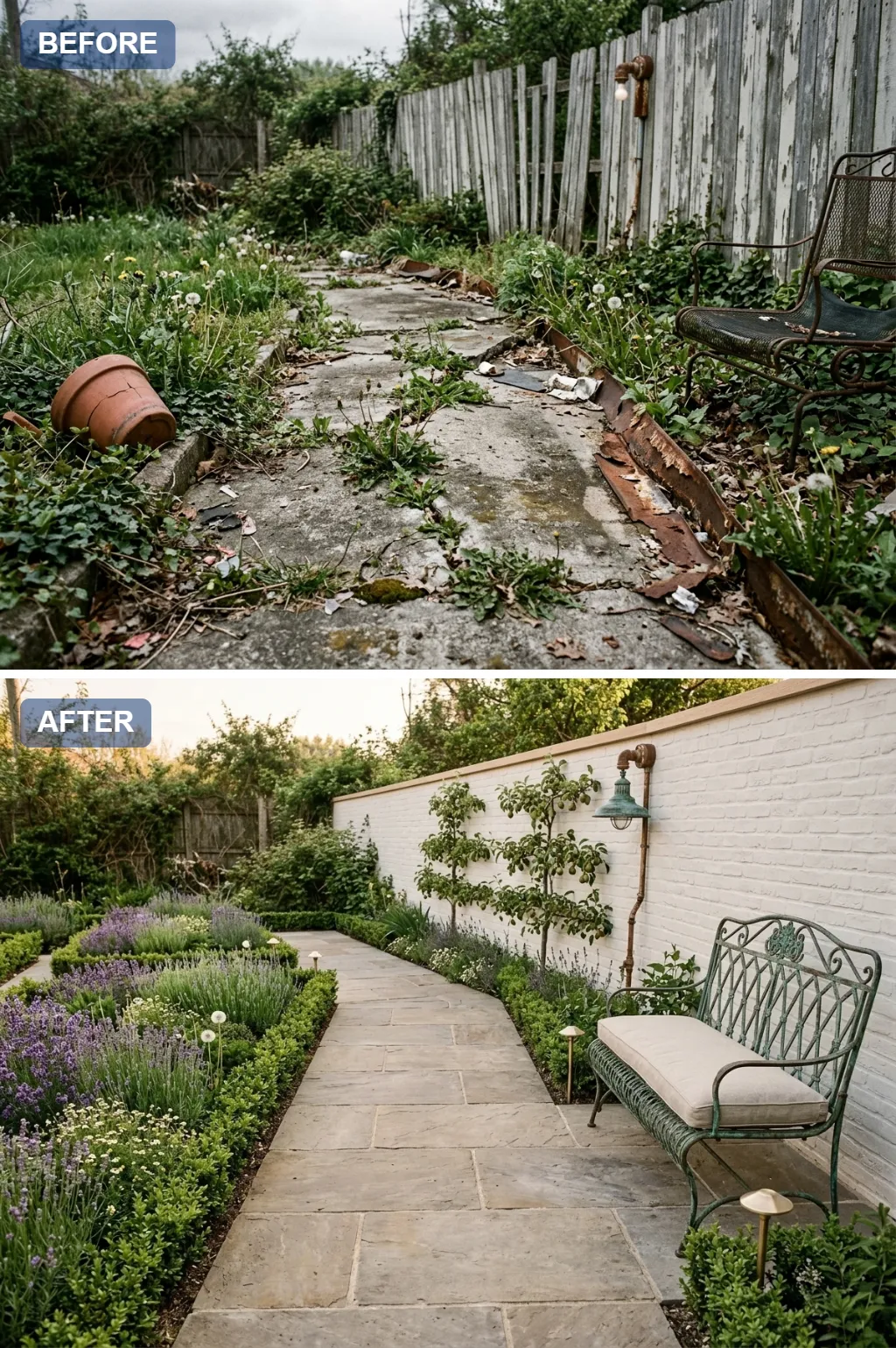
Pure Provençal-meets-English romance, shot in golden evening light. Aged, tumbled sandstone flags — irregular and softly worn — pave the walk so it feels a century old. On one side, a lavender parterre edged in clipped boxwood spills scent and colour over the path; on the other, an espaliered pear is trained flat against a whitewashed brick wall. A verdigris wrought-iron bench with a plump cream cushion invites you to sit among the bees, a weathered copper wall lantern throws warm light, and low brass path-lights guide the way at dusk. It is the walk that smells as good as it looks.
Color Palette
Warm, worn flags that feel a century old
Fragrant rows edged in clipped box
A soft limewashed backdrop for espalier
An antique bench and copper lantern
Inspiration Tips for Similar Spaces
- Edge a loose, romantic planting like lavender with a crisp clipped-box hedge — the tailored green frame stops a cottage border tipping into messy and keeps it looking intentional all year.
- Choose a naturally aged paving (tumbled sandstone, reclaimed York stone) for instant character; sharp-edged new slabs fight the soft, timeworn mood a cottage garden depends on.
6. Mediterranean Dry Garden
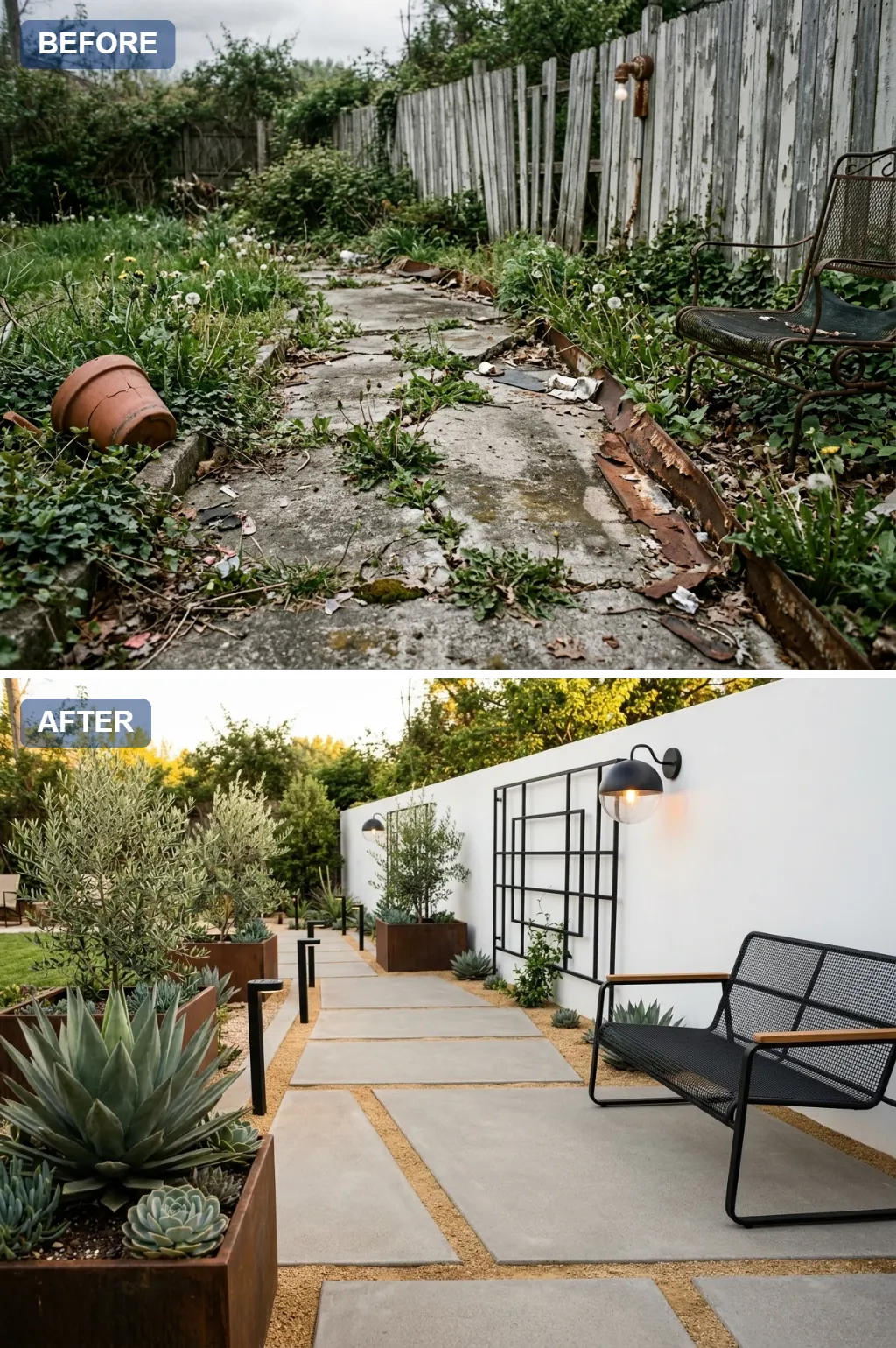
Sun-baked, architectural, and gloriously low-water. Large concrete slabs are set into a bed of golden decomposed granite, the gravel joints giving the path a warm, informal edge. Corten-steel raised beds brim with silvery agave, rosette echeveria, and a young olive tree, while a smooth white rendered wall — dressed with a black geometric grid trellis for climbers — reflects the heat and light. Black globe wall-sconces and slim bollard lights handle the evening, and a modern black-mesh bench with timber arms offers a shaded perch. It is the scheme for a hot, dry, forget-to-water kind of garden.
Color Palette
Pale slabs set in golden decomposed granite
Rusted raised beds for structure and warmth
Drought-proof succulents and a young olive
A bright backdrop with a black grid trellis
Inspiration Tips for Similar Spaces
- Fill a hot, exposed path with drought-tolerant succulents (agave, echeveria, olive) — they thrive on neglect and full sun, and their sculptural shapes suit a modern scheme far better than thirsty bedding.
- Decomposed granite between pavers is cheaper than mortar, drains instantly, and gives a Mediterranean garden that soft, sun-warmed informality — just add a firm edge to keep it in place.
7. Modern Formal Parterre
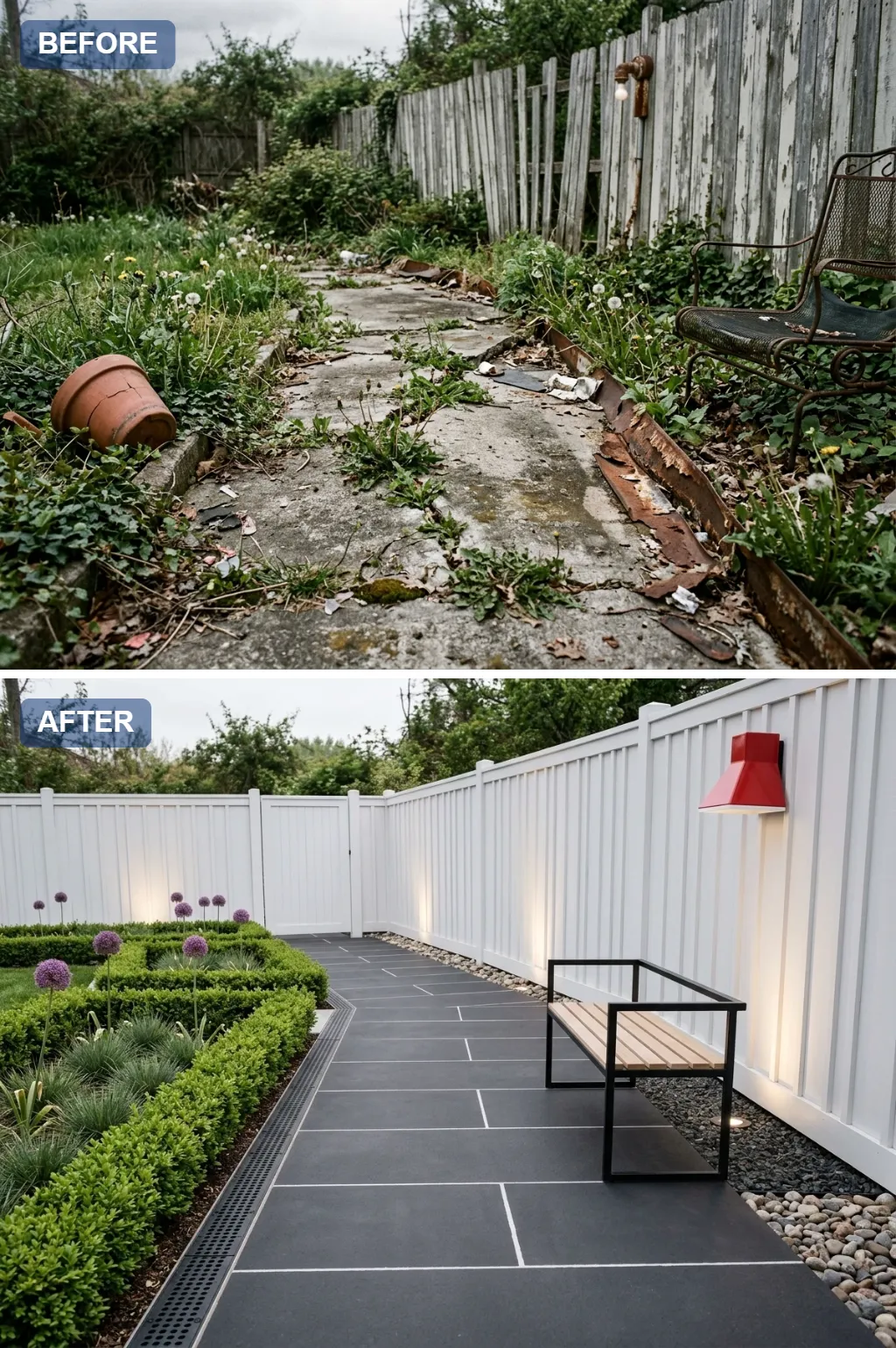
Crisp, tailored, and architecturally confident. Big charcoal porcelain pavers with fine white grout lines form a razor-sharp walk, edged by a slim channel drain and a border of river pebbles set with recessed spotlights. Beside it, a low boxwood knot garden — clipped into neat compartments and studded with purple allium drumsticks — brings formal geometry, while a crisp white vertical-board fence, softly grazed by hidden uplights, glows at night. The single stroke of daring is a bold red wall sconce that pops against all that monochrome, and a slatted-wood bench on a black frame keeps things comfortable.
Color Palette
Dark slabs with fine white grout lines
A clipped knot garden for formal structure
Board fencing grazed with hidden uplight
One bold sconce against the monochrome
Inspiration Tips for Similar Spaces
- One shot of a strong accent colour — a red light, a cobalt pot — reads as deliberate and designed against a disciplined black-and-white scheme; use it once, not everywhere.
- Graze a plain fence with hidden uplights placed close to its base: the light rakes across the surface and turns an ordinary boundary into a glowing backdrop after dark.
8. Coastal Native Boardwalk
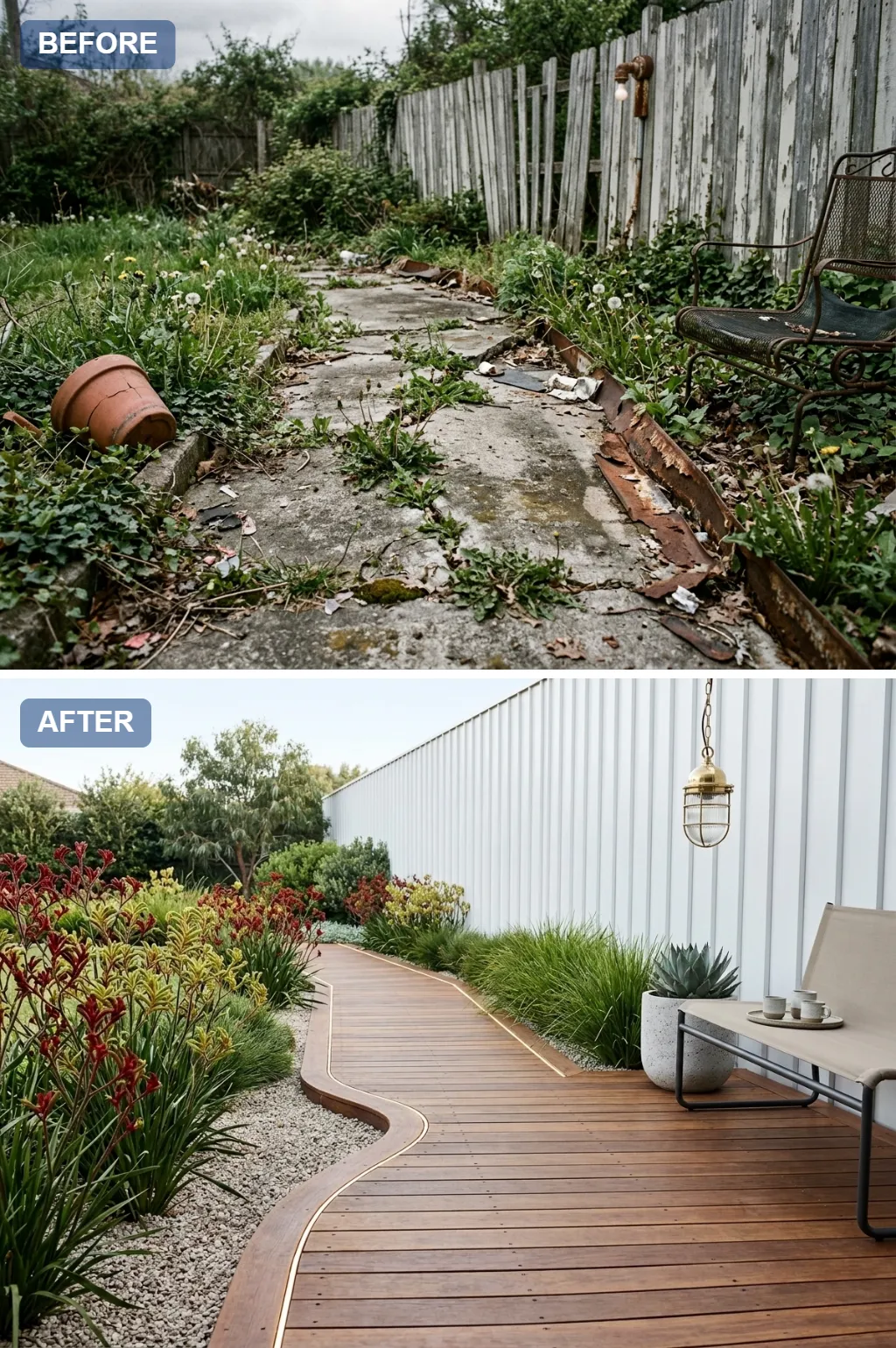
Relaxed, sculptural, and full of movement. Here the hard paving gives way to a gently curving hardwood boardwalk — warm spotted-gum decking that sweeps through the garden, its curved edge traced by a hidden LED strip. A crisp white corrugated-metal fence nods to the beach house, a brass caged bulkhead pendant adds a nautical wink, and the planting does the talking: fiery red-and-green kangaroo paw, feathery ornamental grasses, and a spiky agave in a speckled concrete pot. A low sling sofa with a small table turns the deck into a sundowner spot. It is coastal without a single seashell in sight.
Color Palette
Warm curved hardwood traced with LED
Crisp corrugated metal, beach-house clean
Fiery natives and feathery grasses
A caged bulkhead pendant for a nautical note
Inspiration Tips for Similar Spaces
- A curved timber boardwalk feels far more relaxed and generous than a straight paved path — the gentle sweep slows you down and makes even a narrow side-return feel like a journey.
- Plant hardy natives and ornamental grasses for a coastal look that moves in the breeze, shrugs off wind and salt, and needs almost no watering once established.
9. Mediterranean Azulejo Courtyard
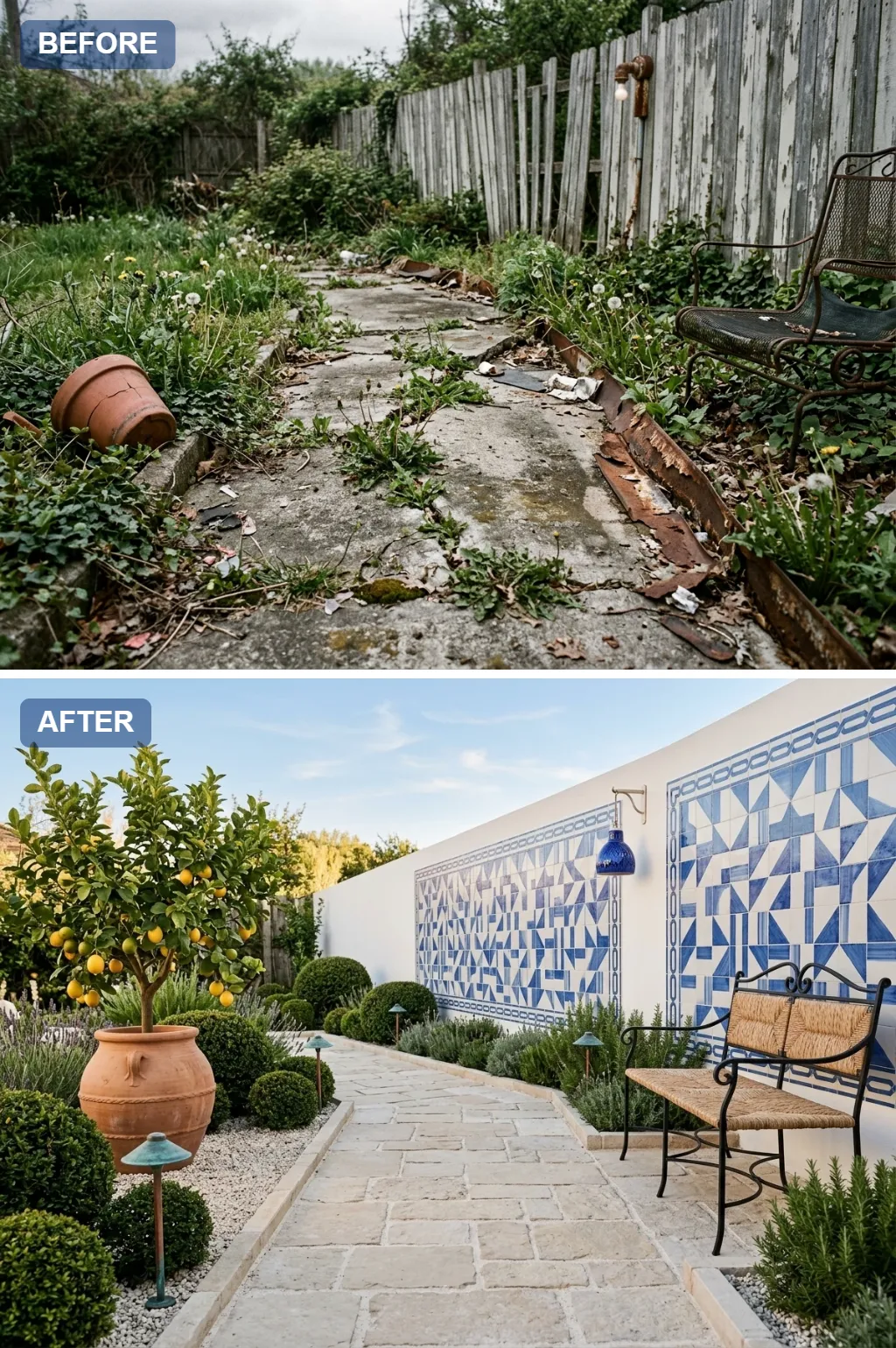
A sun-drenched slice of the Portuguese and Spanish coast. Aged limestone cobbles — softly rounded and pale gold — pave the walk, while the star is the wall: a panel of hand-painted blue-and-white azulejo tiles set into white stucco, turning a plain boundary into a work of art. A lemon tree heavy with fruit sits in a fat terracotta olive jar, lavender and clipped boxwood and rosemary scent the edges, and a wrought-iron bench with a woven rush seat waits in the shade. A little blue ceramic sconce and verdigris path-lights complete the picture under a bright Mediterranean sky.
Color Palette
Pale, rounded stones warmed by the sun
Hand-painted blue-and-white tile on stucco
A fruiting lemon in a fat clay olive jar
Lavender, rosemary, and clipped box
Inspiration Tips for Similar Spaces
- A single panel of patterned tile (azulejo, zellige, encaustic) turns a blank wall into the focal point of a courtyard — more impact, and less upkeep, than trying to plant your way out of a bare boundary.
- A potted citrus in a large terracotta jar is the fastest shortcut to a Mediterranean mood; move it under shelter over winter in cooler climates and it will earn its keep for decades.
10. Mid-Century Modern Tropical
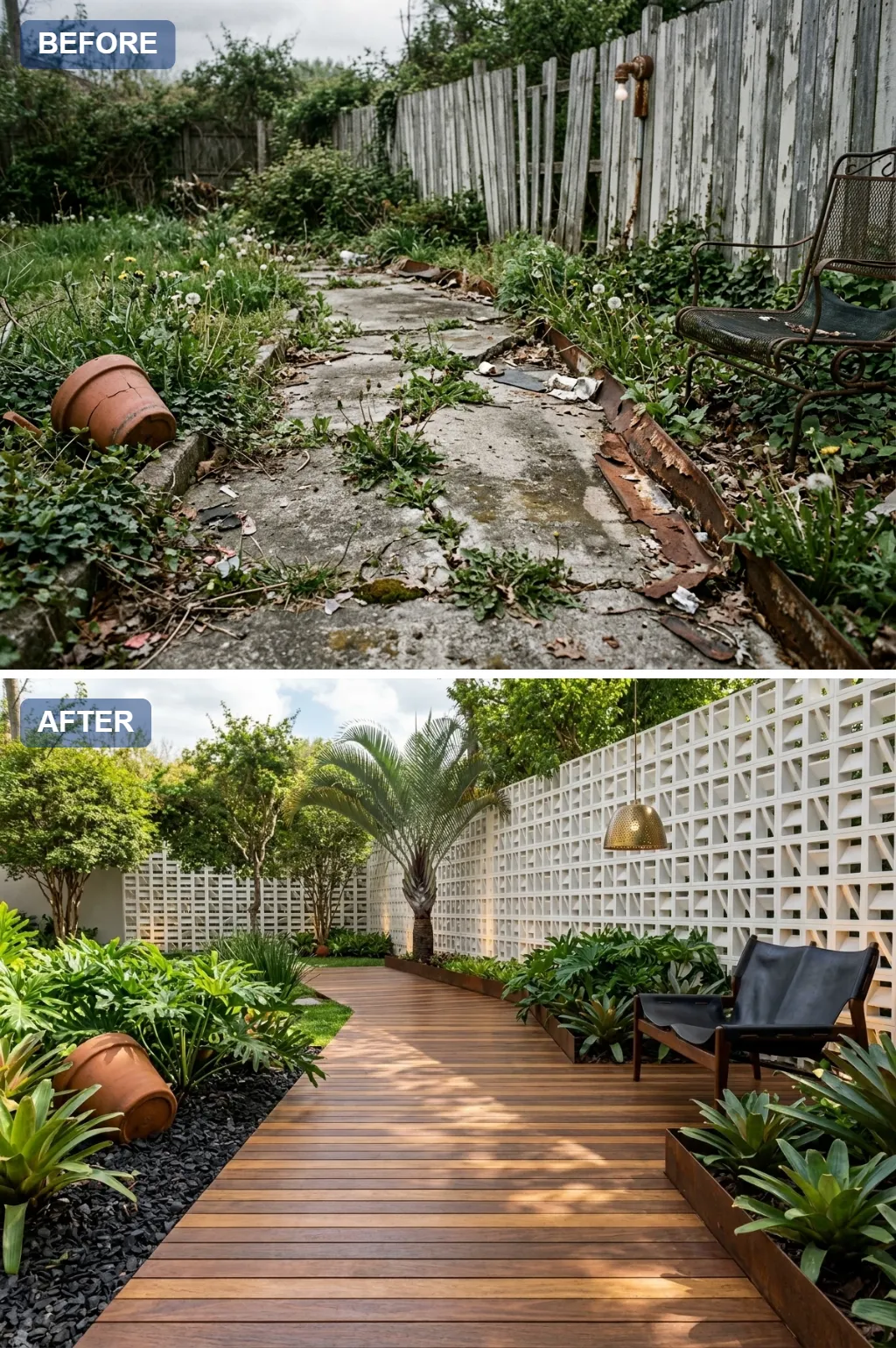
Palm Springs by way of the tropics. A warm hardwood boardwalk runs between beds of lush, big-leaved planting — bromeliads, philodendron, and a feature palm — all mulched in dramatic black volcanic rock. The signature move is the wall: a screen of crisp white breeze-blocks, that iconic mid-century device, which filters light and air while keeping privacy. A perforated brass pendant throws patterned shadows, corten-steel raised beds add warmth, and a black leather-and-timber safari chair is pure 1960s cool. It is a bold, architectural, holiday-every-day kind of walk.
Color Palette
A honey-toned timber boardwalk
The iconic mid-century pierced wall
Bromeliads, philodendron, and a palm
Dark stone that makes green foliage pop
Inspiration Tips for Similar Spaces
- A breeze-block (screen-block) wall is the ultimate mid-century move — it gives privacy and shade while still letting light and breeze through, so a narrow path never feels boxed in.
- Mulch tropical beds with black volcanic rock rather than bark: the dark stone makes green foliage read as electric, suppresses weeds, and never needs topping up.
11. English Rose Garden
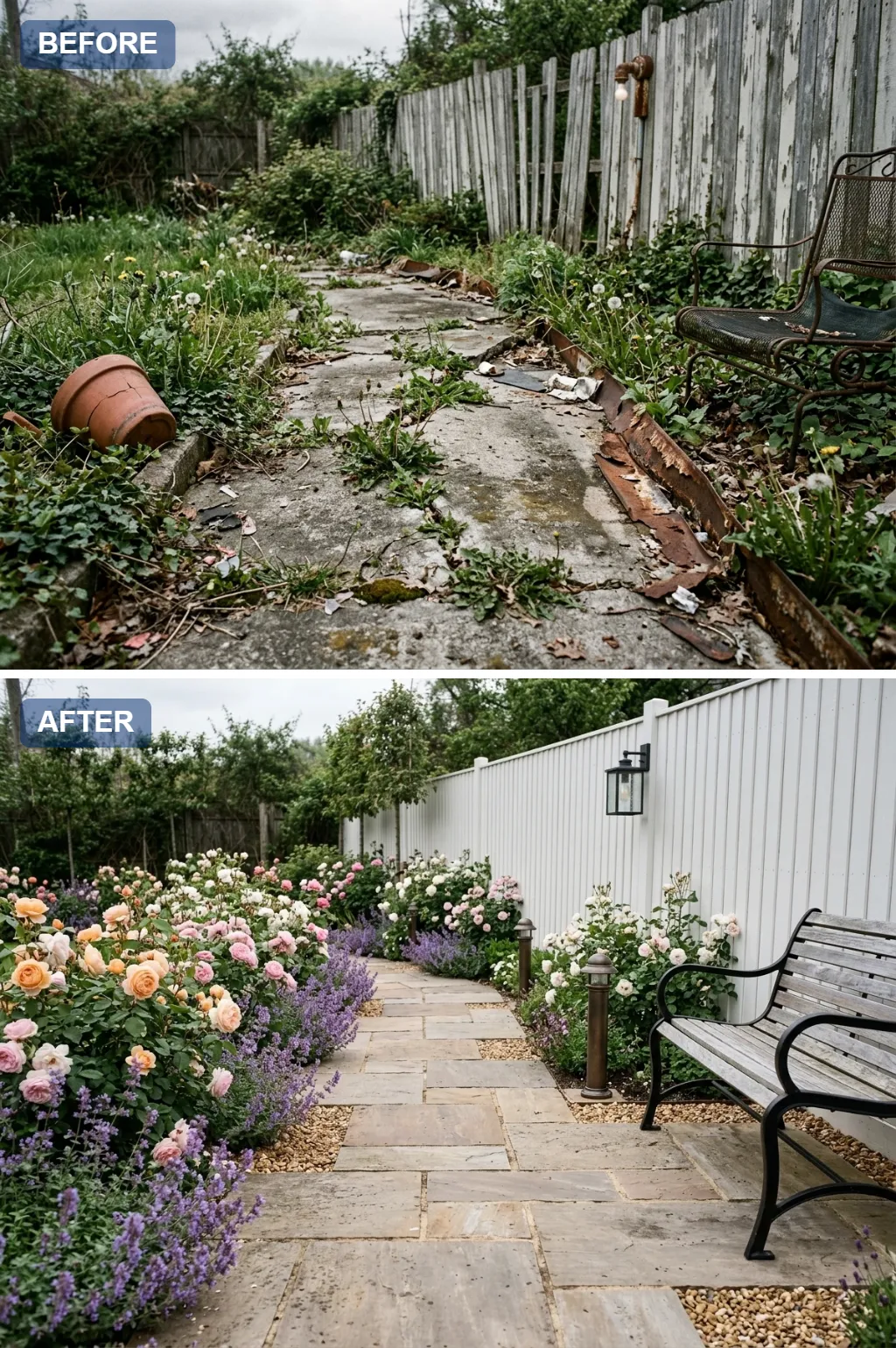
The most romantic walk of them all, in full June bloom. Riven sandstone flags with soft gravel joints wind between billowing borders of English roses — peach, blush, and cream David Austin blooms — underplanted with hazy purple catmint that spills over the edges and hums with bees. A crisp white board fence keeps the backdrop clean and lets the flowers sing, a classic black lantern lights the wall, and a weathered teak-and-cast-iron park bench sits ready for a slow afternoon. Bronze bollard lights line the route for evening strolls. It is unashamedly pretty, and all the better for it.
Color Palette
Softly textured flags with gravel joints
Blowsy David Austin blooms in warm tones
Hazy nepeta spilling over the edges
A crisp backdrop that lets the roses sing
Inspiration Tips for Similar Spaces
- Underplant leggy roses with a froth of catmint or hardy geranium — it hides bare stems, softens every edge, flowers for months, and turns a stiff rose bed into a romantic tumble.
- Keep the hardscape and boundary simple and pale when the planting is this busy; a clean white fence and quiet stone let a riot of roses take centre stage.
12. Moonlit Moroccan Riad
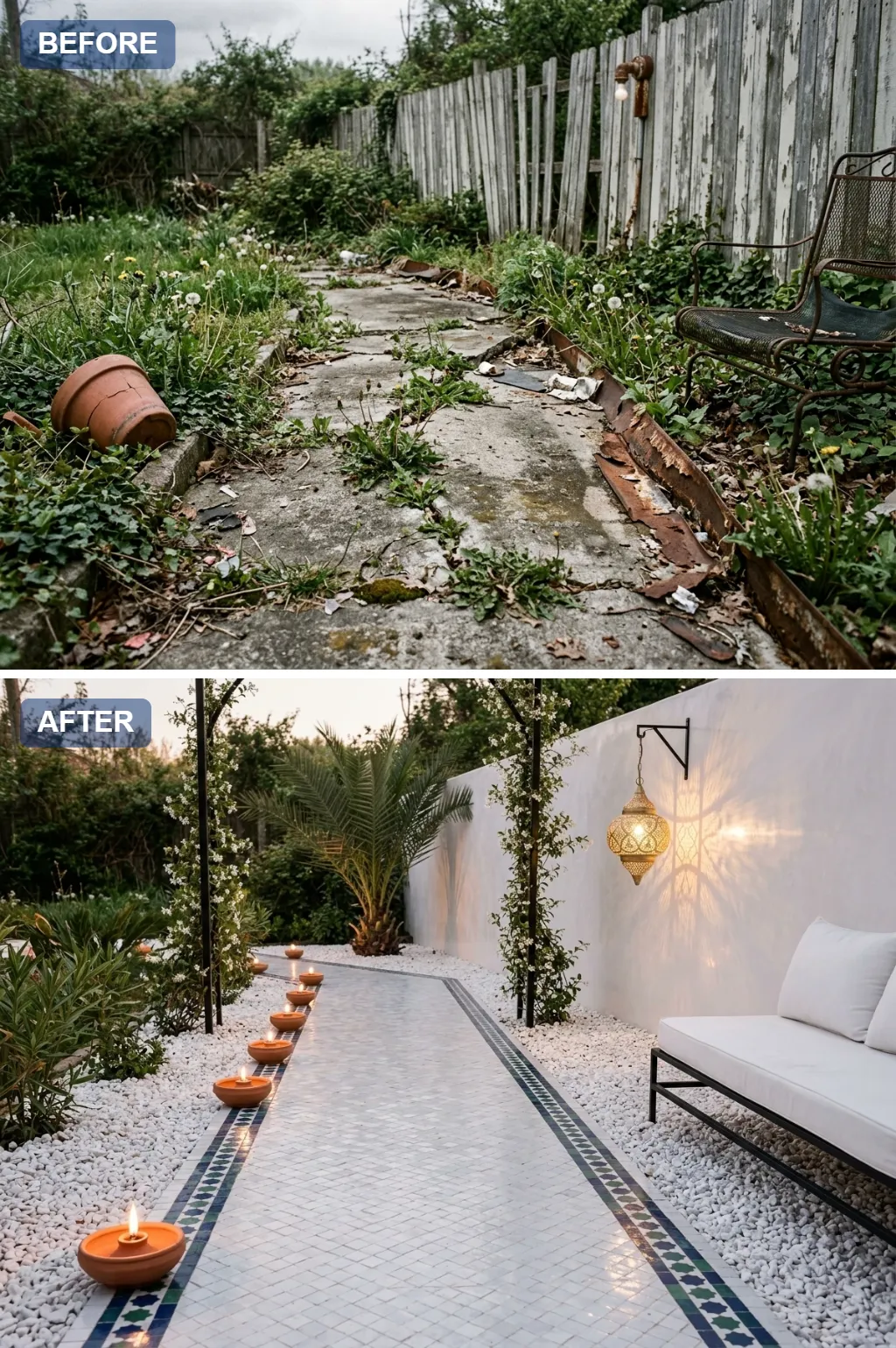
We end after dark, with the most atmospheric transformation of all. A slender runner of white zellige mosaic — bordered by an intricate blue-and-green geometric band — threads through a bed of pale pebbles like a jewelled carpet. Warm tadelakt plaster walls glow in the light of a pierced-brass Moroccan lantern that throws lace-like shadows across the surface, terracotta oil lamps flicker in a line along the path, and jasmine climbs black metal arches overhead, scenting the evening air. A date palm sways beyond, and a low white-cushioned sofa waits for mint tea. This is the "moonlit stone serenade" made real.
Color Palette
A white tiled runner with a jewelled border
An intricate blue-green geometric band
Glowing hand-polished lime plaster
Pierced metal throwing lace-like shadows
Inspiration Tips for Similar Spaces
- Lay a decorative tiled "runner" down the centre of a plain pebble or gravel path — a strip of patterned zellige or encaustic gives the drama of a fully tiled floor at a fraction of the cost.
- Layer real flame into an evening garden — terracotta oil lamps along a path, plus a pierced lantern casting patterned shadows on a pale wall — for more romance than any electric light.
Pro Tips & Advice
- Fix the base before the beauty. A path is only as good as what is under it: excavate to a firm sub-base, lay compacted hardcore and sharp sand or mortar, and build in a slight fall (about 1 in 60–80) so water runs off and away rather than pooling or heaving the surface in winter.
- Sort the drainage and edging. Most "before" paths fail because water had nowhere to go; a channel drain, permeable gravel joints, or a simple soakaway keeps a new walk sound, and a firm edge (steel, brick, or timber) stops pavers creeping and gravel wandering.
- Mind the width and the journey. A comfortable path for one person is about 900mm–1.2m; where you can, let it curve or step rather than run dead-straight, so a short side-return feels like a considered route instead of a corridor.
- Light it in layers. Low path-lights or a recessed LED strip for safe footing, a warm wall sconce or lantern for atmosphere, and a graze of uplight on the fence or a feature plant — good lighting is what lets you actually use a walkway after dark.
- Green the vertical, not just the ground. In a narrow space the walls and fence are your biggest canvas: espaliered fruit, climbers on wires, a tiled panel, or a breeze-block screen add privacy, scent, and beauty without stealing an inch of path.
Final Result & Atmosphere
- Run one crumbling slab through twelve designs and the lesson is impossible to miss: the path never got wider, the plot never changed shape, and the fence line stayed exactly where it was. The cracked concrete and the rusted chair were never the real problem — the space always had the bones. Every version simply chose to see them.
- Whether the mood is architectural bluestone, a raked zen garden, a rose-filled cottage border, or a candlelit Moroccan runner, the payoff is the same. You stop hurrying past the side-return and start looking forward to the walk — coffee in hand at dawn, or a slow, lamplit stroll after dinner.
- Pick the single direction that matches how you actually live — your climate, your light, how much upkeep you want — borrow the two or three moves that make it sing, and let a forgotten strip of concrete become the most romantic few steps in the whole garden.
Conclusion
A cracked, weed-choked path down the side of the house is one of the easiest features to ignore — and, as these twelve before-and-afters show, one of the most rewarding to reclaim. The moves that matter stay consistent across every style (get the sub-base and drainage right, choose a paving that suits your climate, add a firm edge, plant the vertical as well as the ground, and light it in layers); the personality is entirely yours. Save the two or three directions that suit your space and the way you live, borrow the specific pieces that make them work, and remember you are not starting from nothing — you are starting with a private, ready-made ribbon of garden. For more outdoor reinventions, see how we turned wild weeds into Tuscan terraces and reimagined a crumbling rooftop slab as a Mediterranean outdoor kitchen.
Frequently Asked Questions
How much does it cost to replace a garden path?
It ranges hugely with materials and size. A simple gravel or budget-slab path over a sound base sits at the modest end; natural stone such as bluestone or sandstone, porcelain, or a hardwood boardwalk cost considerably more per square metre, and hand-laid mosaic or specialist tiling more again. The biggest hidden costs are the groundwork — excavation, sub-base, and drainage — which stay much the same whatever surface you choose on top, so price those first.
Which of these styles is the most low-maintenance?
The modern bluestone, charcoal porcelain, and Mediterranean gravel schemes are the most forgiving: sealed stone and porcelain just need an occasional wash, and drought-tolerant planting (agave, olive, lavender) barely needs watering. The moss garden, rose border, and clipped parterres are the most demanding, since living carpets and formal hedges want regular attention to stay sharp.
How do I stop weeds growing back through a new path?
The key is what goes underneath. Excavate properly, lay a compacted sub-base with a quality weed membrane, and either mortar the joints or fill them with a polymeric jointing sand or clean angular gravel that gives weeds nowhere to root. Weeds in an old path almost always came up through cracks and open joints, not through the paving itself.
What paving is best for a shady, damp side-return?
Textured, slip-resistant surfaces are safest where light is low and moisture lingers: riven sandstone, textured porcelain, or timber decking with anti-slip inserts all grip better than smooth polished stone. Good drainage and a slight fall matter even more in shade, and a pale paving or a light-coloured fence will bounce what light there is down the path.
Can I really fit a design like this down a narrow path?
Yes — every one of these transformations is the same slim side-return. The tricks are to keep the paving simple and continuous so the eye travels, plant the vertical surfaces rather than eating into the walkway, use one or two repeated elements instead of a jumble, and let the path curve or step where you can to add a sense of journey.
Do I need planning permission or a professional to redo a garden path?
For a straightforward like-for-like path at ground level, usually not — but rules vary by country and locality, and permeable surfaces are encouraged or even required in some areas to manage rainwater run-off. Always check local regulations, and bring in a landscaper or structural advice for anything involving retaining walls, significant level changes, or drainage tie-ins.
Sources & Further Reading
- Royal Horticultural Society (RHS) — guidance on paths, paving, drainage, and plant selection for shade, drought, and low-maintenance gardens.
- American Society of Landscape Architects (ASLA) — professional resources on hardscape design, grading, and sustainable, permeable paving.
- This Old House — practical how-to and cost guidance for laying stone, gravel, and paver walkways.
- U.S. Environmental Protection Agency (EPA) — guidance on permeable paving and managing stormwater run-off in residential landscapes.
- Architectural Digest & Gardens Illustrated — reference gardens across modern, Japanese, cottage, Mediterranean, and mid-century styles.

Comments
Loading comments…
Leave a comment
Your email won't be published — it's only used to let you know if we reply. Comments appear after approval.