
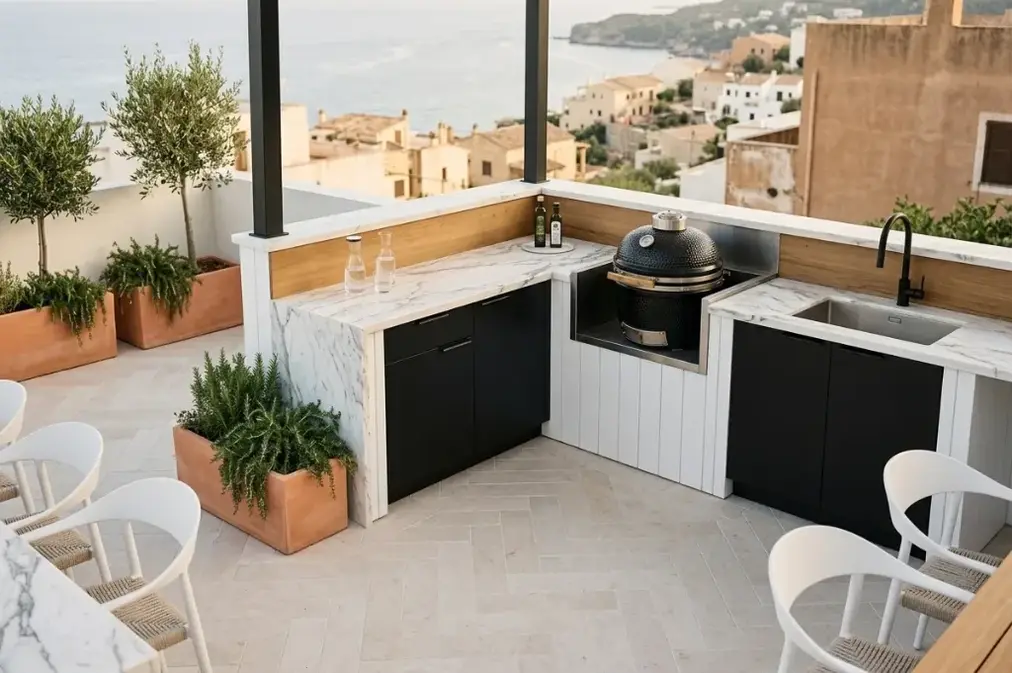

The “before” is the kind of space most people would simply lock the door on: an abandoned rooftop terrace with a rusted-out barbecue, cracked concrete underfoot, a shredded striped awning, and dead plants scattered across the slab. And yet it has the one thing you cannot renovate in — a breathtaking Mediterranean view, straight out over a whitewashed hillside village to the sea. So instead of committing to a single fix, we ran that exact same slab through eleven complete outdoor-kitchen designs — from sleek marble-and-black-steel modern to Provençal farmhouse, Japandi zen, desert Tulum, and a moody backlit onyx built for evening entertaining. Every image below is a true before-and-after of the same rooftop. Use them as a planning tool: find the direction that fits your climate and the way you cook and host, then steal the moves that make it work. If you like this one-space-many-ways format, see the same idea run through a dated kitchen reimagined twelve ways and a gloomy concrete courtyard brought to life.
What’s Inside
- Modern Marble & Black Steel
- Timeless Marble & Brass
- Mediterranean Farmhouse
- Coastal Hamptons Navy
- Coastal Minimalist
- Japandi Zen Garden
- Desert Modern (Tulum)
- Tropical Verde Marble
- Nocturnal Luxe
- Backlit Onyx Nightscape
- Industrial Asado
- Pro Tips & Advice
- Final Result & Atmosphere
- Conclusion
- Frequently Asked Questions
- Sources & Further Reading
1. Modern Marble & Black Steel
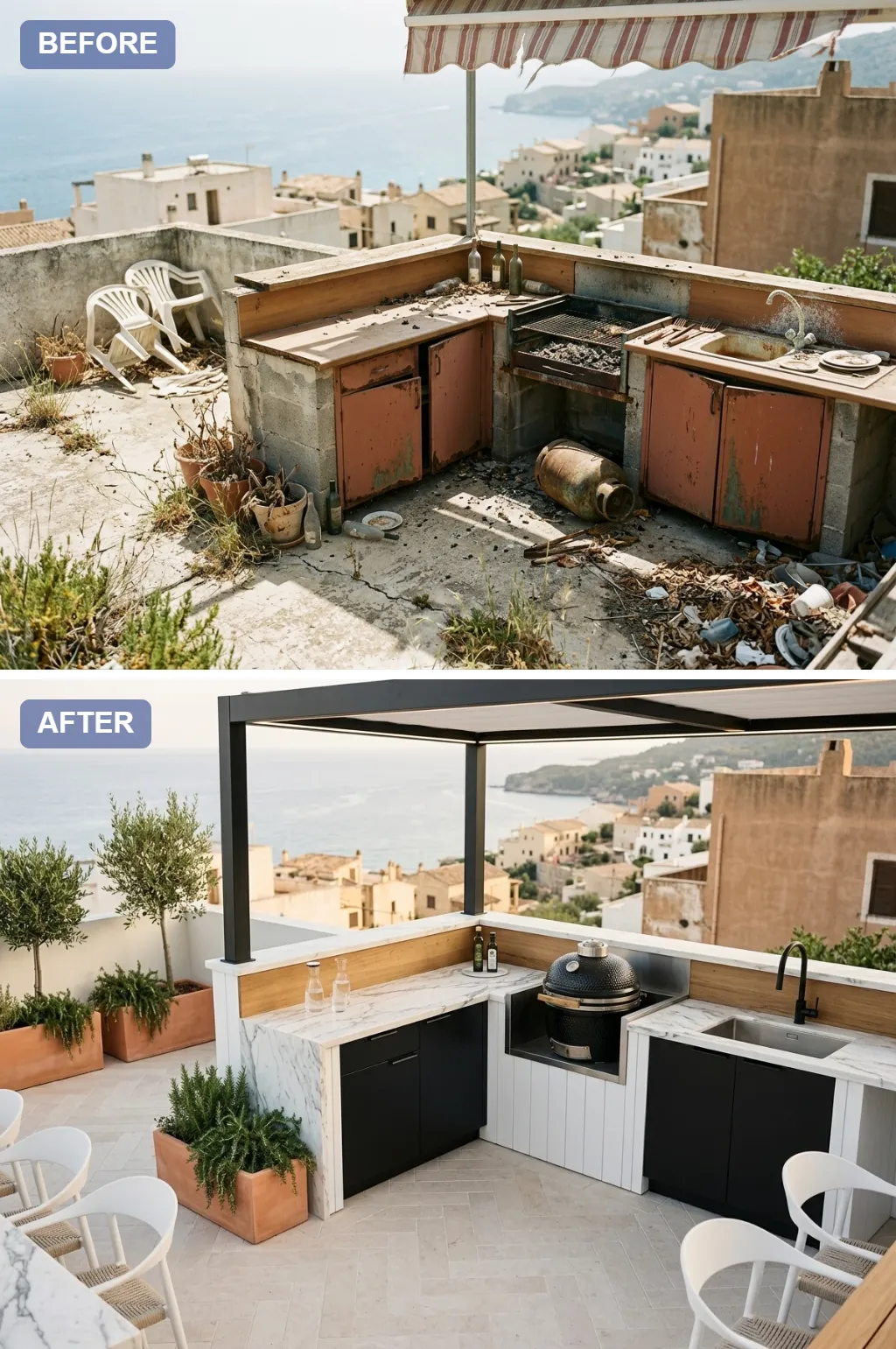
The cleanest, most contemporary direction — and the one that turns the ruined slab into a magazine-ready terrace. A slim matte-black steel pergola frames the sea view in place of the shredded striped awning, and the crumbling block base is rebuilt as a crisp L of white-oak-backed cabinetry with matte-black fronts and a book-matched Calacatta marble waterfall counter. A ceramic kamado grill drops into the run beside a black gooseneck tap and an undermount sink, olive trees and trailing rosemary soften the corners in terracotta troughs, and a set of white woven dining chairs pulls up to the marble. It reads calm, expensive, and effortless.
Color Palette
Sleek black fronts that ground the bright marble
Book-matched white marble with soft grey veining
A slim black pergola that frames the view
Silvery Mediterranean planting in terracotta
Inspiration Tips for Similar Spaces
- Rebuild a failed masonry base as a simple L-shaped run and let one luxury surface — a book-matched marble waterfall — carry the whole design; everything else can stay quiet.
- A slim matte-black pergola does double duty: it defines the "room" on an open roof and frames the sea view like a picture, without the bulk or upkeep of a solid roof.
2. Timeless Marble & Brass
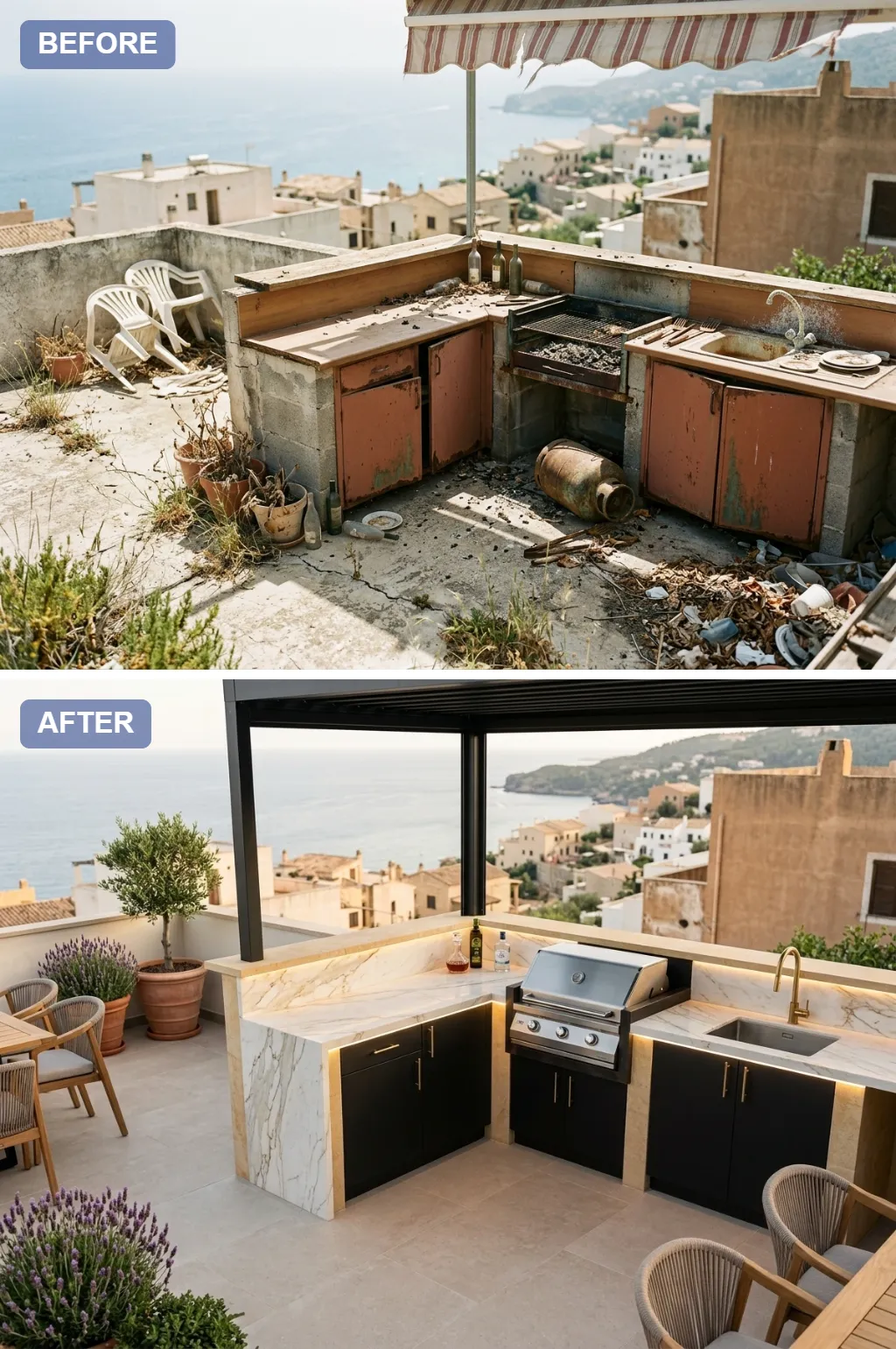
A warmer cousin of the modern scheme, shot in golden afternoon light. The same book-matched marble waterfall returns, but here it is paired with matte-black cabinets dressed in slim brass pulls and a single sculptural brass gooseneck tap that catches the sun. A built-in gas grill sits flush in the run, olive branches and pots of lavender scent the corner, and a proper teak dining set with cushions turns the roof into an outdoor dining room rather than just a cooking station. It is the version that will still look right in fifteen years.
Color Palette
Cream-toned marble that glows in afternoon sun
Deep near-black fronts for timeless contrast
A warm brass tap and pulls that patina beautifully
Warm teak dining furniture for a lived-in feel
Inspiration Tips for Similar Spaces
- Warm your metals: swapping black or steel fixtures for aged brass instantly makes a marble outdoor kitchen feel collected and Mediterranean rather than showroom-cold.
- Budget for a real dining set, not just bar stools — a cushioned teak table is what turns an outdoor "kitchen" into a place people actually linger long after the food is gone.
3. Mediterranean Farmhouse
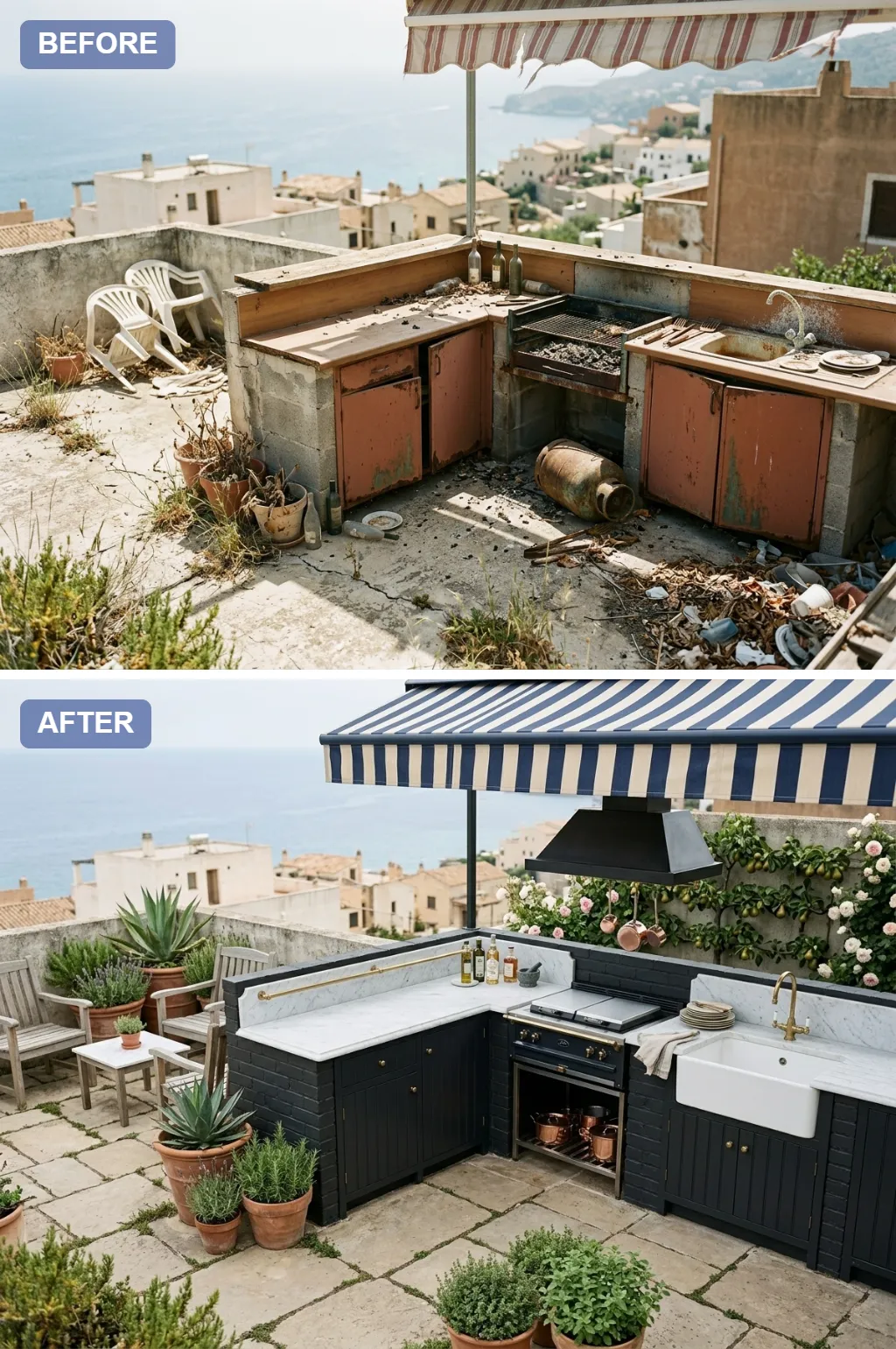
This is the most romantic, rustic take — pure Provençal holiday. A crisp navy-and-cream striped awning replaces the tattered original, a black steel range hood vents a traditional built-in grill, and copper pots hang within reach on a brass rail. The base is rebuilt in dark, almost-black tongue-and-groove with a marble top and a deep white farmhouse apron sink under a brass bridge tap. Espaliered pear and climbing roses green the back wall, herbs and lavender fill terracotta pots, and reclaimed stone pavers underfoot make the whole terrace feel a hundred years old — in the best possible way.
Color Palette
Dark tongue-and-groove for cottage depth
A classic white top and farmhouse apron sink
Hanging copper pots and a brass bridge tap
A navy-and-cream awning and soft-blue notes
Inspiration Tips for Similar Spaces
- Hang your tools: a brass rail of copper pots and utensils over the grill is both genuinely practical and the fastest way to signal warm, lived-in farmhouse character.
- Green a bare boundary wall with espaliered fruit or climbing roses — vertical planting hides an ugly edge and gives a brand-new build instant age and softness.
4. Coastal Hamptons Navy
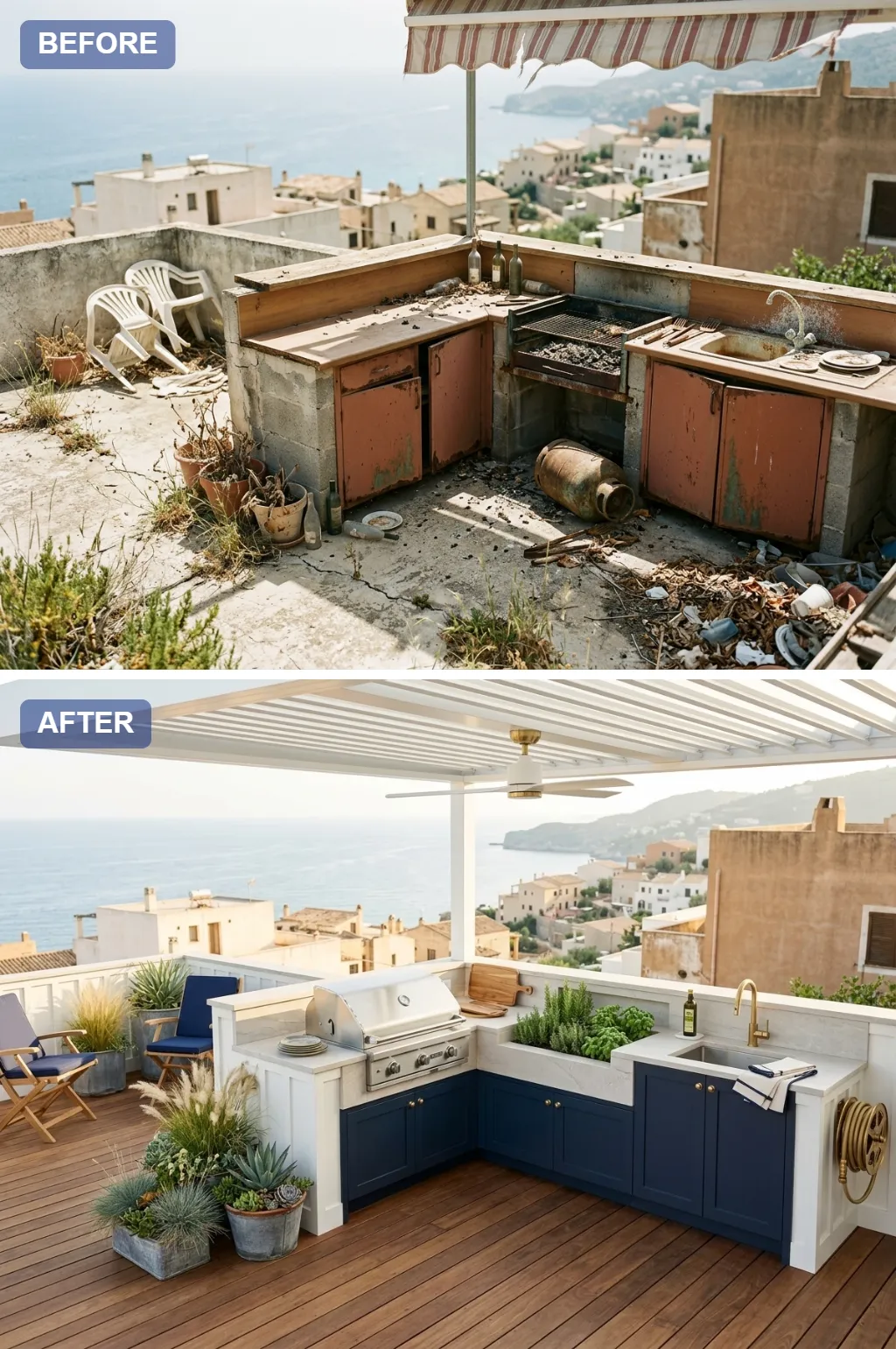
Breezy, bright, and unmistakably by the sea. A white timber pergola with a slim outdoor ceiling fan tops crisp navy shaker cabinets set in a white frame, with a marble counter and a warm brass gooseneck tap. The clever move is a built-in raised planter of herbs running right along the counter, so basil and thyme are an arm’s reach from the grill. A honey-toned ipe deck underfoot, navy sling chairs, and galvanized pots of pampas grass and succulents finish the look. It is the friendliest, most family-ready of the eleven.
Color Palette
Crisp navy shaker doors in a white frame
Clean white cabinetry frame and pergola
A honey-brown hardwood deck underfoot
A warm brass tap against the cool navy
Inspiration Tips for Similar Spaces
- Build a narrow herb planter into the counter run itself — fresh herbs within arm’s reach of the grill is the single most-used luxury in any outdoor kitchen.
- Pair cool navy cabinetry with a warm timber deck; the contrast keeps a blue-and-white coastal scheme from feeling cold or clinical.
5. Coastal Minimalist
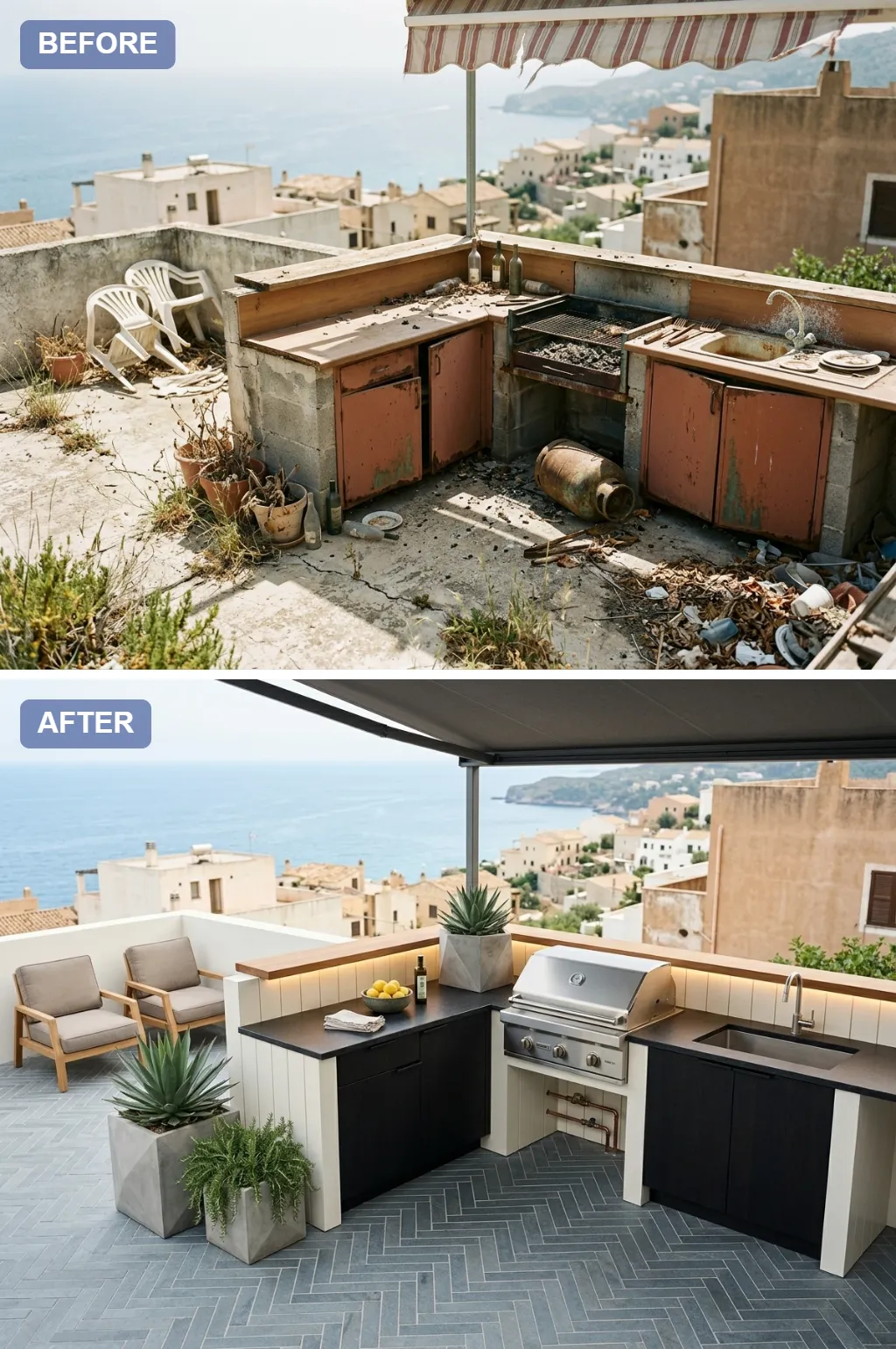
The pared-back, quietly expensive option. A retractable charcoal awning shades a low run of white shiplap cabinetry topped with a slim matte-black counter, holding the palette to just three calm tones so nothing competes with the view. A stainless grill sits flush, faceted concrete planters hold architectural agave and trailing ferns, and a pair of teak lounge chairs with taupe cushions invite you to sit rather than fuss. The grey herringbone tile underfoot is the only pattern in the room — and it is all the more effective for it.
Color Palette
Simple white shiplap fronts, calm and bright
A slim near-black top for quiet contrast
Grey herringbone as the room’s only pattern
Faceted concrete pots with architectural agave
Inspiration Tips for Similar Spaces
- Hold the whole scheme to three tones — white, charcoal, and one stone grey — so an open-air kitchen reads as restful and lets the landscape be the star.
- Choose one architectural plant (agave, a clipped olive) repeated in matching planters instead of a mixed jumble; repetition is what makes minimalism look deliberate.
6. Japandi Zen Garden
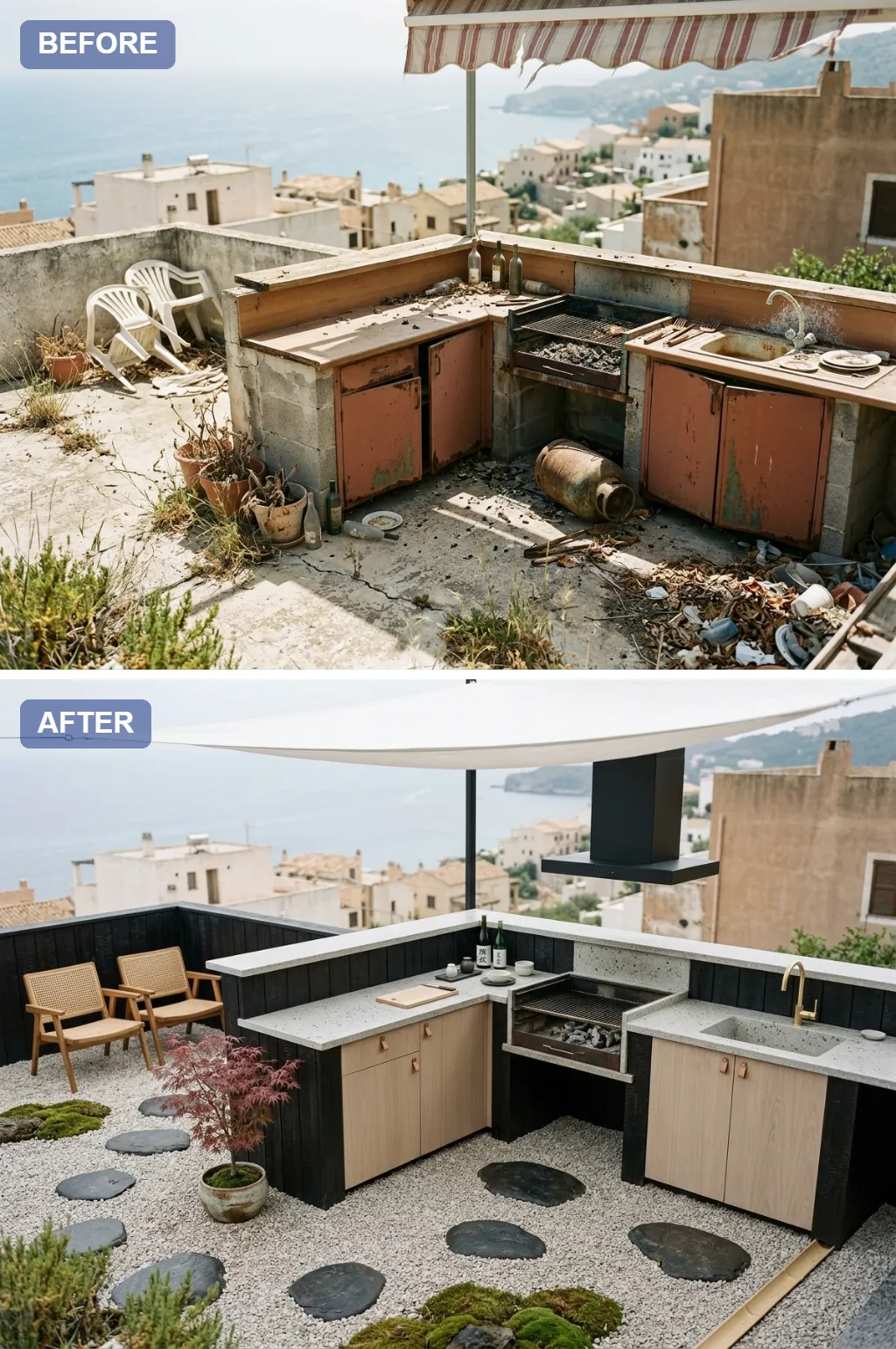
The calmest, most meditative of the set, and the boldest reinvention of the floor plan. The rebuilt base is wrapped in charred shou-sugi-ban timber, topped with speckled terrazzo and fronted by pale-oak drawers — a warm, tactile mix of dark and light. A white triangular sail shade floats overhead, but the real move is underfoot: instead of paving the whole roof, this version lays a Japanese dry garden of raked gravel, slate stepping stones, cushions of moss, and a single red-maple accent. Cane-back chairs and a low table complete a space built for slow mornings and quiet coffee.
Color Palette
Shou-sugi-ban black wood, tactile and matte
A soft, flecked stone top for gentle texture
Light natural oak to lift the dark base
Raked gravel, moss, and a red-maple accent
Inspiration Tips for Similar Spaces
- Do not pave every square foot: giving part of an outdoor kitchen over to a small gravel-and-moss garden creates a calm buffer and makes the whole roof feel larger and more considered.
- Combine charred dark timber with pale oak and terrazzo — the light-and-dark, rough-and-smooth contrast is the heart of the Japandi look and keeps a minimal space from feeling flat.
7. Desert Modern (Tulum)
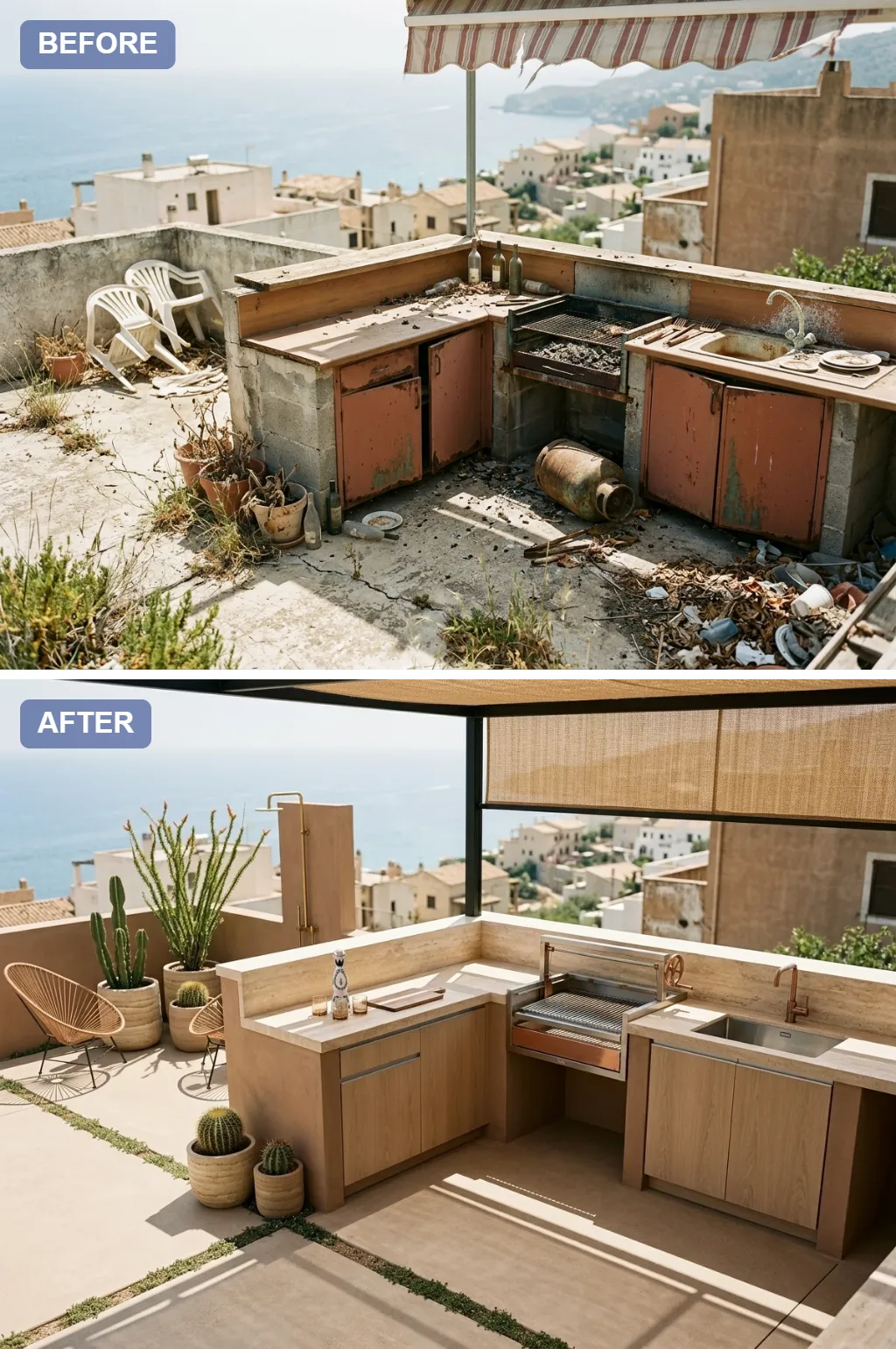
Earthy, sun-baked, and relaxed. A black steel frame carries a woven cane roller-screen for dappled shade, warm rift-cut oak cabinets sit under a honed travertine counter, and a rose-gold tap plus a wall-mounted outdoor shower add a resort note. The planting does the heavy lifting here: barrel cacti, ocotillo, and agave in ribbed stone pots turn the terrace into a desert courtyard, while tan Acapulco chairs and a poured-concrete slab keep everything low-slung and casual. It is the version that feels most like a permanent holiday.
Color Palette
Warm, straight-grained oak fronts
A soft, sandy stone with a matte finish
A warm copper-toned tap and fittings
Cacti, ocotillo, and agave in stone pots
Inspiration Tips for Similar Spaces
- Swap solid roofing for a woven cane or reed screen on a steel frame — it throws beautiful dappled shade, moves in the breeze, and suits a warm, dry climate far better than a heavy roof.
- Lean into drought-tolerant desert planting (cacti, agave, ocotillo); it thrives on a hot, exposed roof with almost no water and gives instant, sculptural character.
8. Tropical Verde Marble
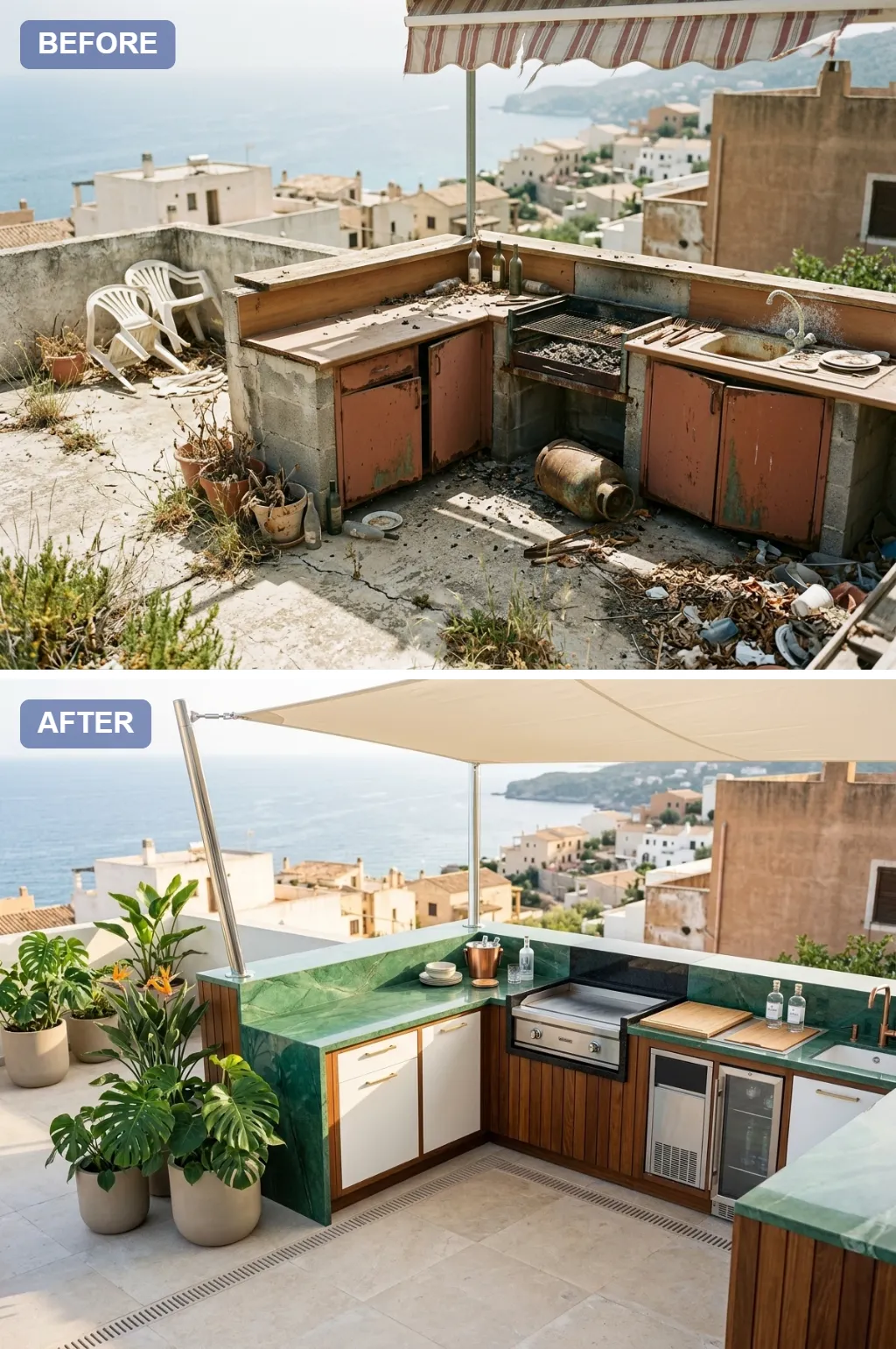
The most glamorous, jewel-box direction. A striking verde (green) marble waterfall counter and matching backsplash anchor a run of walnut and white-lacquer cabinets with brass hardware, and the spec sheet climbs a level: a built-in wine fridge, an ice drawer, and a proper prep zone. Big-leafed tropical planting — monstera, bird-of-paradise, and philodendron — turns the corner into a lush green wall, a white sail shade keeps it cool, and pale travertine underfoot grounds it all. It is the version for someone who entertains, and wants it to look the part.
Color Palette
A deep green marble waterfall and backsplash
Rich walnut paired with crisp white lacquer
Warm brass hardware and tapware
Monstera and bird-of-paradise for a lush wall
Inspiration Tips for Similar Spaces
- Make one bold surface the whole story: a green-marble waterfall counter is dramatic enough that the rest of the kitchen — walnut, white, brass — only has to support it.
- If you entertain, build in the extras now (wine fridge, ice drawer, a real prep zone); retrofitting appliances into a finished outdoor run later is far harder than planning for them up front.
9. Nocturnal Luxe
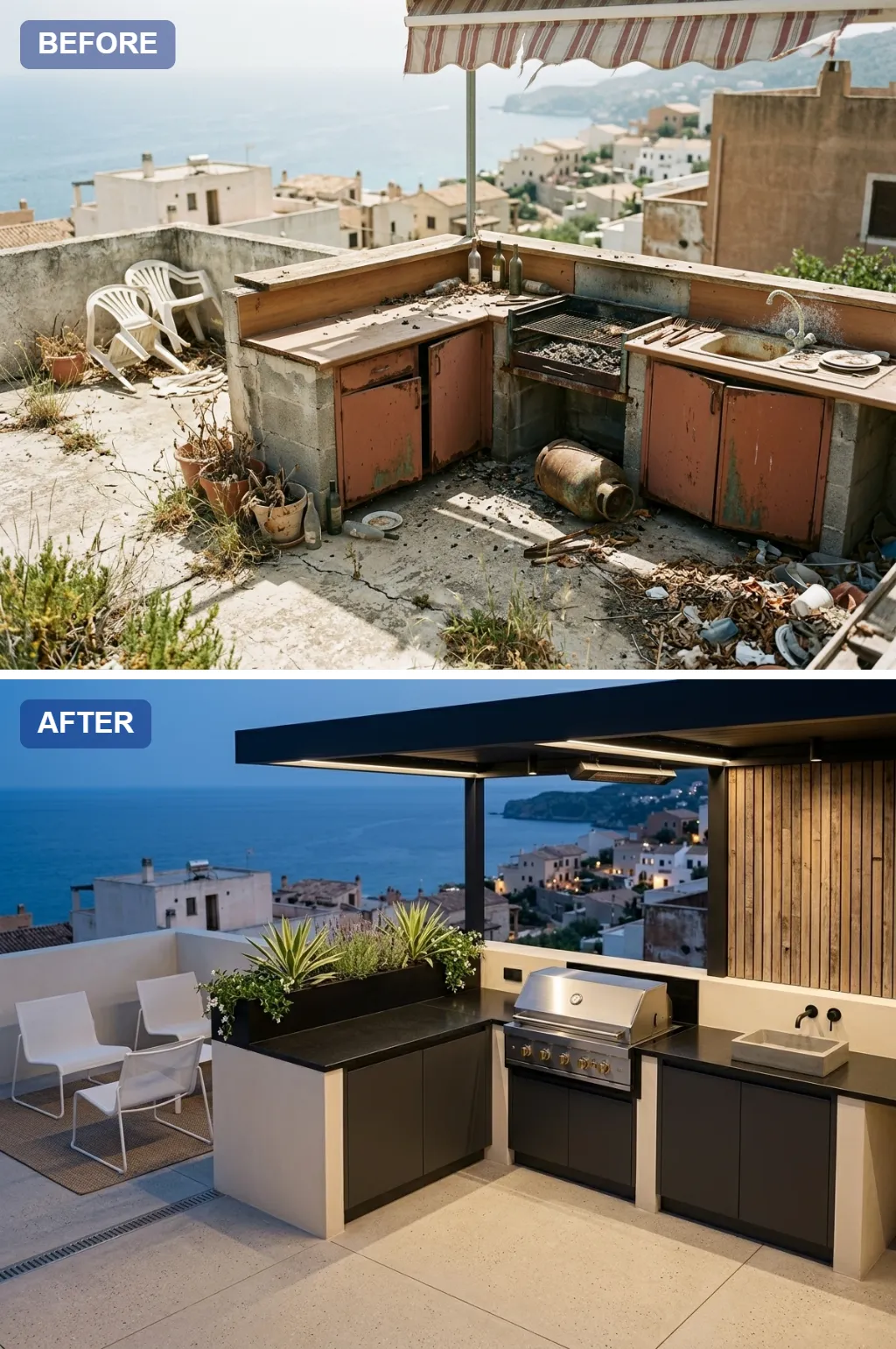
This is the same footprint reimagined for after dark. A dramatic cantilevered dark roof with integrated warm downlights hovers over the counter, a floor-to-counter timber slat wall glows in the light, and matte-black cabinets under a dark stone top all but disappear into the evening. A full stainless gas grill anchors the run, teak and agave soften the edges, and the whole scheme is tuned for that blue hour when the village lights come on below. If you cook and host mostly in the evening, this is the mood to steal.
Color Palette
Near-black fronts that recede at night
A glowing slatted wood wall for warmth
A deep charcoal worktop for evening drama
Integrated downlights tuned for the blue hour
Inspiration Tips for Similar Spaces
- Design the lighting first if you host at night: warm, integrated downlights under a roof or counter lip do more for the mood of an evening terrace than any single decorative fixture.
- A backlit or grazed timber slat wall gives a dark, moody scheme a warm heart — without it, all-black cabinetry can read cold once the sun is down.
10. Backlit Onyx Nightscape
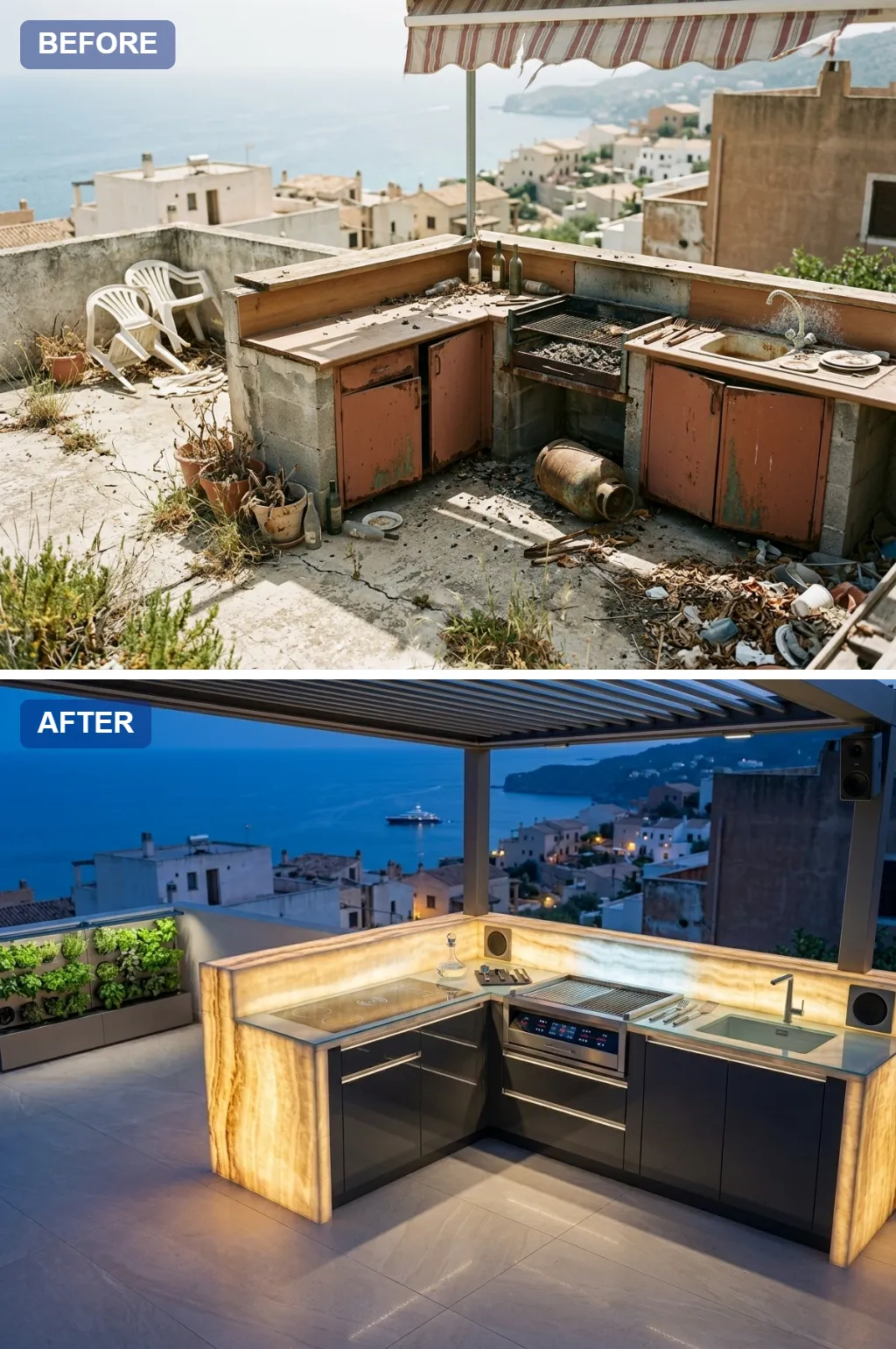
The showstopper, and the most futuristic. Here the counter is a slab of backlit onyx that glows amber from within — a jaw-dropping centerpiece against dark cabinetry and the deep blue of dusk. The appliances go high-tech to match, with a sleek induction or teppanyaki top and digital controls set flush into the stone, while a vertical living wall of herbs keeps it from tipping into nightclub. A superyacht drifts across the bay beyond. It is unapologetically luxurious, and it makes the ruined "before" feel like another planet.
Color Palette
Translucent stone that glows warm from within
Dark fronts that let the onyx take over
The deep blue-hour backdrop of the scheme
A vertical garden that softens the tech
Inspiration Tips for Similar Spaces
- Backlit onyx or agate is the ultimate outdoor-kitchen statement — used on one panel or the counter face, an LED-lit translucent stone turns the whole terrace into a light feature after dark.
- Balance high-tech surfaces and appliances with something living — a vertical herb wall or trailing greenery — so a very sleek scheme still feels like part of a garden, not a showroom.
11. Industrial Asado
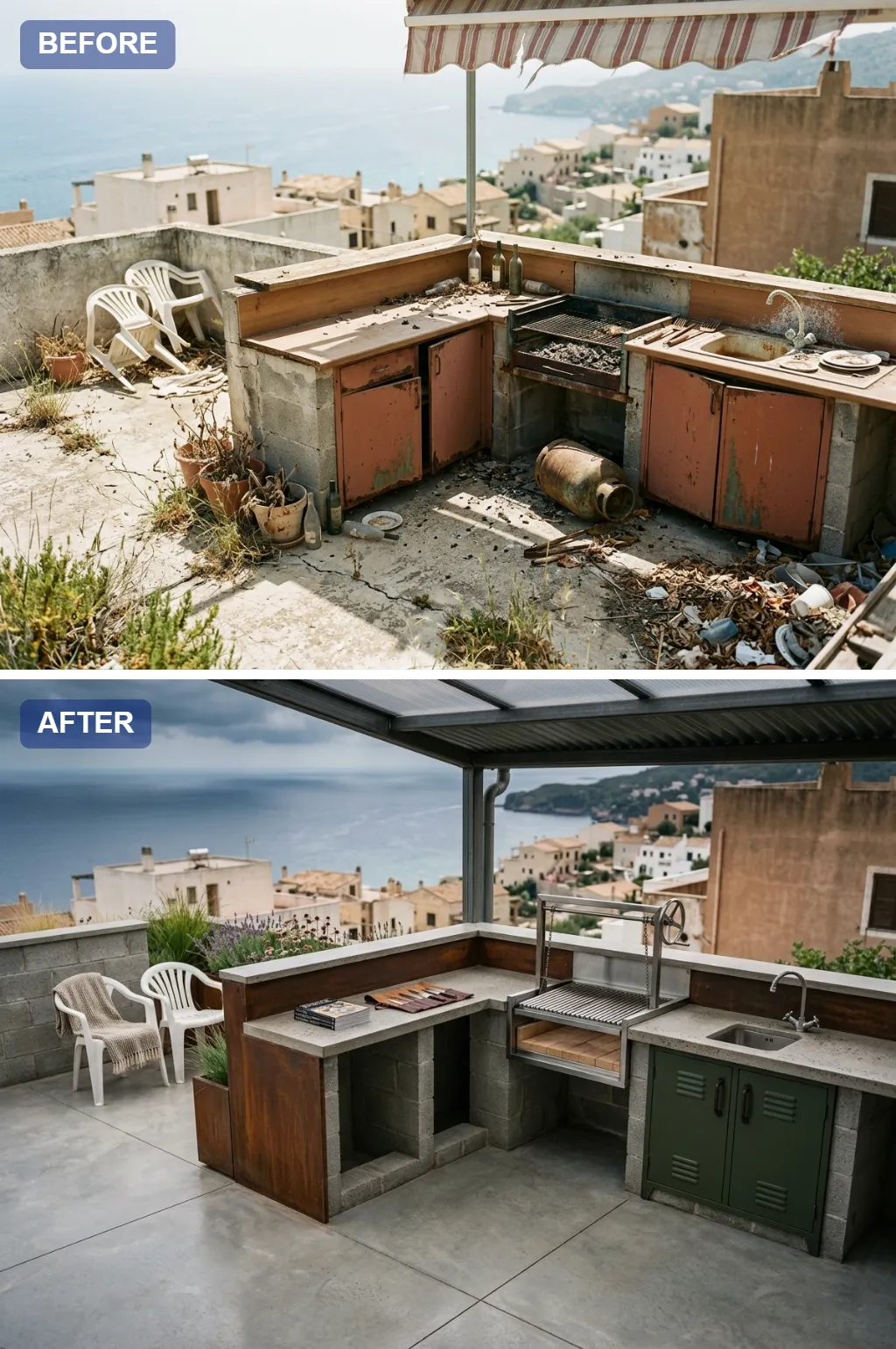
We end on the most honest, hardest-working version — a serious cook’s outdoor kitchen. A simple corrugated-metal lean-to gives real weather cover, the base is left as raw concrete block and reclaimed timber (embracing the ruin rather than hiding it), and an olive-green steel locker cabinet adds a hit of utilitarian color. The star is a proper Argentine parrilla: a height-adjustable grill on a crank wheel over a brasero for real wood-fire cooking. Even the original white plastic chairs are kept — cleaned up with a throw — as a wink to where this space started. It is rugged, characterful, and built to actually be used.
Color Palette
Honest block and reclaimed timber, left exposed
A parrilla and brasero for live-fire cooking
A utilitarian green steel cabinet for color
A simple corrugated lean-to for weather cover
Inspiration Tips for Similar Spaces
- If you genuinely cook, invest in the grill over the finishes: a height-adjustable parrilla with a wood-fire brasero will out-perform a stainless gas grill and become the reason people come over.
- Embrace raw materials — exposed concrete block, reclaimed wood, galvanized metal — for a rugged industrial kitchen that shrugs off weather and only looks better as it ages.
Pro Tips & Advice
- Fix the bones first. Before any finish, make sure the roof structure is sound, the slab drains away from the building, and there is safe access to gas, water, and power — an outdoor kitchen lives or dies on the boring infrastructure underneath the pretty surfaces.
- Choose weatherproof everything. Marble, teak, powder-coated steel, terrazzo, and stainless are here for a reason; anything that will not survive full sun, salt air, and winter rain has no place on an exposed roof.
- Plan the work triangle outdoors too. Keep the grill, the sink, and a landing/prep counter within a step of each other so cooking for a crowd never means crossing the terrace with a hot pan.
- Light it in layers. Task light over the grill and prep zone, soft ambient light for dining, and a low glow for the edges — an outdoor kitchen you can only use in daylight is half a kitchen.
- Shade is not optional. Whether it is a pergola, a sail, a cane screen, or a metal lean-to, plan protection from midday sun and sudden rain from day one; it is what makes the space usable across the whole season.
Final Result & Atmosphere
- Run the same ruined slab through all eleven designs and one thing becomes obvious: the view and the footprint never changed. The rusted grill, cracked concrete, and dead potted plants were never really the problem — the space always had the bones and the backdrop. Every version simply chose to see it.
- Whether the mood is bright modern marble, Provençal farmhouse, or a live-fire asado under corrugated metal, the payoff is the same. You stop noticing the "before" entirely and start planning the first long lunch that drifts into dinner as the village lights come on below.
- Pick the one direction that matches how you actually live — how you cook, when you host, how much upkeep you want — steal the two or three moves that make it work, and let the Mediterranean do the rest.
Conclusion
An abandoned rooftop slab with a rusted barbecue is one of the easiest spaces to write off — and, as these eleven before-and-afters show, one of the most rewarding to reclaim. The moves that matter stay consistent across every style (sort the structure and drainage, keep cook-sink-prep in a tight triangle, specify weatherproof materials, light in layers, and plan real shade); the personality is entirely yours. Save the two or three directions that suit your climate and the way you entertain, borrow the specific pieces that make them work, and remember you are not starting from nothing — you are starting with the one thing money cannot buy, a spectacular view. For more outdoor reinventions, see how we turned wild weeds into Tuscan terraces and reworked eleven neglected backyards into outdoor rooms.
Frequently Asked Questions
How much does it cost to build a rooftop outdoor kitchen?
It ranges enormously with scope and finishes. A simple version — a sound structure, a built-in gas grill, weatherproof cabinets, and a stone counter — sits at the modest end, while marble waterfalls, built-in wine fridges, custom pergolas, and premium appliances climb quickly. The biggest hidden costs are almost always structural: confirming the roof can carry the load and running gas, water, and drainage. Price those first, because they rarely change no matter which style you choose on top.
Can any flat roof take an outdoor kitchen?
No — never assume. Masonry counters, stone, appliances, planters, and people add serious weight, so a structural engineer must confirm the roof’s load capacity and waterproofing before anything is built. On many roofs the answer is yes with some reinforcement; on others it is not. This is the one step you cannot skip or eyeball.
What worktop material holds up best outdoors?
Natural granite and porcelain or sintered stone are the most bulletproof; honed marble and travertine are beautiful but need sealing and will patina over time. Whatever you choose must tolerate full UV, temperature swings, and rain — many indoor-rated surfaces (including some quartz composites) can discolor in constant sun, so always confirm a material is specified for exterior use.
Which of these styles is easiest to maintain?
The Coastal Minimalist, Desert Modern, and Industrial Asado directions are the most forgiving: powder-coated steel, concrete, travertine, and drought-tolerant planting all shrug off weather and need little fuss. The marble-and-brass and backlit-onyx schemes are the most demanding, since polished stone and warm metals want sealing and occasional care to keep their glow.
Do I really need a roof or pergola over an outdoor kitchen?
Some shade or cover is strongly recommended. It protects both you and the appliances from harsh sun and sudden rain and greatly extends how much of the year the space is usable. It does not have to be solid — a pergola, a tensioned sail, a woven cane screen, or a light metal lean-to all work, and each brings its own character, as these eleven versions show.
How do I get the most out of a small rooftop kitchen?
Keep the layout to a tight L or U so the grill, sink, and prep counter are all within a step, build storage into the base rather than adding freestanding furniture, and choose one focal material instead of many. And do not feel you must cover every inch with cabinetry — as the Japandi version shows, leaving room for a little planting or a couple of chairs is what makes a compact terrace feel like a place to be, not just a place to cook.
Sources & Further Reading
- International Residential Code (IRC) — requirements for rooftop decks, guardrails, live and dead load, and safe access relevant to elevated outdoor living.
- National Fire Protection Association (NFPA) — clearances and safe-installation guidance for outdoor gas grills, fuel lines, and solid-fuel cooking.
- American Society of Landscape Architects (ASLA) — guidance on rooftop planting, drainage, waterproofing, and structural load for green terraces.
- This Old House — practical cost ranges and construction detailing for outdoor kitchens, pergolas, and hardscaping.
- Architectural Digest & Dezeen — reference interiors and exteriors across modern, Mediterranean, Japandi, desert, and industrial directions.
Comments
Loading comments…
Leave a comment
Your email won't be published — it's only used to let you know if we reply. Comments appear after approval.