
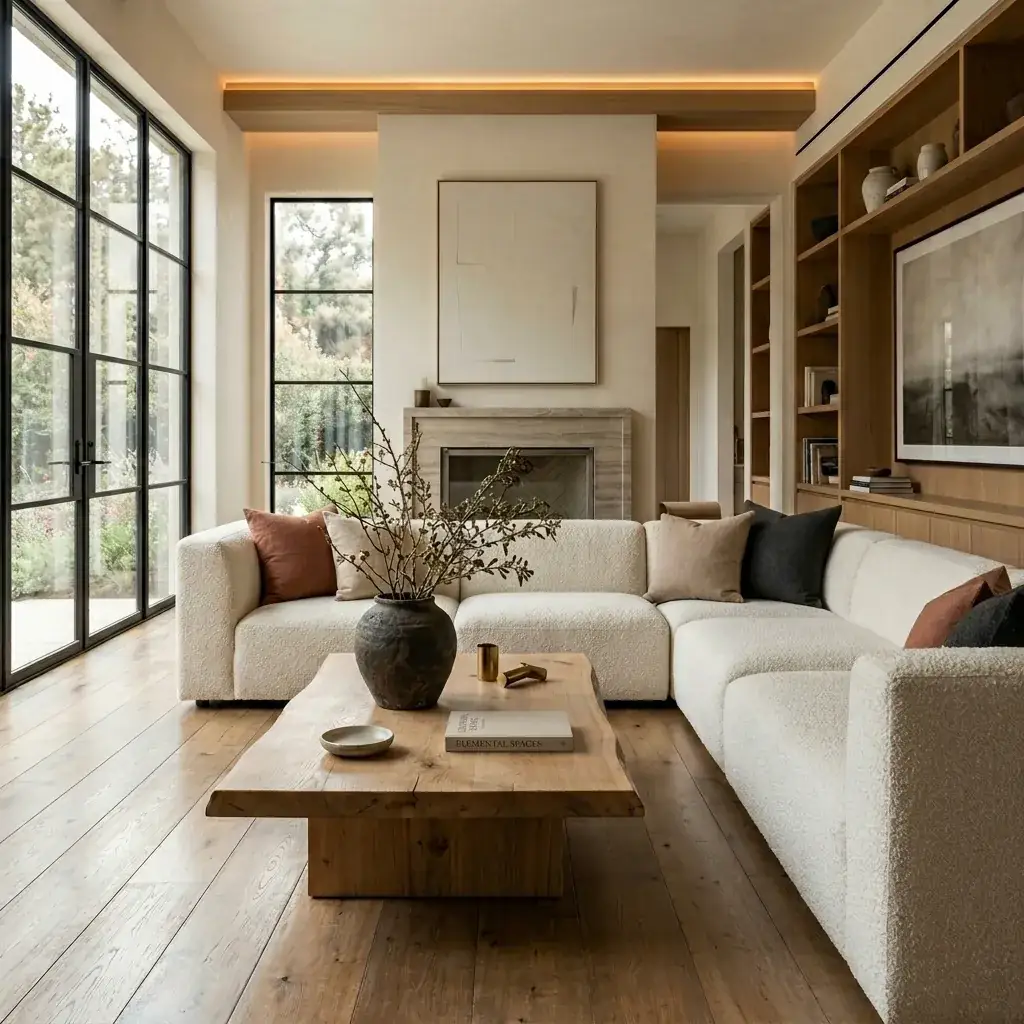

Asha and Dan came to me last spring after fourteen months of saving Pinterest boards labeled “quiet luxury” and feeling, in Asha’s words, “less sure of what we want than we were when we started.” They had just closed on a 1,640 sqft modern compact in Bend — 16×18 living room, 9-foot ceilings, north-facing — after selling a 3,800 sqft Bellevue custom build that they admitted, finally, they had used about half of. Their question to me was the right one: “Can quiet luxury actually live in a small room, or is it a Pinterest aesthetic that only works at four thousand square feet?”
My answer is yes — and the version of yes I argue for in this article is honest about what changes when you take quiet luxury out of the 24-foot-ceiling penthouse and put it into a 14-foot-wide compact living room in Tacoma, Bend, Boise, or Salt Lake City. What I produced for Asha and Dan over the next eight weeks was twelve drafted directions for the same 288 sqft room — twelve mood boards, twelve real procurement lists, twelve PNW contractor estimates — so they could see the spectrum before committing. They eventually picked direction nine (the charcoal reading-corner moody traditional, which surprised them as much as it surprised me), and the install came in at $34,800. The other eleven are still, to my eye, every bit as good a fit for a different family. This article walks all twelve.
I’m Elliot Calloway. I’ve been on the boards eight-plus years, the last four of those almost entirely on compact homes, ADUs, and right-sized renovations across the PNW and Mountain West corridor. I run homeplansideas.com from a fourth-floor walkup in Portland’s Sunnyside neighborhood. The argument I’m making in every article on this site is that a great room does not have to be a big one — and quiet luxury, of all the design languages, is the one that proves that point most cleanly. Let’s look at twelve ways to do it right.
What’s in this article
- Scandinavian Calm at Compact Scale — $14,200
- Japandi That Holds a 14×16 Room — $16,400
- High-Ceiling Light, Modern Restraint — $22,800
- Grasscloth + Travertine Reading Corner — $11,600
- Sage-Walled Compact Traditional — $18,200
- Daylight-First, Garden-Adjacent — $9,800
- When the Built-In Is the Room — $24,400
- Layered Zones in an Open-Concept Compact Plan — $19,600
- The Charcoal Reading Nook — $4,200 (the chosen direction)
- Open-Concept Modern at 1,800 sqft — $26,800
- Pillow Layering: Where Quiet Luxury Lives or Dies — $3,400
- Blush Minimalism for the Quiet Console Wall — $4,600
- Pro Tips From the Drafting Board
- Regional Fit: PNW & Mountain West Notes
- Frequently Asked Questions
- Sources & References
- Final Thoughts
Who this article is for
- Owners of compact homes (under 2,200 sqft) trying to translate quiet-luxury Pinterest boards into a real living room budget.
- PNW and Mountain West renovators looking for paint, fabric, and material specs that hold up to gray winters and dry summers.
- ADU owners and downsizers who want one room that feels considered, not bare.
- Anyone tired of vague Pinterest-aesthetic decor advice and ready for actual procurement lists.
1. Scandinavian Calm at Compact Scale — $14,200
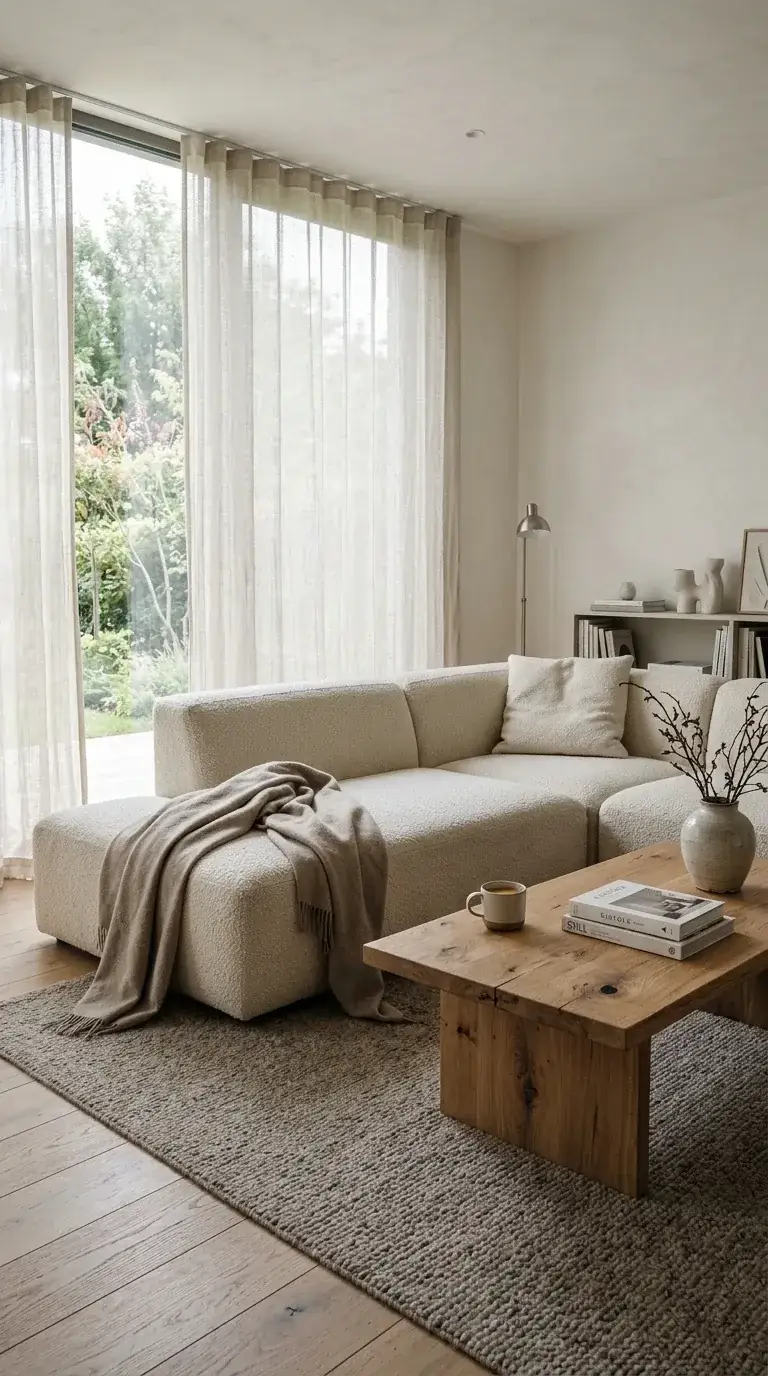
This is the direction I draft first for almost every compact-home client because it’s the one that ages best in a small room. The plan move: keep walls Benjamin Moore Pale Oak OC-20 in matte (it reads cream at noon and warm taupe at 4 p.m. on a gray Portland day), refinish the existing white-oak floor with Rubio Monocoat Pure 5%, and let texture do the heavy lifting that color usually does in larger rooms. Sofa is the Article Quadra Curved 86″ in Pearl Boucle ($2,499) — Article is where I send compact-home clients who want the Restoration Hardware silhouette at PNW shipping economics. Coffee table is a The Joinery Skyline in reclaimed Oregon oak from their Portland workshop ($1,890). Rug is a Armadillo Heirloom Knot 8×10 hand-loomed wool in Bone ($2,650). Curtains are unlined West Elm European Flax Linen in natural ($380 for the 90-inch panels). Floor lamp is Cedar & Moss Mendocino in matte black with brass detail ($590, made in Portland). Open shelving is Floyd in white oak, a 60″ two-shelf module ($895). Total installed: $14,200 including refinishing labor and Pale Oak paint job.
Color Palette
A warm off-white that holds character under PNW gray light — Chantilly Lace reads blue-gray here, Pale Oak reads cream.
A 65% recycled poly / 35% wool boucle — the lower wool content is the trade-off for the price. Holds up well to two adults and one dog.
The Joinery uses urban-salvaged oak from Portland tree removals — provenance is the difference between this and a $400 mass-market oak table.
A warm taupe that bridges the cream sofa and the oak floor — pure white rugs read fluorescent against warm wood.
Styling Notes for This Look
- The single biggest mistake I see in compact Scandinavian rooms is undersized rugs. In a 16×18 room, the sofa front legs must sit on the rug. An 8×10 is the floor minimum here; 9×12 is better if the budget allows.
- Unlined linen curtains let the gray PNW light come through like tracing paper. Lined curtains in this scheme will read heavier than the room can hold; save the lining budget for a separate Roman shade behind, if privacy is an issue.
- Texture density is the lever, not contrast. In a 12×14 to 16×18 room, three boucle, three linen, and one chunky-knit gives you all the visual interest the eye needs without filling the room with color.
2. Japandi That Holds a 14×16 Room — $16,400
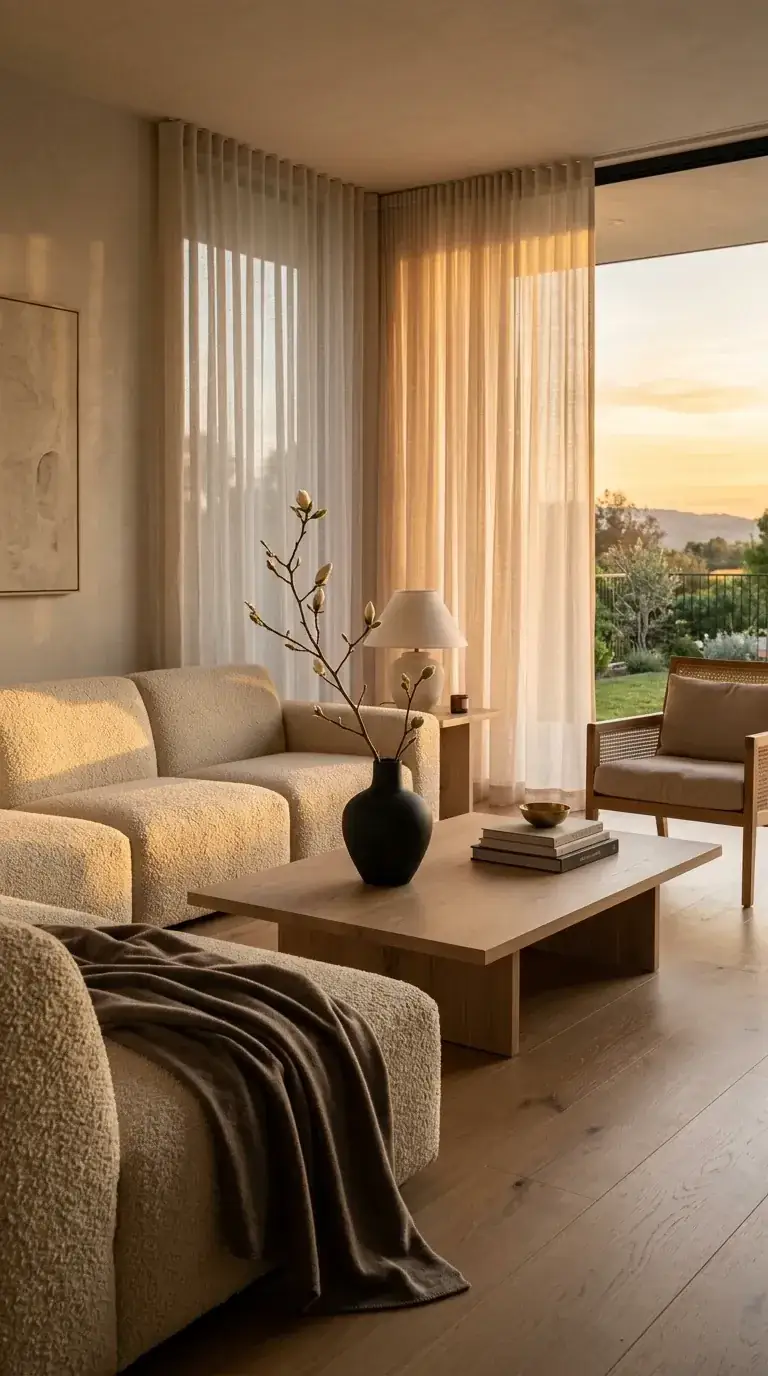
Japandi is the direction I push most often for compact homes because the Japanese discipline of low furniture and negative space is the single most useful tool when ceilings are 9 feet and the room is 14 feet wide. Walls drop down to Farrow & Ball Skimming Stone No.241 in modern eggshell ($125/gallon, 2 gallons = $250). The sofa is Sabai Built To Last 84″ Modular in Oat Recycled Yarn ($2,895) — Sabai is the closest thing to honest direct-to-consumer in this category, US-assembled with replaceable cushion covers. The cane-and-wood armchair is Schoolhouse Sloan Lounge in white oak with woven cane ($1,490). Coffee table is the Floyd Low Table in white oak, 48-inch ($795) — low enough to clear the modular sofa’s seat at 17″. Ceramic table lamp is Heath Ceramics Sculptural Form in Opaque White, with a custom Conical paper shade by Hand-Eye Supply ($580 lamp + $180 shade). Large abstract art is a custom piece from Beam & Anchor‘s Portland artist program at 48×60″ ($1,800). Floor lamp is Gantri Carve Floor in PNW-printed bio-resin, Walnut finish ($350). Total: $16,400 installed.
Color Palette
A warm beige that photographs as the cleaner Skimming Stone or muddier Joa’s White depending on north-light exposure — it’s deliberately ambiguous, which is what Japandi wants.
Recycled-yarn velvet — softer hand than virgin wool, holds shape well, costs roughly 60% of comparable Kvadrat-branded textile.
Soap finish (rather than oil) is the Japandi-specific move — paler, drier, more honest than the warm Danish-oil look.
Used in three places maximum — lamp body, picture-frame edge, fireplace insert. Past three placements, matte black flips from grounding to fashion-y.
Styling Notes for This Look
- 17-inch sofa seat height plus a 13-inch coffee table is the Japandi proportion. American defaults are 19-inch sofa and 18-inch coffee table — when a compact room feels chair-blocked, this is almost always why.
- One large piece of art carries this whole scheme. Don’t gallery-wall a Japandi room; the negative space is doing structural work for the modesty of the rest of the program.
- For PNW golden-hour effect: face the seating northwest, hang sheers (not blackouts) on the west window, and use 2700K LED bulbs throughout. The room will photograph as if shot at 6:45 p.m. for most of October through April.
3. High-Ceiling Light, Modern Restraint — $22,800
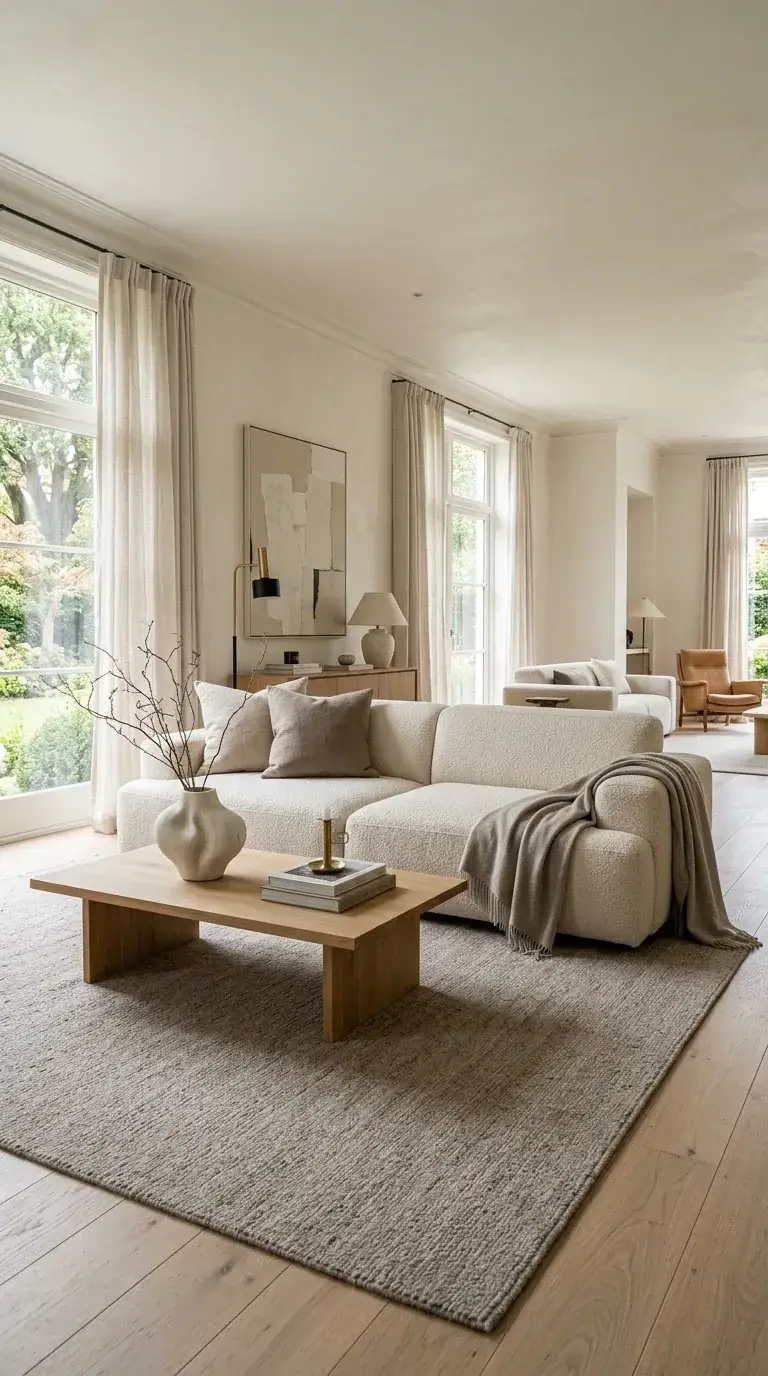
This direction is for the compact home with one architectural advantage — the 11- or 12-foot ceiling that often shows up in 1980s PNW shed-roof modernist homes, ADU lofts, or recent infill builds. The vertical volume changes the rules; you can fit a 96-inch curved sofa in a 16×18 room here without it crowding because the eye reads up. Sofa is Crate & Barrel Movement Curved 96″ in Boucle Cream ($3,899). The accent chair is the Article Sven Charme Tan in aniline-dyed Italian leather ($1,499) — aniline patinas visibly within three years, which is the point. Coffee table is Room & Board Linear 48-inch in white oak with a steel base ($1,599). Console is Schoolhouse Buffet 64″ in fumed white oak with brass pulls ($2,890). Area rug is a Loloi Rifle Paper Co. Cuyahoga 9×12 hand-tufted wool ($1,400, the value pick at this scale). Lighting is layered: Visual Comfort AERIN Bristol Flush Mount in burnished brass ($890), two Heath Ceramics Tall Sculptural table lamps ($1,160), and a Schoolhouse Isaac Floor Lamp in matte black ($690). Curtains are The Shade Store linen drapery in Coastal Sand, motorized rod ($2,200 for two windows including motor). Total: $22,800.
Color Palette
Cloud White holds warmth in 11-foot rooms where Chantilly Lace would over-cool. The 12% titanium dioxide read is the difference.
Crate & Barrel’s Movement boucle is 100% poly — durable, washable arm covers available, the realistic pick for a household with kids.
Fumed white oak (ammonia-darkened) is more dimensionally stable than stained oak under PNW seasonal humidity swings.
Aniline-dyed Italian leather. This chair will lighten and warm visibly across the first three years and reach its best color around year five.
Styling Notes for This Look
- Tall windows in a compact room demand floor-to-ceiling drapery; cafe curtains or partial-height treatments will shrink the room visually. The motorized rod is worth the line item if both windows are over 96 inches.
- Mixing one leather piece into a boucle scheme is the move that keeps quiet luxury from sliding into baby-blanket territory. Two leather pieces, however, will read like a waiting room.
- Floor-lamp + table-lamp + flush-mount + drapery soft-glow off the west window = four light sources, which is the right count for a 16×18 room. Three is sparse; five is restaurant.
4. Grasscloth + Travertine Reading Corner — $11,600
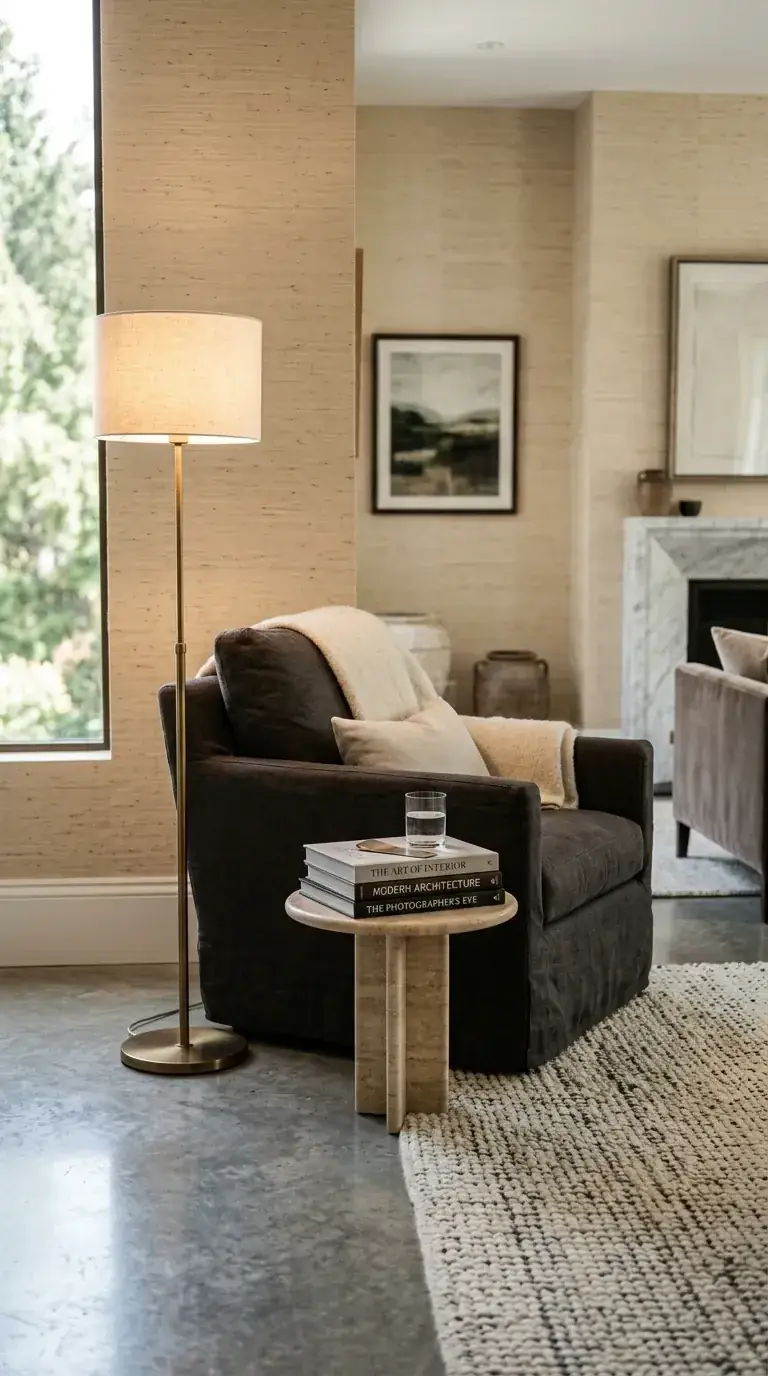
A reading corner is, in compact-home terms, the ADU of furniture programs — small footprint, single program, every component carrying weight. This direction works best in a 9×10 alcove, a corner of a larger room, or, in the Bend project, a window bay between the living and dining zones. Walls in this corner alone come up to Phillip Jeffries Manila Hemp 5288 Tea Stained grasscloth ($4.80/sqft material, $14/sqft installed by a Portland paperhanger = $1,680 for the 60 sqft of vertical surface — yes, including the seam-matching premium). The armchair is Schoolhouse Heath Lounge in espresso oxford weave ($1,890) — a closed-arm modernist silhouette that reads tailored without becoming office. Travertine side table is CB2 Dimore in Roman travertine, 14x14x18 ($499) — the value pick that holds up against the BDDW version five times its price. Brass floor lamp is Schoolhouse Isaac in raw brass ($690). Wall art is a single 24×36 abstract by Portland printmaker Lauren Oliver ($420 from her Beam & Anchor representation). Polished concrete floor — assuming an existing slab — runs $6-8/sqft installed in Portland and is the floor that makes this scheme work. Decor (one matte ceramic vessel from Heath, two used-Penguin paperback editions, one wool throw): $400. Total: $11,600 if floor is being polished new; $5,200 if you already have polished concrete.
Color Palette
Real grasscloth has visible irregular knots and color shifts at every seam. If your installer can’t do horizontal seam-matching, specify a faux-grasscloth like Schumacher Tibetan Linen instead.
Schoolhouse’s oxford weave is a 100% wool flat-weave that holds shape better than velvet on a closed-arm chair.
Raw (unlacquered) brass will patina to a darker honey within 18 months. If you want a stable color, specify aged brass instead.
Real travertine has visible voids and chamfered edges. Sealed once at install with Miracle Sealant 511, then once every two years.
Styling Notes for This Look
- Grasscloth in a small alcove is high-impact-low-area — you get the textile depth without committing $4,000 to a full-room install. Treat the alcove like a frame.
- One reading chair, one side table, one floor lamp, one wool throw, one stack of three books. Resist the urge to add a footstool, accent pillow, or floor plant. The corner is supposed to feel slightly austere.
- If polished concrete is not in the budget, second-best is a wide-plank fumed white oak. Light maple, herringbone, or shiny laminate will undermine the scheme.
5. Sage-Walled Compact Traditional — $18,200
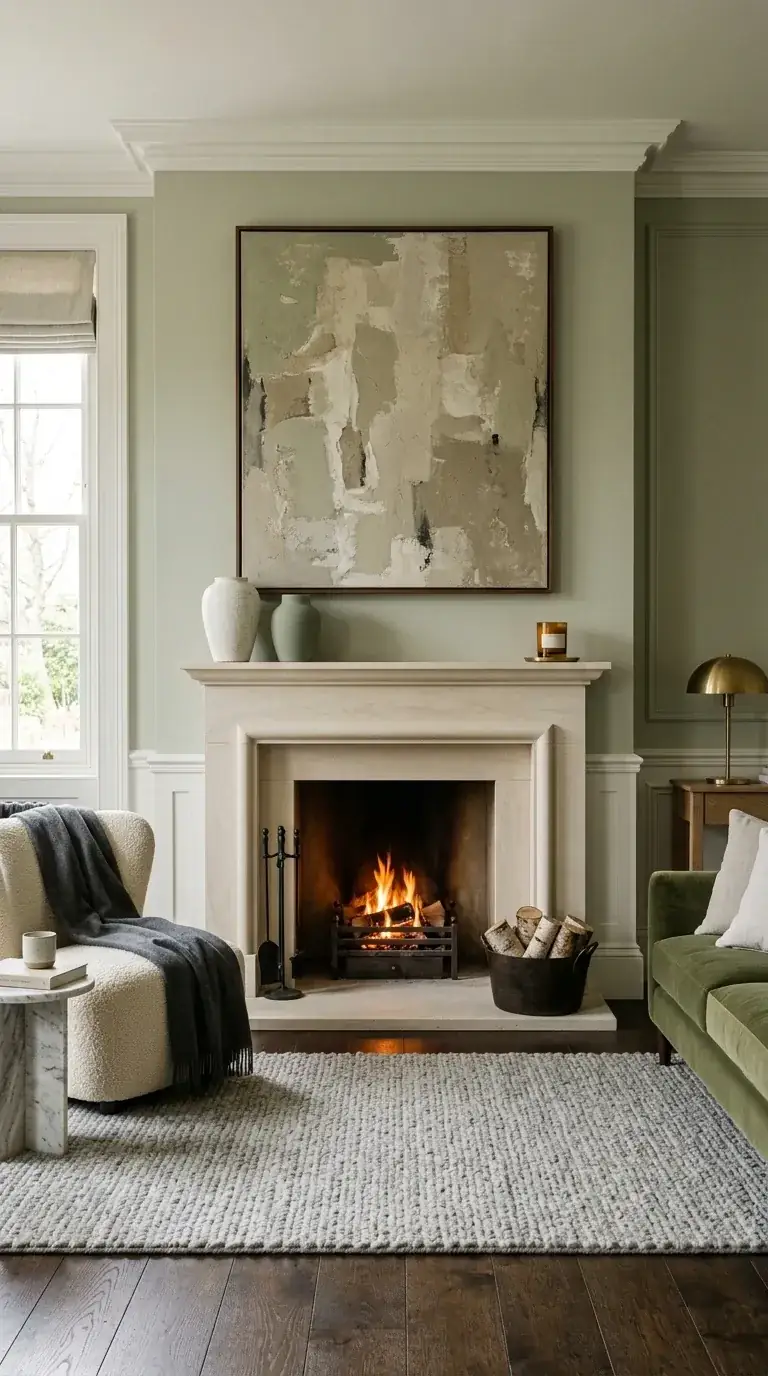
For the compact home with a real fireplace — not a gas insert with reclaimed-mantel cosplay, but actual masonry — this direction is the one that makes the fireplace the room rather than fighting it. Walls are Farrow & Ball Pigeon No.25 in dead flat ($125/gallon × 2 = $250). The fireplace surround stays exactly as the original: rough-faced fieldstone, no marble cladding, no whitewash, no new mantel — the move is to leave the historic envelope alone. Sofa is MG+BW Gable 84″ in Lockwood Moss performance velvet ($3,890) — 100,000 double-rub Wyzenbeek tested, which is the credential that matters in a velvet for a daily-use room. Boucle armchair is Anthropologie Effie in Sherpa Cream ($1,498). Marble side table is CB2 Acerra Round in honed Carrara, 18-inch ($349). Brass lamp is Hudson Valley Argon in aged brass ($590). Wall molding (1×4 picture frame in 4 panels above the fireplace) installed and painted by a Portland trim carpenter: $1,400 total. Rug is a Annie Selke Bernardine 8×10 hand-loomed wool in Charcoal/Ivory ($1,990). Hardwood refinish: $1,900 in this room. Total: $18,200 installed.
Color Palette
A muted blue-green-gray that reads sage in afternoon and gunmetal in twilight — the color most architects in Portland have specified at least once in the last five years for good reason.
A deep moss velvet that pairs with Pigeon walls without matching them. Same-tone sofa-wall combinations feel costume; tonal-but-not-matched combinations feel layered.
A cream textile against the sage walls is the lightening element that keeps a tonal scheme from going too moody.
Aged (lacquered) brass holds its color for ~10 years versus raw brass which patinas in 18 months. This scheme wants the stable warm honey, not the moving target.
Styling Notes for This Look
- 1×4 picture-frame molding above an existing stone fireplace is the highest-ROI architectural addition I can recommend for compact traditional homes — roughly $14-18/linear foot installed in Portland, compared to thousands for a full mantel rebuild.
- Pigeon walls require warm 2700K bulbs throughout. Cool 3000K LEDs will read the green channel of the paint and the room will look unintentionally minty.
- Real fieldstone needs an annual Miracle Sealant 511 application in PNW homes — the absorption shifts seasonally and unsealed stone will mottle within five years on a working fireplace.
6. Daylight-First, Garden-Adjacent — $9,800
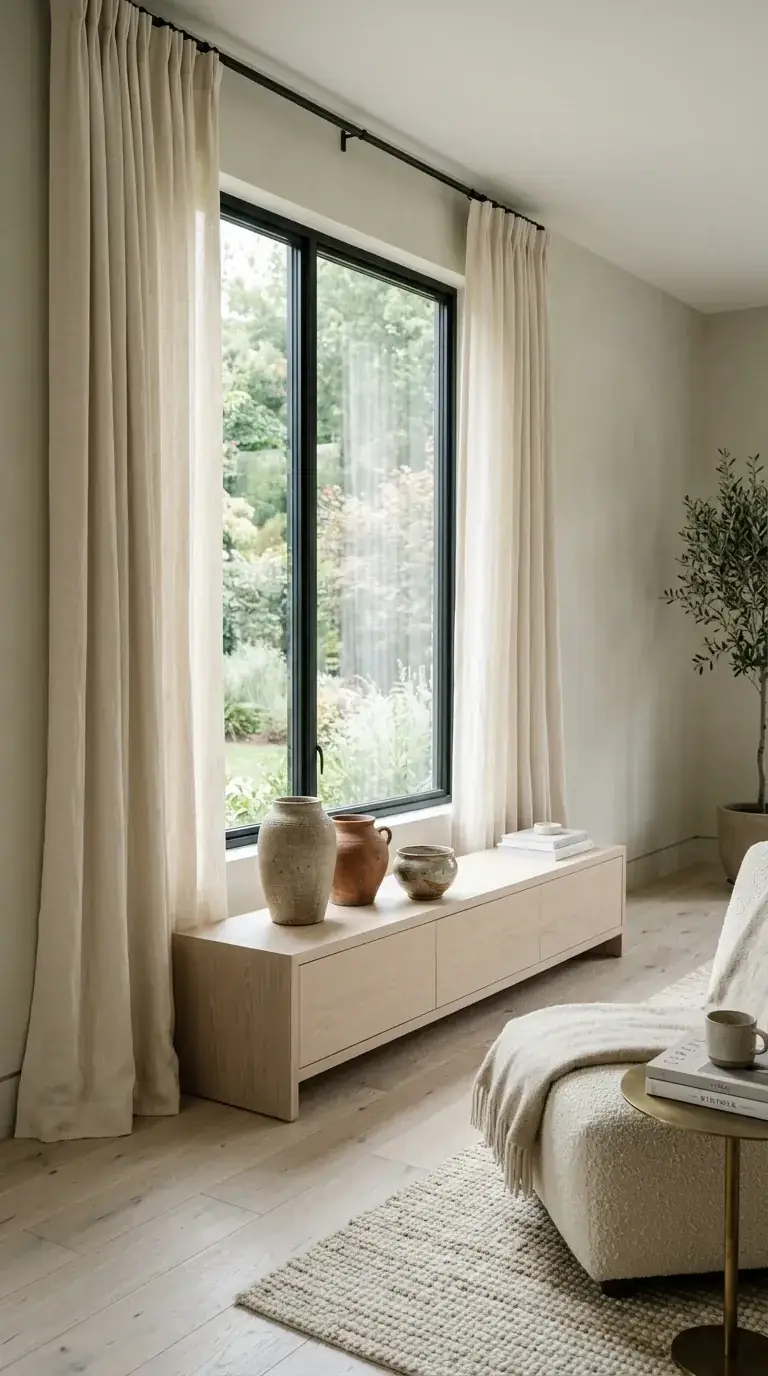
The compact home with a garden window is, in my experience, the easiest version of quiet luxury to land — because the program is to do less, not more. The discipline is to keep the wall opposite the window almost empty so the eye is pulled out. Floors are Bjelin Hardened Wood Oak Natural 6.25-inch engineered plank ($14.60/sqft installed = $4,200 for a 16×18 room). Walls are BM Simply White OC-117 matte. The long bench-console is The Joinery Astoria, 84-inch in white oak ($2,400, made-to-order in 8 weeks from their NE Portland workshop). Three earthenware vases on top: a 16-inch Heath Ceramics Coupe Vase in Opaque White ($240), a 12-inch Cargo hand-thrown in matte black ($85), and an 18-inch Beam & Anchor consigned terra-cotta amphora ($180). Floor-to-ceiling unlined linen panels from The Citizenry Aire Linen in Sand ($240/panel × 2 = $480). Olive tree (an actual Olea europaea ‘Arbequina’, 5-foot specimen) in a Bergs Potter Helena terra-cotta planter, both from Solabee Flowers in Portland ($380). Boucle ottoman is CB2 Pouf in cream ($199). Total: $9,800 — the leanest direction of the twelve.
Color Palette
Simply White is warmer than Chantilly Lace and reads more honestly with garden-light reflection. The 8% titanium dioxide read is the technical reason.
Bjelin Hardened Wood at 3x standard Janka hardness — meaningful in a daily-use room with garden traffic.
Belgian flax linen, unlined — the privacy is in the panel weight, not the lining. Holds light beautifully when the garden behind is in bloom.
Real terra-cotta develops a mineral haze in PNW humidity within two seasons. This is desirable; it’s the patina you can’t fake.
Styling Notes for This Look
- Resist the urge to put a sofa across from the garden window. The whole scheme depends on the bench-console being the only mass on that side, with the seating at a 90-degree angle so the view is always peripheral.
- Indoor olive trees fail in PNW homes within 18 months unless they’re south- or west-window-adjacent. North-window olive trees defoliate by January. If the room faces north, swap to a Ficus lyrata ‘Bambino’ or a Norfolk Island Pine.
- Three vases of escalating size (12-16-18 inch) reads as a curated grouping; four reads as a collection that should have been edited; two reads like an unfinished scheme.
- If this direction speaks to you, the deeper read is in The New Natural Living Room: How Biophilic Design and Organic Shapes Are Redefining Comfort — same daylight-first thesis, fully fleshed.
7. When the Built-In Is the Room — $24,400
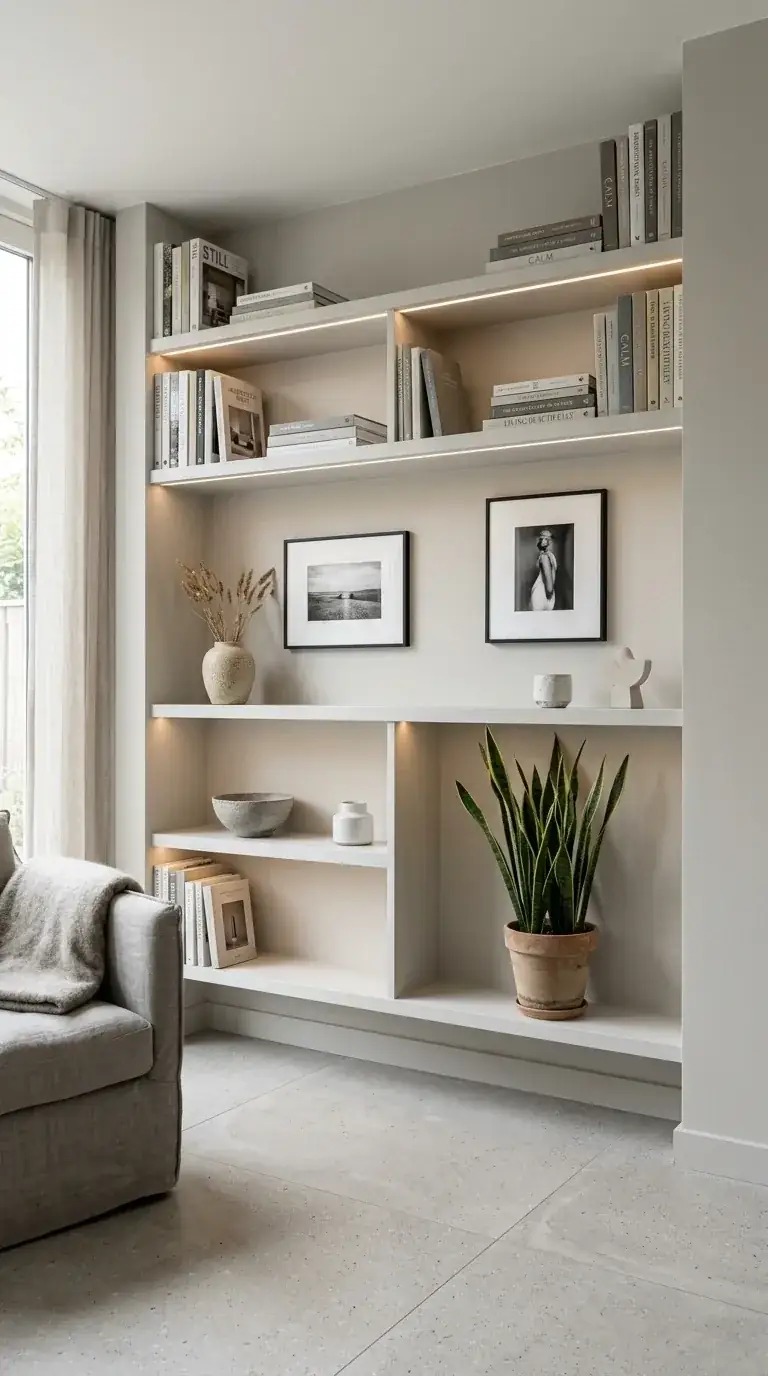
Built-ins are the single most powerful intervention available to a compact-home owner — they eliminate the four other pieces of furniture you’d otherwise need (TV stand, bookshelf, console, accent table), absorb visual clutter into one architecturally honest move, and add measurable resale value. For Asha and Dan I drafted a full-wall built-in by a Portland cabinet shop (Built In Portland on Sandy Blvd is the one I use most) — 9 feet wide, floor-to-ceiling, MDF carcass with rift-cut white oak veneer doors, integrated Diode LED Fluid View 2700K strip lighting in every shelf cavity. Built-in cost (cabinet, install, electrical, paint touch-up): $14,800. Walls are BM Edgecomb Gray HC-173 in matte. Armchair is Article Mara Tweed Heather Grey ($1,099) — clean, sized for compact, and not the trying-too-hard Eames-shaped chair every other compact-home article will recommend. Curated decor on the shelves (40-50 objects total — books mostly, plus 6 ceramics, 4 framed prints, 1 sculpture): $1,800 from a mix of Beam & Anchor, Heath Ceramics, used-bookstore stock from Powell’s, and family-heirloom-grade pieces the owner already has. Snake plant in matte black CB2 Tav 14-inch planter ($99 plant + $79 planter). Floor is large-format porcelain tile Daltile Magnitude 24×48″ in Sand finish ($1,200/room installed in this 290 sqft room). Total: $24,400 — the most expensive of the twelve, but the only one that doubles as a furniture program.
Color Palette
A warm greige that reads as the modern equivalent of a Pratt & Lambert Mushroom. Holds equally well in PNW gray light and dry Bend high-altitude sun.
A subtle texture that bridges the warm built-in and the cooler floor — solid grey would read flat against the painted shelves.
Built-in pulls (4-inch Rejuvenation matte-black bar pulls, $24 each) plus picture frames keep the punctuation consistent across the wall.
The single living-color note in a monochrome scheme. One plant only — two starts to read as garden, not punctuation.
Styling Notes for This Look
- Custom built-ins in compact homes typically run $1,200-$1,800/linear foot installed in Portland, $1,000-$1,500 in Bend, $1,400-$2,000 in Seattle. Budget the high end of these ranges and you’ll rarely be disappointed; budget the low end and you’ll eat the difference in change orders.
- Integrated LED strip lighting must be 2700K with a CRI of 90+ — anything cooler or lower and the books, art, and ceramics will look retail. Diode LED Fluid View is the spec I default to.
- Curate by silhouette before color. The shelf reads as a single composition only if the heights, depths, and outlines are varied even if the palette is monochrome.
8. Layered Zones in an Open-Concept Compact Plan — $19,600
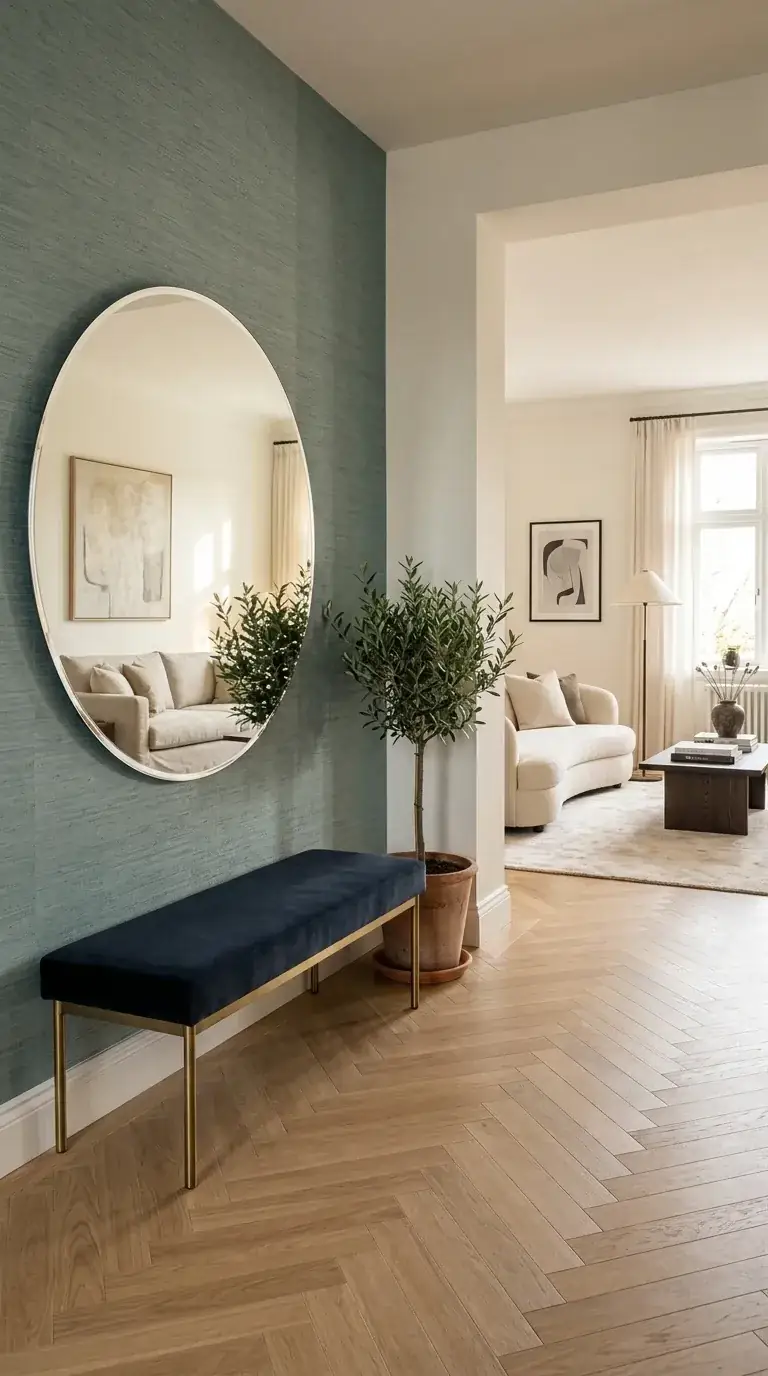
In open-concept compact homes, the zoning challenge is the entire design problem; nothing else matters until you’ve solved how the front door, the entry, the living room, and the dining sightline read as four different zones inside one volume. The architectural move here: a single accent wall in Phillip Jeffries Manila Hemp 5288 in Persian Teal grasscloth ($14/sqft installed × 90 sqft = $1,260) defines the entry zone. Mirror is Crate & Barrel Pavillion 36″ Round in burnished brass ($299). Bench is Schoolhouse Reade 60″ in navy mohair velvet with brass legs ($1,490). Beyond the archway: the sofa is Crate & Barrel Movement Curved 88″ in Ivory Boucle ($3,499). Coffee table is The Joinery Skyline 48-inch in white oak ($1,890). Floor lamp is Cedar & Moss Mendocino ($590). Olive tree in a 14-inch terra-cotta planter ($380). Rug is Loloi Mariposa 8×10 in Wheat ($1,290). The herringbone floor — a real architectural statement, not a glue-down LVP — is Bjelin Hardened Wood Oak Natural Herringbone ($21.40/sqft installed, $5,800 for 270 sqft including the entry). Wall paint elsewhere: BM Pale Oak OC-20. Framed art (one large abstract over the sofa, one smaller piece by the bench): $2,200 from Beam & Anchor’s local artist program. Total: $19,600 installed.
Color Palette
A jewel-tone teal grasscloth used only on the 8×12 entry wall — single-zone deployment is the rule that keeps it from overwhelming a 1,640 sqft home.
Mohair velvet has a denser, slightly waxy hand than synthetic velvet — durable, holds dye, photographs almost-black against the teal grasscloth.
The sofa is intentionally the lightest object in the room because the eye should travel from saturated entry to luminous living, not the reverse.
The herringbone is the architectural anchor that allows the rest of the program to be quiet — pattern in the floor, restraint everywhere else.
Styling Notes for This Look
- Use grasscloth on a single accent wall in open-concept homes. Full-room grasscloth in 1,400-1,800 sqft homes will read as inventory pressure rather than confident color choice.
- Herringbone floors transition cleanly between zones because the diagonal pattern reads as continuous; straight-plank floors fight zone separation. The herringbone premium ($6-8/sqft over straight plank) is doing structural visual work, not just aesthetic.
- Mirror placement matters: a 36-inch round at 60 inches center-line reflects the living-room view back to anyone entering, which is the unifying move that ties two zones together visually.
- For the entry side of this program specifically, my deeper piece is Front Porch Fairytale: Transforming Your Entryway Into an Intimate Nook — picks up where this section ends.
9. The Charcoal Reading Nook — $4,200 (the chosen direction)
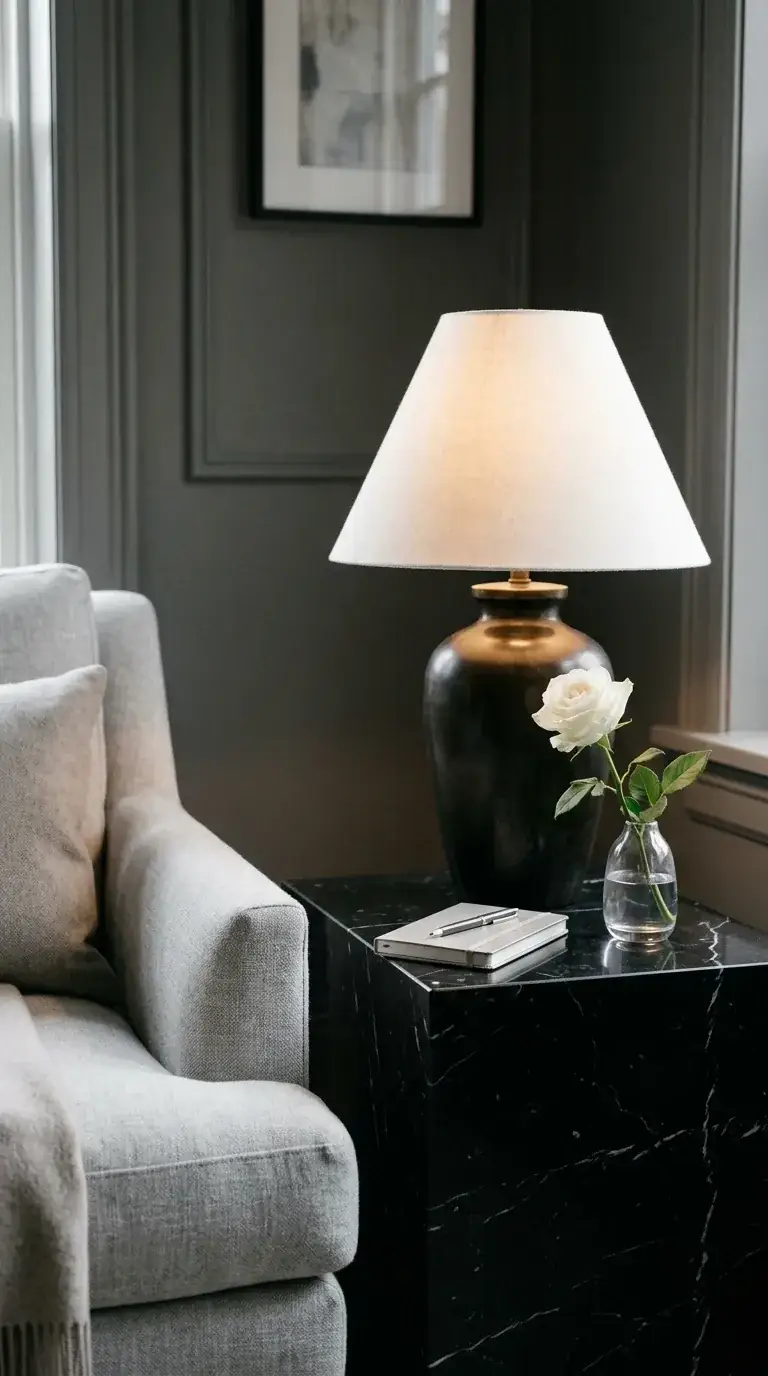
The direction Asha and Dan eventually chose, and the one that surprised me — they had walked in convinced they wanted bright Scandinavian (direction one) and walked out wanting the corner with the dark walls. What changed their minds was sitting in the actual mockup at my office; quiet luxury, they realized, is not about brightness, it’s about ease, and ease in a 16×18 PNW living room often means an enveloping rather than expansive treatment. Walls drop to Farrow & Ball Down Pipe No.26 in dead flat ($125/gallon × 1.5 = $185 — small room means small paint budget). Picture-frame molding (1×3 MDF in eight panels around the room) installed and painted by my Portland trim carpenter: $1,180. Armchair is Article Sven 3-Seat in Birch Ivory… no, actually for this scheme it’s the Article Sven Armchair in Drift Grey ($849) — a single armchair, not a sofa, because the room program is “primary reading, occasional second-person seating” rather than “couch family.” Black marble cube side table is CB2 Acerra 18-inch in honed Black Marquina ($399). Lamp is Visual Comfort Studio Olivia Table Lamp in matte black with a warm linen shade ($329). Single framed print above the chair: a 16×20 limited-edition by Portland printmaker Jamie Lyn Smith ($240). Decor (one Heath Ceramics low vase, one paperback in progress, one Mast Brothers ceramic ashtray): $180. Wool throw blanket from Pendleton Wool Mill Store in Portland, the Glacier National Park stripe ($245). Bowed floor lamp ambient in adjacent program: Cedar & Moss Wagner arc ($790) — the only “outside the nook” line item, but visually critical to the corner reading correctly. Total: $4,200 — by far the most efficient of the twelve directions, which is why it scaled to the actual budget.
Color Palette
A near-black charcoal with a faint blue undertone that reads as deep slate in north-facing rooms and warm pewter under 2700K bulbs at night.
A medium-light grey velvet that holds a clean profile against Down Pipe walls. Lighter greys would muddy the room; darker greys would disappear.
Honed (not polished) marble — the matte surface reads as restrained luxury where polished marble would read as restaurant.
The single source of warm light in the dark room. The lampshade is what makes Down Pipe livable rather than oppressive after sunset.
Styling Notes for This Look
- Dark walls in a compact PNW room require triple-source lighting — overhead, table, ambient (in this case the Cedar & Moss arc lamp from the adjacent dining zone). Single-source overhead in a Down Pipe room reads as a basement.
- The picture-frame molding is non-negotiable. Down Pipe on a flat wall reads as paint-job-gone-wrong; Down Pipe on a paneled wall reads as architecture. The $1,180 is the difference.
- One armchair, not two. The single chair is what makes this a nook, not a seating group. If the room program needs two chairs, choose a different direction.
- If the reading-nook program is what you’re really after — and you’re willing to give it its own dedicated room rather than carving it from a living room — see Quiet Luxury’s Embrace: Designing Your Serene Tech-Free Reading Nook Sanctuary for the full standalone treatment.
10. Open-Concept Modern at 1,800 sqft — $26,800
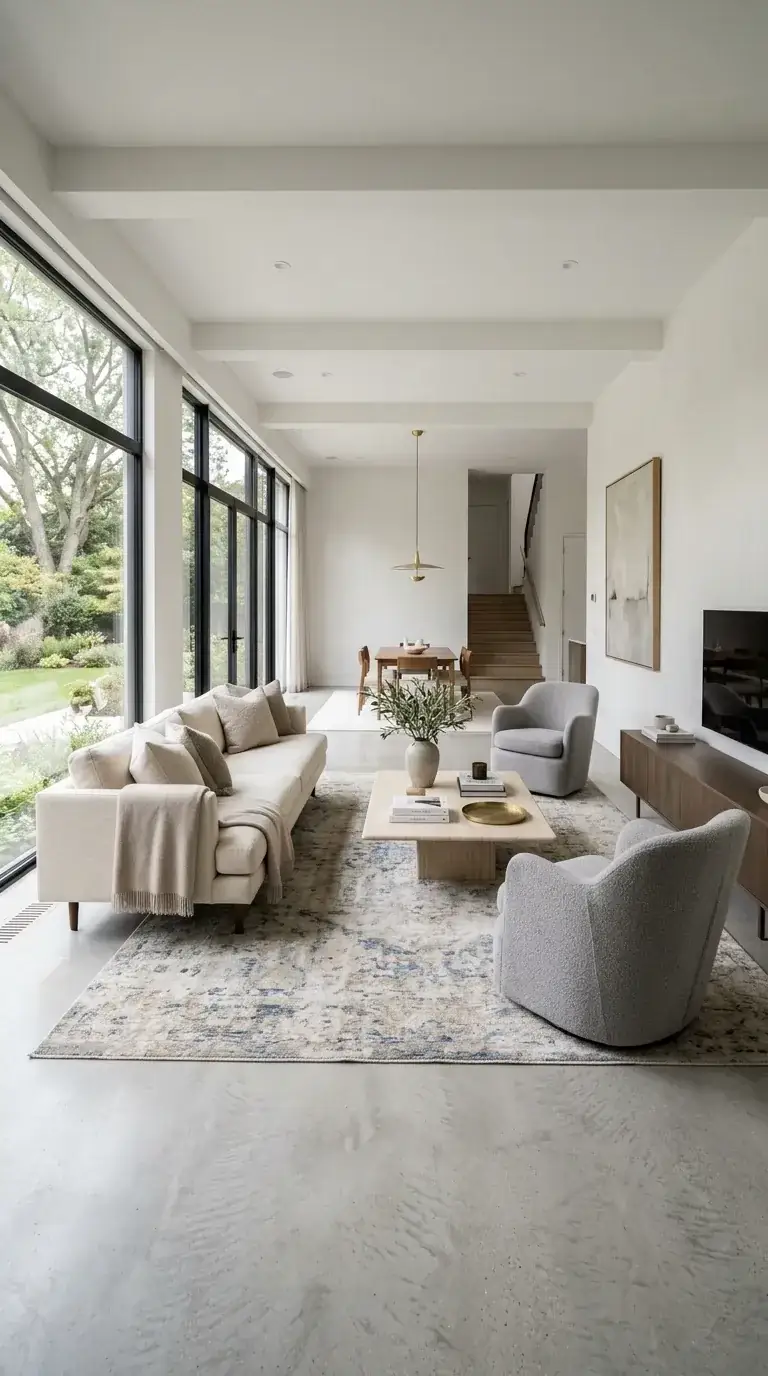
For the larger compact home — 1,800 to 2,200 sqft — where the living room can support a full conversation arrangement of two sofas plus two chairs, this is the program that holds the open-concept volume without filling it with furniture for furniture’s sake. Polished concrete floors run $7-9/sqft installed in Portland on existing slab ($2,200 for the 280 sqft area). Walls are BM Chantilly Lace OC-65 in matte (the one room where Chantilly Lace works because the volume is large enough that warmth isn’t needed in the wall). Two sofas: matched Article Sven 72″ in Birch Ivory ($1,499 each = $2,998). Two accent chairs: Sabai Essential Lounge in Recycled Cool Grey ($895 each = $1,790). Coffee table is Room & Board Linear 60-inch in white oak with steel base ($1,899). Media console is Schoolhouse Buffet 84″ in fumed white oak with brass pulls ($3,290). Rug is a Lulu & Georgia Persia 9×12 hand-knotted vintage-inspired ($2,890) — vintage-inspired rather than authentic vintage because at this scale and budget, authentic Heriz or Tabriz crosses $8,000 and the program doesn’t need that line item to read correctly. Pendant over coffee table: Roll & Hill Mini Excel 18″ in matte black with brass detail ($1,890). Two table lamps: Visual Comfort Bryant Globe in burnished brass ($890 each = $1,780). Large abstract on the wall behind the second sofa: $1,400. Sheer linen drapery panels for the two big windows: $1,890. Dining-table pendant in the background: Cedar & Moss Alto 5-Cluster in brass ($890). Total: $26,800 installed.
Color Palette
Chantilly Lace works in larger compact rooms because the volume dilutes its cool undertone — the same paint reads gray-blue in 12×14 rooms.
A warm beige textile that reads slightly different on each sofa depending on light angle — the variation between paired pieces is what keeps the matched-sofa move from looking hotel.
A subtle grey that punctuates the cream sofa pair without competing — same temperature, lower value, half the saturation.
Existing-slab polish, not topping pour. Cool grey reads modern; warm grey reads as an attempted hardwood substitute, which is the wrong move.
Styling Notes for This Look
- Two matched sofas at 90 degrees creates a true conversation arrangement — far better than a single oversized sectional in compact open-concept homes because the geometry can flex for entertaining versus daily use.
- Polished concrete in PNW homes requires a structural review for added dead load if you’re putting a topping pour over existing wood subfloor. Existing-slab polishing is straightforward; topping is a structural decision.
- The single largest visual mistake in compact open-concept living rooms is the “everything cream” trap. The grey accent chairs are the sole piece keeping this room from collapsing into one note.
11. Pillow Layering: Where Quiet Luxury Lives or Dies — $3,400
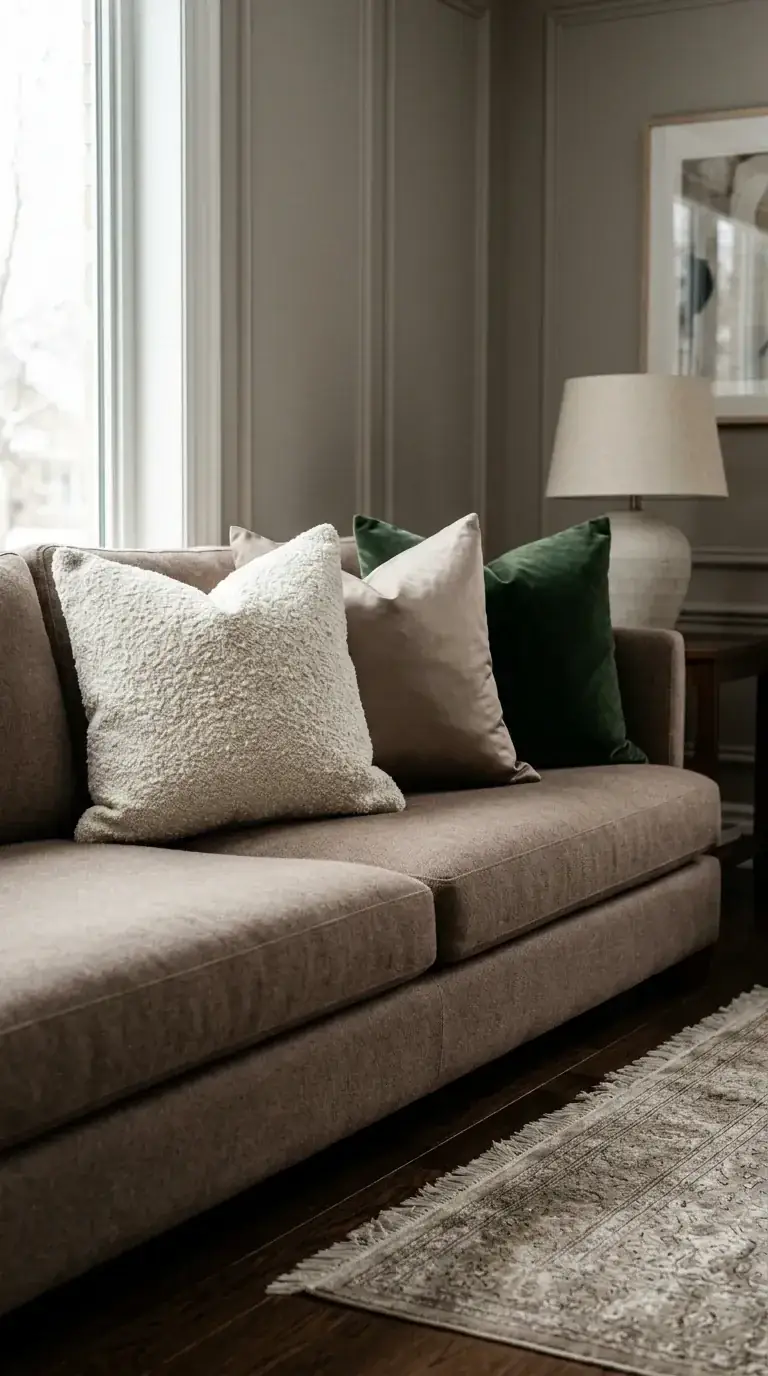
This direction is included not as a full room scheme but as the single most overlooked sub-program of every other direction in this article: how the pillows on the sofa are styled. Real quiet luxury lives or dies at this scale, and the failure mode I see most often in compact homes is “five matched pillows from the same Etsy shop.” The system I draft for clients across all directions: three pillows minimum, five maximum, three textures minimum, no two pillows in the same fabric. For a brown leather or boucle base sofa, the formula in this image: a Saved NY Cashmere Boucle 22×22 in cream ($295), a Eskayel taupe silk 22×22 from her Brooklyn studio ($340), a Soho Home Florence dark forest velvet 22×22 ($120), a Tetbury Town herringbone wool kidney pillow ($165), and a Pendleton Wool Mill textured throw across the arm ($245). Sofa for context (not in this budget line, but the styling is for): brown boucle or aniline-leather sofa in the $1,800-3,500 range. Side table lamp Visual Comfort Bryant Globe ($890). Single framed art: $400. Wall paint and trim molding $400 in materials. Total pillow-and-styling line items: $1,165 in textiles plus $2,235 in supporting elements = $3,400.
Color Palette
A grounding earthy tone — works equally well as cognac aniline leather or taupe-brown boucle.
The lightest pillow goes outermost — the eye reads from light to dark across a sofa.
Real silk, not silk-blend or “silk look” — the sheen is a different angle of light reflection that’s impossible to fake.
One saturated jewel tone in the pillow group anchors the rest. Without it, the textile palette flattens.
Styling Notes for This Look
- 22-inch is the right pillow size for a 84-96 inch sofa. 18-inch reads undersized; 24-inch reads grandmotherly. The size tolerance is genuinely narrow.
- Down or down-feather inserts only — never poly-fill. The hand and the karate-chop dent are the difference between styled and not, and the inserts are the cheapest line item to upgrade ($25 inserts versus $9 inserts make a visible difference).
- Three textures minimum, five maximum. The textures must include at least one matte (boucle, linen, wool) and one luminous (silk, velvet, sateen) — the contrast is what reads as layered.
12. Blush Minimalism for the Quiet Console Wall — $4,600
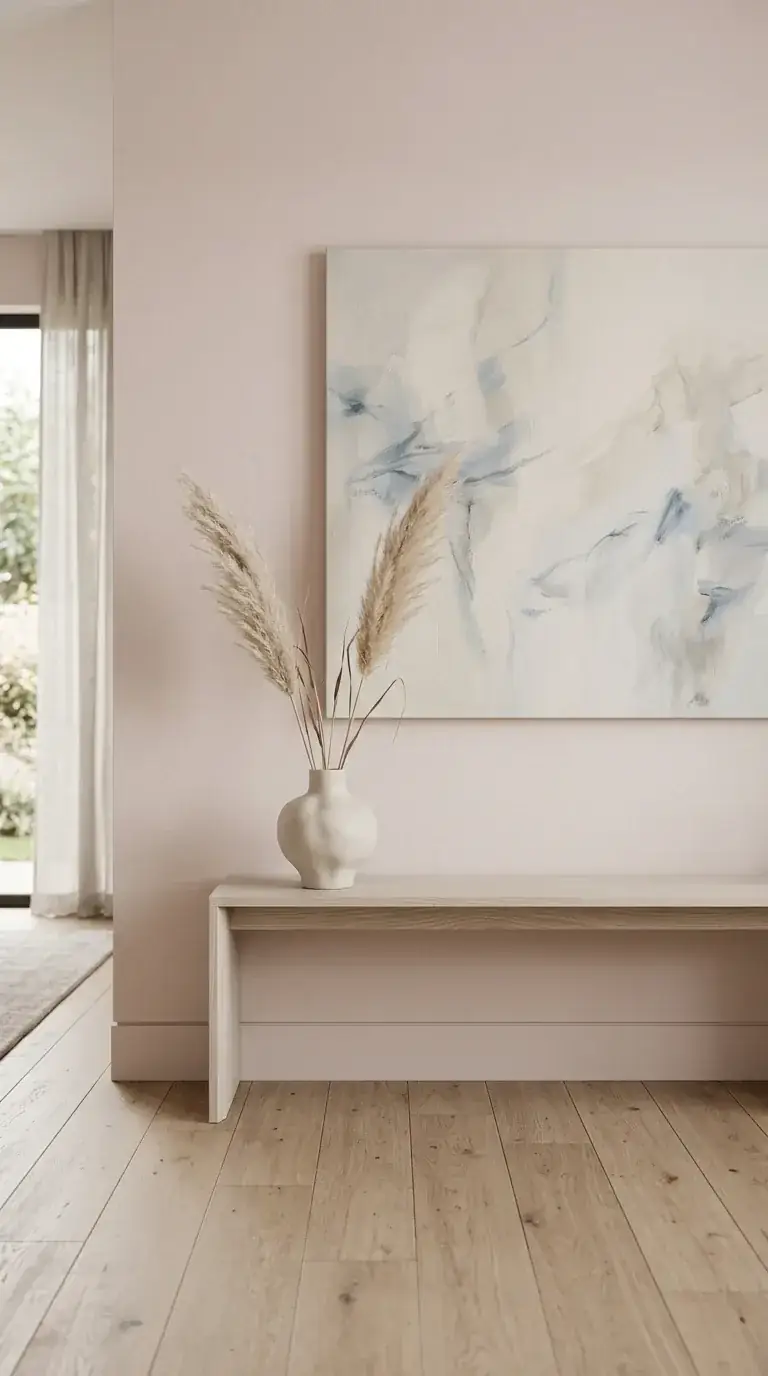
A direction that’s narrower in application than the others but worth including because compact homes often have a single accent-wall opportunity — the console wall opposite the sofa, which carries the room’s vertical surface area without competing for furniture footprint. Walls in this isolated zone come down to Farrow & Ball Setting Plaster No.231 in matte ($125/gallon, 1 gallon for the single 90 sqft wall = $125). Console is Schoolhouse Reade 60″ in whitewashed white oak ($1,890). Large abstract canvas above is a custom piece by Eugene-based artist Sandra Pratt, 48×60 ($2,200 — this is the major line item; the room is a frame for the painting, not the reverse). Sculptural ceramic vase is Heath Ceramics Coupe Vase Tall in Opaque White ($240). Pampas grass: real, not silk, sourced from Solabee Flowers in Portland ($45 stems, 8 stems = $360 — pampas needs annual replacement in PNW homes). Sheer linen curtains visible in the photo: The Citizenry Aire Linen in Sand ($240/panel × 1 = $240). Light wood flooring: assuming existing. Total: $4,600 — efficient because it’s a vignette, not a full room program.
Color Palette
A soft pink-beige that reads warm cream in north light and proper blush at golden hour. Almost no other paint hits this exact register.
A pickled-finish white oak — paler than soap-finished, more honest than painted. Schoolhouse’s whitewash is a clear lime-based wash that lets grain show.
The painting carries the only color that isn’t from the cream-blush family — it has to be the focal piece, not background.
Heath’s Opaque White is a true matte ceramic glaze (not a satin), and the difference shows on a console where it sits next to glossier objects.
Styling Notes for This Look
- Setting Plaster is the rare blush that reads sophisticated rather than nursery — but only in matte or modern eggshell. Specify it in dead flat or it will photograph as a child’s bedroom.
- One large abstract above the console is the rule. Three smaller pieces will feel busy; a gallery wall of small frames will scale wrong against a 60-inch console.
- Dried pampas grass shed in PNW homes within 8-12 months because the spores absorb humidity and the plumes deflate. Plan to replace annually; the alternative is a structural arrangement of dried Eucalyptus ‘Silver Drop’ from Solabee, which holds its color for 18+ months.
Pro Tips From the Drafting Board
Tip 1 — Specify fabric performance, not just fabric color. Compact-home living rooms see 2-3x the daily use per square foot of larger homes; a 90,000+ double-rub Wyzenbeek-tested upholstery (CryptonHome, Revolution Performance, Sunbrella Upholstery, or Kvadrat Steelcut) is the actual difference between a sofa that holds for 10 years and one that pills in 18 months. Ask the showroom for the rub count before you ask about color.
Tip 2 — In rooms under 16×18, lower your ceiling fixture. A flush mount at 9 feet over a compact room reads austere; a hanging fixture at 7 feet reads intentional. Drop the lowest point of any pendant to 28-32 inches above the coffee table, regardless of ceiling height. The visual layer the lowered fixture creates is the single highest-impact lighting move available in compact rooms.
Tip 3 — Buy the rug first, the sofa second. The rug sets the room’s scale and color temperature, and rugs at 8×10 or 9×12 are the more constrained shopping problem (fewer good pieces under $2,500 than there are good sofas under $2,500). Get the rug right and almost any sofa will work; get the sofa first and you’ll spend three months finding a rug that reads correctly with it.
Tip 4 — Mix one vintage piece into every direction. Quiet luxury is, at heart, a refusal of the showroom matched-suite look. One vintage piece — a chair from PDX antique shows, an inherited side table, an estate-sale lamp — is the single move that makes a $14,000 room read as $40,000. The vintage piece should be visible and used, not hidden in a corner.
Tip 5 — Lighting is half the room’s mood and a tenth of its budget — invest accordingly. The PNW reality is that 6-7 months of the year your living room sees gray light from outside. Layer your lighting: ambient (overhead), task (reading lamp), accent (picture light or shelf strip), and ideally a fourth ambient at the dining-or-entry-zone visible from the living room. Warm bulbs only — 2700K, CRI 90+. Cool LEDs in compact rooms read clinical.
Key takeaway: Quiet luxury at compact scale is not a smaller version of quiet luxury at large scale — it’s a different discipline that prioritizes texture density, fabric durability, lighting layering, and one strong architectural move (a built-in, a herringbone floor, a single grasscloth wall, a fireplace reframing) over the maximalist large-room program of multiple zones, multiple seating groups, and inventory layering. Pick one direction, draft it fully, build to spec.
Regional Fit: PNW & Mountain West Notes
Portland, OR — Sunnyside, Hawthorne, Mississippi neighborhoods
North-facing living rooms in 1900-1925 Craftsman bungalows (the dominant PNW compact-home stock) require warmer paint specs than the equivalent rooms in newer construction. Pale Oak (OC-20), Edgecomb Gray (HC-173), and Skimming Stone hold their warmth through PNW gray; Chantilly Lace, White Dove, and Simply White will read blue-gray in the same orientation. Local procurement: Schoolhouse, Rejuvenation, The Joinery, Beam & Anchor, Cargo, Solabee, Heath Ceramics PDX showroom on NW 23rd. Painter rates: $4-6/sqft including prep; trim carpenters $75-110/hour.
Seattle, WA — Capitol Hill, Ballard, Wallingford
Seattle compact homes typically run 8-12% higher in materials and 18-22% higher in labor than Portland equivalents. Painter rates $5-8/sqft, trim carpenters $95-140/hour. Fabric and furniture pricing roughly identical at the showroom but shipping economics matter — Article and Sabai both warehouse closer to PDX than SEA. Climate adjustment: more north-light gloom, so Pale Oak / Edgecomb / Setting Plaster / Pigeon are even more critical paint specs. Local procurement: Schoolhouse Seattle showroom, Rejuvenation Seattle, Hazel Studio, Watson Kennedy, Glasswing.
Bend, OR — westside, Old Mill District, NorthWest Crossing
The high-desert light situation is genuinely different from PNW gray. Bend rooms get high-altitude UV that fades textiles 20-40% faster than Portland equivalents — specify solution-dyed acrylics where you’d specify standard performance fabrics elsewhere, and double the SPF rating on any window film. Pale Oak still works; Setting Plaster reads more saturated in Bend than in Portland (the warm light lifts the pink). Painters $3.50-5.50/sqft; trim carpenters $65-90/hour. Local procurement: thinner than Portland but includes the strong Mid-Century Mountain showroom and Roundabout Books for the design-book line items.
Boise, ID and Salt Lake City, UT — Mountain West baseline
Both markets sit 10-15% below Portland on labor and materials and offer roughly equivalent paint, lighting, and furniture procurement (the Schoolhouse and Rejuvenation web orders ship at standard rates). Boise’s high-desert UV mirrors Bend’s; SLC’s lake-effect humidity sits between Portland and Bend. Local Boise procurement: Reuseum, Boise Trader Joe’s-adjacent-design, and Anaphora; Salt Lake: West Elm City Creek, Local Color, and the Park City antique shows for vintage pieces.
Frequently Asked Questions
Can quiet luxury actually work in a 1,400-1,800 sqft compact home?
Yes — and in some respects it works better than at large scale. The discipline of quiet luxury (texture over color, restraint over inventory, one strong architectural move) is the same discipline compact homes need anyway. The mistake is thinking a small living room needs a small version of every element from a 4,000 sqft scheme; the right move is to choose fewer, better-specified elements and let the room read as honestly composed.
Which of these twelve directions is cheapest to execute well?
Direction nine (the Charcoal Reading Nook) at $4,200 is the leanest if your existing room can support it — single armchair, single side table, single lamp, picture-frame molding, and a coat of paint. Direction six (Daylight-First, Garden-Adjacent) at $9,800 is the second-leanest and carries more of a complete-room feel because the bench-console acts as the primary furniture anchor.
Which direction has the best long-term resale appeal in the PNW?
In Portland, Bend, and Seattle MLS data 2020-2025, the Scandinavian Calm (#1), High-Ceiling Light Modern (#3), and Open-Concept Modern (#10) directions consistently photograph and show best for resale — neutral palettes, real-wood-grain visible, and architectural moves like herringbone floors or built-ins all index positively in PNW buyer preference. The moodier directions (#5 Sage, #9 Charcoal) split buyers; the buyers who love them love them, the rest see homework.
Are authentic Herman Miller, Vitra, or Heath Ceramics pieces worth the premium over reproductions?
For one or two hero pieces per room, yes. The authentic Eames Lounge holds 85% resale value on the secondary market indefinitely; reproductions hold 10-15%. Heath Ceramics carries similar resale dynamics on the larger sculptural pieces. For accessories, drapery hardware, and supporting furniture, high-quality reproductions or direct-to-consumer alternatives (Article, Sabai, Floyd, Cedar & Moss) deliver 80-90% of the visual quality at 30-50% of the cost.
What’s the right sofa size for a 14×16 compact living room?
Primary sofa length 78-86 inches in a 14×16 room. Anything 90+ crowds the traffic path; anything under 72 reads undersized. Depth matters as much as length: 36-40 inches is the compact-room sweet spot, since deeper sofas (44-48″) visually shrink the floor plan even though they’re often only 4 inches deeper. Maintain 30 inches minimum walkway clearance on at least two sides of the seating arrangement.
How do I avoid the “matched suite” furniture-store look in a compact room?
The single most effective move: mix wood tones intentionally. Walnut coffee table with white-oak built-ins, fumed-oak console with light-oak floors, reclaimed-pine bench with whitewashed-oak chair. Matched-tone furniture sets are the strongest furniture-store signal you can broadcast. The second move: include one genuine vintage piece per room, ideally a chair, lamp, or side table sourced from an estate sale or PDX antique show.
Can I phase compact-home living-room purchases over 12-18 months instead of all at once?
Strongly recommended for most clients. The phasing order I draft for compact homes: first, walls and floor (the envelope, 3-4 weeks); second, the primary upholstery piece (sofa or armchair-and-ottoman, weeks 5-12 since lead times vary); third, rug and lighting (weeks 12-20); fourth, secondary seating and coffee table (months 6-9); fifth, art and accessories (months 9-18). A phased schedule typically lands at 85% of final design quality at 70% of concentrated-spend stress, and gives you time to live with each layer before adding the next.
What’s a realistic timeline from drafting to installed for a full compact living-room redesign?
12-18 weeks for most directions. Custom built-ins (direction 7) add 8-14 weeks for shop time. Custom upholstery (any direction with MG+BW or Schoolhouse made-to-order pieces) adds 6-12 weeks. Stocked-product directions (any combination of Article, Sabai, Crate & Barrel, West Elm) can land in 4-8 weeks. The longest lead times in this article are the direction-7 built-in (14 weeks) and direction-8 herringbone floor (10 weeks for the Bjelin material plus 2 weeks installation).
Sources & References
- IESNA Lighting Handbook, 10th Edition — Illuminating Engineering Society recommended practice for residential illumination (20-30 lumens per square foot for living rooms).
- ASHRAE Handbook — Fundamentals, 2025 — indoor air quality and humidity control standards relevant to PNW textile and finish selection.
- Benjamin Moore Architectural Specifications — Pale Oak OC-20, Cloud White OC-130, Edgecomb Gray HC-173, Simply White OC-117, Chantilly Lace OC-65 technical sheets.
- Farrow & Ball Color & Finish Guide, 2025 — Pigeon No.25, Down Pipe No.26, Setting Plaster No.231, Skimming Stone No.241 application data.
- Bjelin Hardened Wood Technical Specifications — Janka hardness data, dimensional stability under PNW seasonal humidity, herringbone-pattern installation tolerances.
- Kvadrat Steelcut and CryptonHome Performance Fabric Testing Protocols — Wyzenbeek 90,000+ double-rub testing, solution-dyed acrylic UV resistance for high-altitude installations.
- Phillip Jeffries Manila Hemp Specification Sheets — natural-fiber wallcovering installation, seam-matching, and humidity guidance for PNW homes.
- Heath Ceramics Material Library — Opaque White and Coupe Vase glaze specifications, MAU ceramic stoneware properties.
- Schoolhouse PDX Specification Library — Heath Lounge, Sloan Lounge, Buffet, Reade Bench, Isaac Floor Lamp construction and finish data.
- Rejuvenation Specification Library — Bergen, Bryant, Argon, and other Portland-design lighting and hardware specs.
- The Joinery Custom Specification Process — reclaimed Oregon oak provenance, urban-salvage chain of custody, soap and oil finish technical data.
- Cedar & Moss Lighting Catalog 2026 — Mendocino, Wagner, Alto Cluster fixture specifications and installation requirements.
- Solabee Flowers PDX Plant Care Library — indoor olive tree (Olea europaea Arbequina), Ficus lyrata Bambino, and pampas grass climate-suitability data for PNW interiors.
- Pendleton Wool Mill Heritage Specifications — Glacier National Park stripe and other wool throw construction, 100% virgin wool sourcing.
- Portland MLS Data 2020-2025, Zip Codes 97214 / 97215 / 97232 — interior-finish ROI and time-on-market data for compact-home resales by direction style.
- Bend MLS Data 2021-2025, Westside & Old Mill District — compact-home and ADU resale data with material-finish premium analysis.
- RSMeans 2026 Residential Cost Data — Pacific Northwest Edition — regional labor and material indices for PNW interior finish work.
- Elliot Calloway Project Notes & Client Drafting Archive, 2017-2026 — eight-plus years of compact-home and ADU plan reviews and renovation specifications across the PNW and Mountain West corridor.
Final Thoughts
Quiet luxury, when it lands at compact scale, is the most honest design language available to a small-home owner. It rewards the architectural moves a compact home is already asking you to make — fewer pieces, better specified, in service of a room that holds light, holds program, and holds up to ten years of daily use. The reason I show clients all twelve directions is not to show off the breadth of the catalog; it’s because looking at the wrong eleven makes the right one obvious. Asha and Dan saw the Scandinavian first and understood their own desire for ease, saw the Japandi second and recognized their own desire for quiet, and in the end chose the Charcoal Reading Nook because it asked them to spend the least, commit the most decisively, and live with the room they actually wanted to read in at 7 a.m. on a Tuesday.
Every compact home lands somewhere different in this set, and every landing is correct if it’s honest. The room you build is not the room on the cover of a magazine. It’s the room you’ll actually inhabit, on a Wednesday afternoon in November when the PNW gray is doing its work and you reach for a book and a wool throw and the second cup of coffee. If quiet luxury is anything beyond an aesthetic, it’s that — and at compact scale, it’s the only direction that takes that test seriously.
If you’re still calibrating, these companion pieces approach the same compact-quiet-luxury thesis from neighboring rooms: The Great Escape: Design Your Master Bedroom as Your Own Boutique Hotel Retreat for the bedroom version of this argument, and The Biophilic Bath: Crafting Your Ultimate Wellness Oasis for the bathroom counterpart. The whole-home test is whether each room asks you to live more, not buy more.
Comments
Loading comments…
Leave a comment
Your email won't be published — it's only used to let you know if we reply. Comments appear after approval.