
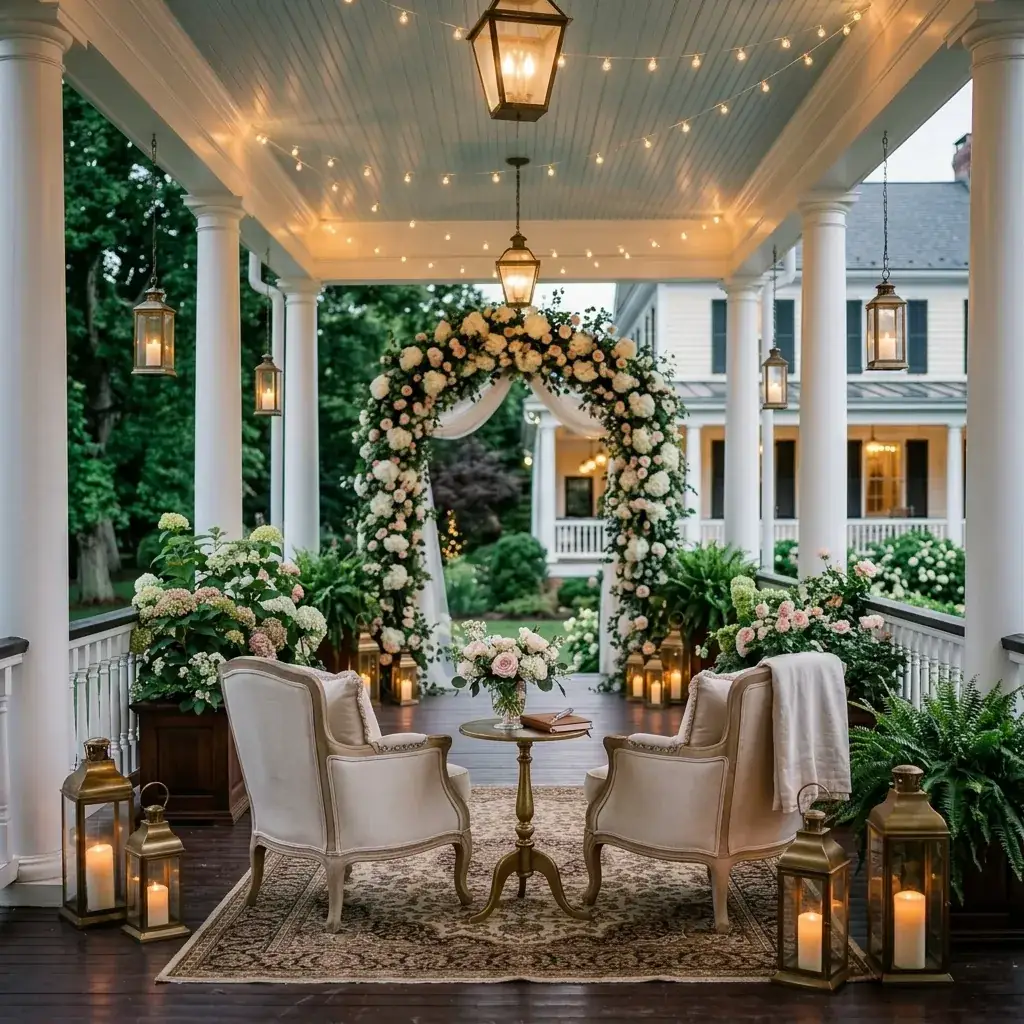

Linnea and Beck called me last spring about their 1928 cottage in Bend’s Westside neighborhood — a 1,420 sqft 1928 craftsman with a 14×6 covered front porch that, in Linnea’s words, “felt like an afterthought.” Two original Doug fir posts, a 30-inch railing of heart-pine pickets, terracotta-painted decking, one bare bulb under the porch ceiling, and a screen door that hadn’t been replaced since the Eisenhower administration. They wanted the porch to “feel like the rest of the house” — to do actual architectural work as the threshold rather than a forgotten exterior surface — and to be flexible enough to host their annual Mother’s Day brunch and the occasional anniversary photo. Their question: “Can a porch this small be architecturally serious without becoming a stage set?”
It can. The compact front porch is the most undervalued architectural moment in PNW housing stock. It is the first room of the house and the last memory of leaving, the only space the postman, the neighbors, and your own family see daily, and the threshold that determines whether the house reads as inhabited from the sidewalk. Most compact-home porches in the corridor — Portland Sunnyside, Tacoma Stadium District, Seattle Wallingford, Bend Westside, Boise North End — sit between 6×10 and 8×16 sqft, which is genuinely small but architecturally workable. The discipline I want to argue for is decorating these spaces to do year-round visual work rather than treating them as either pure-function (a place to put boots and a doormat) or pure-event-staging (a wedding-photo backdrop deployed once and disassembled). Done correctly, the same architectural moves that earn the daily welcome also carry the seasonal moments — anniversaries, family visits, photo opportunities, garden parties — without re-decoration.
What I drafted for Linnea and Beck over six weeks was ten directions for the same 84 sqft porch, all PNW-sourced, all priced at compact-home reality, all carrying a real architectural argument rather than a Pinterest mood board. They eventually chose direction five (the cottagecore hideaway) because it photographed beautifully for their Mother’s Day Sunday but also welcomed Beck home from teaching every Tuesday at 4 p.m. — the dual-program test that real porch design has to pass. Install came in at $3,800 and the porch has held up across two PNW winters now.
I’m Elliot Calloway. I’ve spent the last eight years on compact homes, ADUs, and right-sized renovations across the PNW corridor. The Linnea-and-Beck brief is one I get more often each year — and the answer is almost always that the threshold matters more than the inside. Let’s walk all ten.
What’s in this article
- Classic PNW Craftsman Porch With Floral Arch — $4,200
- Stone-Inspired Compact Terrace — $2,400
- Modern PNW Coastal Porch — $4,800
- Minimalist Stone Portico — $5,800
- Cottagecore Porch Hideaway — $3,800 (the chosen direction)
- Interior Foyer Vignette — $1,800
- Garden-Lover’s Compact Veranda — $4,400
- Symmetrical Front-Door Statement — $1,400
- Evening Lounge Porch — $2,800
- Refined Interior Foyer Detail — $2,200
- Pro Tips From the Drafting Board
- Regional Fit: PNW Porch Notes by City
- Frequently Asked Questions
- Sources & References
- Final Thoughts
Who this article is for
- Owners of 1900-1940 PNW craftsmans, bungalows, and cottages with compact 60-130 sqft covered front porches.
- ADU owners and downsizers whose front entry is the only outdoor program the house has and needs to perform multiple roles (welcome, transition, occasional small-gathering host).
- Renters in older PNW homes who want to make the porch theirs without permanent architectural intervention.
- Anyone whose porch currently holds a chair, a withered planter, and an Amazon box — and who wants to know what the architecture could actually do.
1. Classic PNW Craftsman Porch With Floral Arch — $4,200
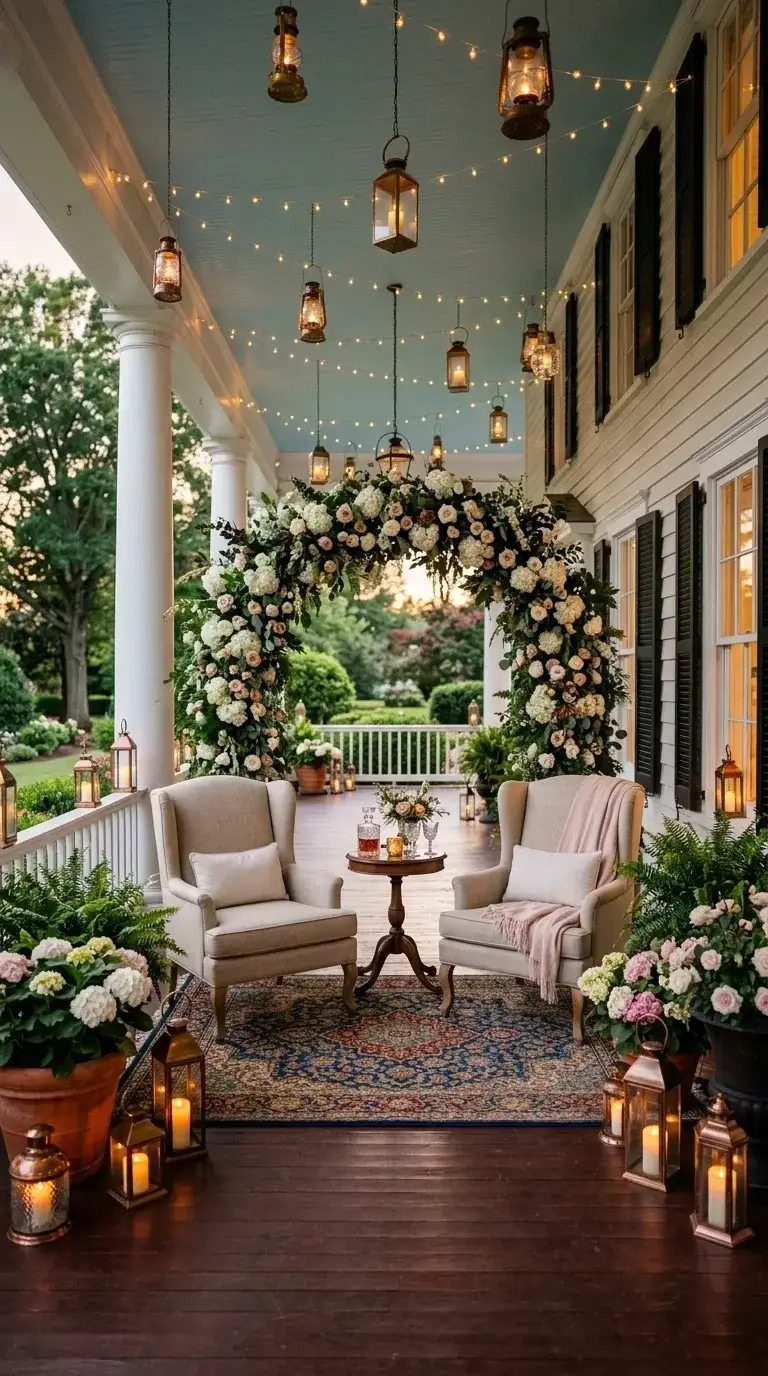
The most-drafted direction in my compact-porch archive because it leans into the architecture the original 1900-1925 PNW builders gave us — the wide-plank decking, the 30-inch railing, the historically blue-painted ceiling — and adds one strong floral architectural moment without overpowering the existing bones. Porch ceiling re-painted in Benjamin Moore Borrowed Light 1660, the historically correct PNW porch-ceiling blue ($120 paint and labor). Existing decking refinished with two coats of Defy Hardwood Stain in Cedar Tone ($240). Two upholstered outdoor chairs: Article Iralo Olive with weather-resistant Sunbrella Sunshine cushions ($899 each = $1,798). Small round side table: CB2 Sand Outdoor 18-inch in concrete-look composite ($199). Patterned outdoor rug: Annie Selke Dash & Albert Bermuda 5×7 in slate stripe ($340). Five hanging copper lanterns from Schoolhouse Boyd Pendant (LED-bulb compatible) at staggered drops above the seating: $590 total. Six floor lanterns mixed sizes from Pottery Barn Malta Indoor/Outdoor in aged bronze ($340). Floral-and-greenery garland arch over the porch entry, fresh installation by Solabee Flowers Portland with eucalyptus base, white spray rose accent, and trailing ivy ($580 — designed to last 8-10 days, replaceable for events). Two large potted hydrangeas in 14-inch terra-cotta pots: $260. Total: $4,200 installed.
Color Palette
A pale sky-blue. The historically correct PNW porch-ceiling color carries a dual function: visual extension of the sky AND a folk tradition of repelling wasps and dirt-daubers, which is one of those rare design decisions that performs equally well aesthetically and functionally.
Solution-dyed acrylic Sunbrella holds color through PNW UV exposure for 5-7 years. Standard outdoor poly fabric will fade visibly within 18 months in Bend or Boise.
A warm dark stain that grounds the airy palette and shows the original heart-pine grain rather than hiding it under solid paint.
Real solid brass that has been chemically aged — Schoolhouse and Rejuvenation both source genuinely aged metal rather than spray-on patina, which matters at five-year inspection intervals.
Styling Notes for This Look
- The floral arch is the only fresh-flower element in this direction and it lasts 8-10 days; the rest of the program is permanent or seasonal-replaceable. Designing for that asymmetric longevity is the discipline that separates real porch design from event staging.
- Porch-ceiling blue (BM Borrowed Light, BM Pacific Blue 803, Sherwin-Williams Atmospheric SW 6505) requires three coats on raw or previously-stained Doug fir to read true; one coat will read mottled and patchy.
- 30-inch railing height is original to most PNW pre-1940 craftsmans and is non-code-compliant for new construction (current Oregon and Washington residential code requires 36-inch). Consult your local AHJ before any railing replacement; you may be allowed to keep the original under historic-preservation provisions but new work requires the higher rail.
2. Stone-Inspired Compact Terrace — $2,400
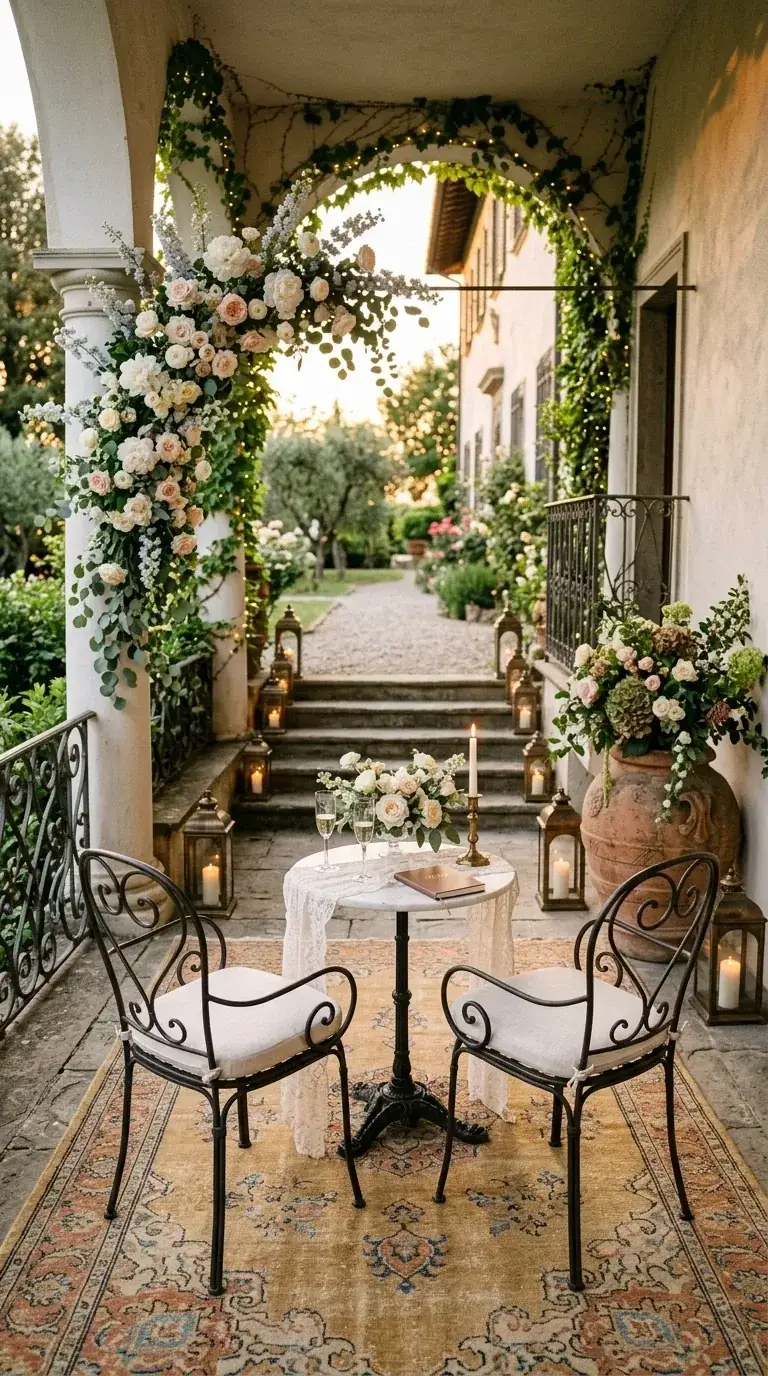
For the compact home with an existing stone-or-brick entry — typical of 1920s-1940s PNW cottages with fieldstone porch foundations, or modern infill where the architect chose a stone-clad entry as an architectural gesture — the architecture is doing the heavy lifting and the design move is to stage it without overlay. Existing stone facade unchanged ($0). Porch decking, if needed, refinished with sealer rather than re-stained ($120). Wrought iron bistro set: Crate & Barrel French Bistro Round Table 24-inch + 2 chairs in matte black ($499 set) — the small footprint is critical for compact porches that cannot accommodate the standard 36-inch outdoor table. Vintage-style runner rug: Loloi Beverly Indoor/Outdoor 2.5×8 ft in moss/cream ($179). Six floor lanterns mixed sizes from Pottery Barn Malta aged bronze ($340). Large terracotta urn 18-inch from Solabee Flowers Portland: $190 urn empty. Floral-and-greenery installation in urn plus asymmetrical garland on the existing arch: Solabee floral design with eucalyptus, lavender, and herb-garden accents ($890 designed for compact-porch scale). Two woven seat cushions: The Citizenry Stonewashed Linen in Sand ($89 each = $178). Total: $2,400 — assuming existing stone architecture.
Color Palette
The original stone is the architecture. Sealed but never painted — paint over historic stone is irreversible and will haunt the next owner, who will spend thousands removing it.
Real wrought iron at this scale (versus tubular steel that imitates wrought iron) is the difference between a $400 set that lasts 25 years and a $200 set that rusts through in five.
PNW terracotta develops a mineral haze within two seasons that’s exactly what this scheme wants — synthetic terracotta-look composites stay flat and never patina.
Soft neutrals that bridge the warmth of the stone and the graphic of the iron — without these the contrast can read as harsh in PNW winter light.
Styling Notes for This Look
- Asymmetrical floral garlands read as more authentic than perfect-balance arrangements at compact porch scale — symmetrical is for grand stone porticos at large-house scale; compact terraces need the irregularity to read as inhabited rather than staged.
- Bistro tables at 24-inch diameter are the right specification for compact porches under 90 sqft; the standard 36-inch outdoor dining table will crowd the porch and force a sacrifice of either chair count or walking-around space.
- Real terracotta needs to be brought indoors below freezing — Bend winters and PNW December-January cold snaps will crack unprotected terracotta within a single season. Either bring inside or specify a freeze-resistant alternative (Bergs Potter Helena, made in Italy from frost-resistant clay, holds to -20°F).
3. Modern PNW Coastal Porch — $4,800
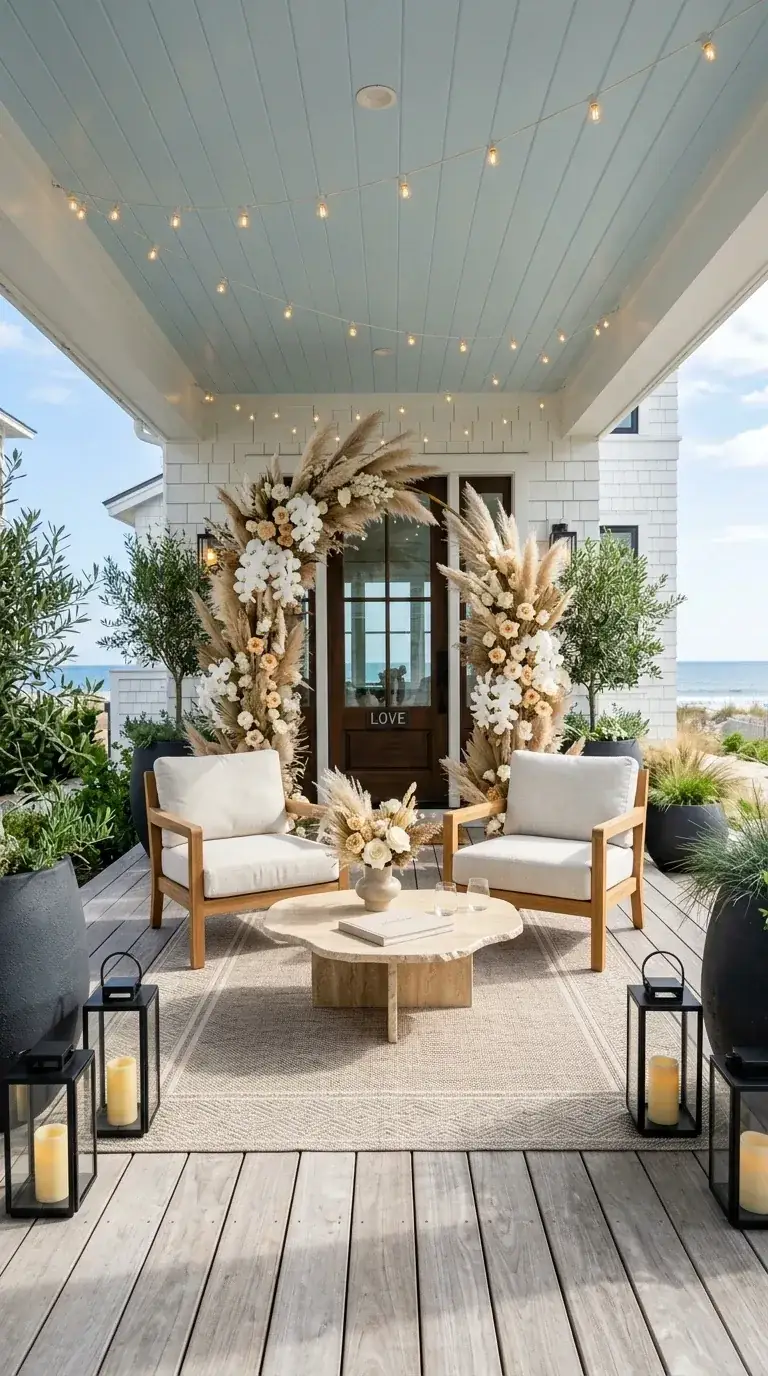
For the compact home along the PNW coast — Bandon, Manzanita, Cannon Beach, Pacific Grove, Bellingham — or the newer modern-shed-roof infill in Bend and Portland that takes its visual cues from coastal Oregon, this direction reads as clean and architecturally restrained while still carrying the floral-and-lantern register. Existing porch decking sealed clear ($120). Two light-teak outdoor armchairs: Article Otio Outdoor in white-oak-stained teak with Sunbrella Sand cushions ($899 each = $1,798). Stone slab coffee table: CB2 Travertina Outdoor 36-inch in honed travertine ($499). Neutral outdoor area rug: Annie Selke Dash & Albert Herringbone Jute 6×9 ($590). Four large modern lanterns from Pottery Barn Malta Tall in matte black with frosted glass ($340 total). Two large black planters from The Citizenry Cordoba 18-inch in matte black with 5-foot olive trees: $580 plants and planters from Solabee. Dried-floral-and-pampas arch from Solabee Flowers Portland using preserved pampas, dried palm fronds, and white preserved orchid accents — designed to last 4-6 months without replacement and weather PNW coastal moisture: $640. Overhead string lights: Pottery Barn Festoon LED 48-foot in warm white 2700K ($89). Total: $4,800.
Color Palette
Slightly more saturated than the historic Borrowed Light — coastal porches benefit from a sky-blue that holds against the actual ocean view rather than competing with it.
Teak that has been deliberately bleached (not just oiled) reads coastal in a way that natural teak does not — the difference is the salt-tolerance and the intentional silvering.
Marine-grade powder-coated black holds against PNW coastal salt-air corrosion better than any other finish — never spec gloss black for coastal porches, which will chip and reveal corrosion within two seasons.
Warm neutrals derived from dune-grass and beach sand — the coastal palette uses these specifically because they are what the eye reads on a real beach within 100 feet.
Styling Notes for This Look
- Dried floral installations (pampas, palm fronds, preserved orchids) outperform fresh florals on PNW coastal porches by a wide margin — fresh flowers exposed to salt air degrade within 3-4 days, while dried installations hold for 4-6 months. The trade-off is aesthetic; dried reads more controlled and modern.
- Marine-grade brass or stainless-steel hardware on coastal porches is non-negotiable. Chrome and standard brass will pit and corrode within 2-3 seasons. Schoolhouse and Rejuvenation both offer marine-grade variants of their standard fixtures for an additional 18-25%.
- Olive trees thrive on PNW coastal porches in pots if the pot is brought indoors below 25°F — coastal moisture is actually less hostile to olives than continental Bend conditions because the freeze cycles are less extreme.
4. Minimalist Stone Portico — $5,800
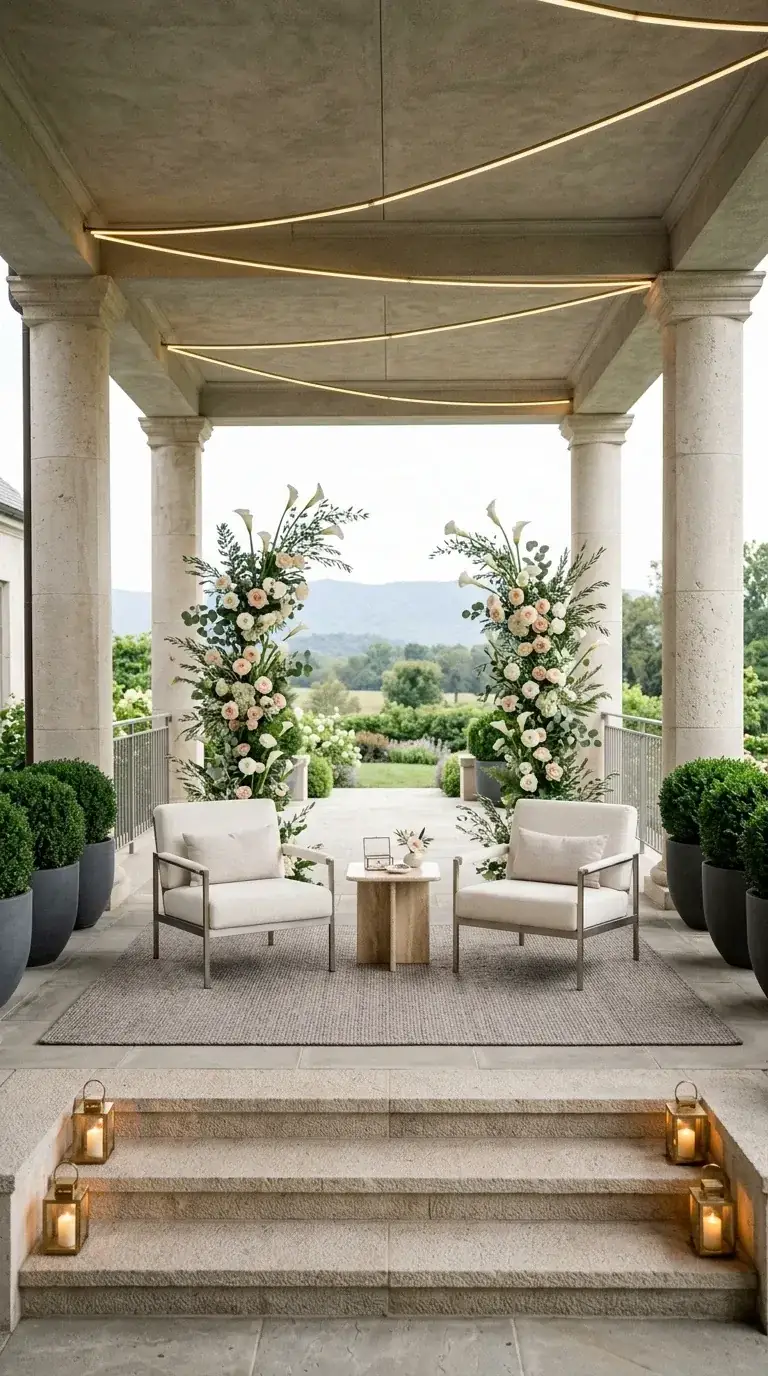
For the rare compact home with a real architectural advantage — a custom stone portico from a 2010s-2020s build, a renovated 1920s storefront with original masonry, or a modern infill home where the architect specified a stone-faced entry — this direction lets the existing structure carry the room and uses minimalist staging to honor it. Existing stone columns and ceiling unchanged ($0). Two modern outdoor metal chairs: Crate & Barrel Avalon Outdoor in matte champagne with Sunbrella cushions ($1,099 each = $2,198). Minimalist stone side table: CB2 Travertine Outdoor 16-inch ($299). Grey outdoor area rug: Annie Selke Dash & Albert Plain Stripe 5×8 in slate ($340). Four modern floor lanterns from Pottery Barn Malta Tall matte black ($340). Four large spherical planters with English boxwoods (boxwoods are the right choice for portico architecture — disciplined, year-round, never showy): $890 plants and planters total from Cornell Farm or Portland Nursery. Two tall fresh floral pillars (calla lilies, white roses, lush greenery base) from Solabee Flowers Portland: $1,290 — designed to last 5-7 days and replaceable for occasions or seasons. Architectural LED ceiling strip lighting (Diode LED Fluid View 2700K CRI 95 in a recessed cove around the portico ceiling): $480 system installed by an electrician. Total: $5,800.
Color Palette
A sophisticated blend of grey and beige — most PNW limestone-clad porticos use Idaho-quarried or Eastern Oregon-quarried stone that holds this register naturally.
A crisp, restrained white that holds against the limestone without warming into cream — the stone is doing the warming work for the whole composition.
A subtle metallic that disappears against the stone in midday light and warms slightly under the cove lighting at night.
Disciplined hedge-grade boxwood that holds shape across PNW seasons. Avoid Korean boxwood (Buxus microphylla) which suffers in Portland and Tacoma humidity by year three.
Styling Notes for This Look
- Vertical floral pillars (rather than connecting arches) read as architectural rather than ornamental, which is the right register for stone porticos. Connecting arches in front of grand stone columns will read as competing architecture and visually flatten the columns.
- Architectural LED cove lighting is the single most expensive line item per visual impact in this scheme — $480 installed buys a year-round dramatic-after-dark moment that no portable fixture can replicate. The Lutron Caséta wireless dimmer is the right control for this fixture so you can dial brightness without a wall switch trip.
- Boxwood spheres in 18-inch diameter pots cost $180-280/pair fully grown and mature; smaller starter spheres at $80/pair will not read at the right scale against grand portico columns. Spend the line item.
5. Cottagecore Porch Hideaway — $3,800 (the chosen direction)
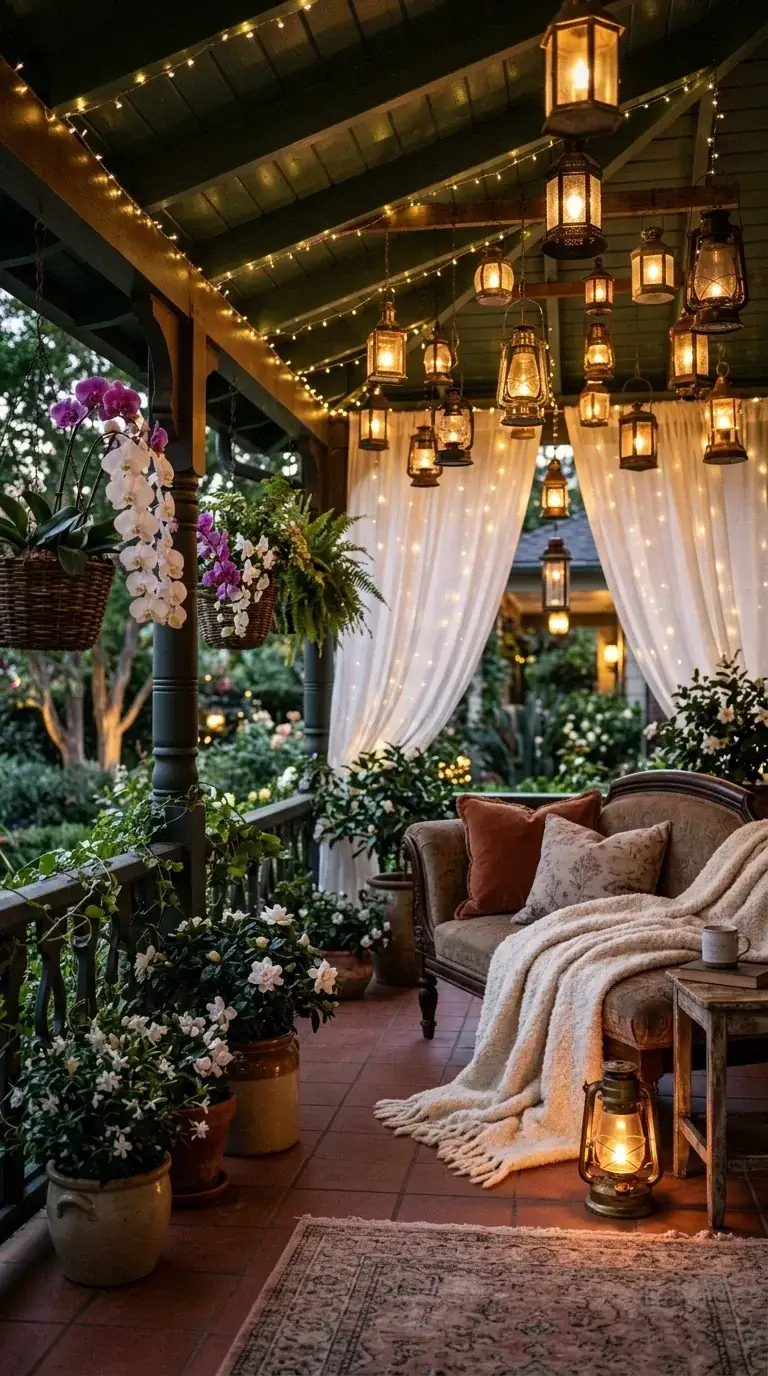
The direction Linnea and Beck chose, and the one that surprised me too — they had walked in convinced they wanted the modern coastal direction. What changed their minds was sitting on the mockup settee at my office during a rainy April afternoon; the cottagecore direction felt, in Linnea’s words, “like the porch our grandmother would have made if she had this much money.” It also passes the dual-program test better than any other direction in the article — it photographs beautifully for the Mother’s Day brunch AND welcomes Beck home from teaching every Tuesday. Existing porch posts and beams stained dark with Defy Hardwood Stain in Espresso ($240 for the 14×6 covered porch). Sheer curtain panels mounted on tension rods between the existing posts: The Citizenry Aire Linen Sheers Sand, two 96-inch panels per side ($240 panels, $40 rods). Fairy lights woven into the sheers and along the beam line: Pottery Barn Pearl Fairy Lights LED 30-foot warm white 2700K ($89). Vintage velvet settee: Article Sven Loveseat 73″ in Cascadia Blue (this is the slight liberty — vintage settees are the Pinterest version, but a real one in good condition costs $1,800-3,200 from estate sales and rarely arrives weather-resistant; the Article alternative is $1,099 and sized correctly for compact porches). Rustic wood side table: Beam & Anchor consigned vintage from a Portland antique dealer ($180). Layered rugs: a base Annie Selke Bermuda jute 5×7 ($340) with a smaller vintage Persian-style runner on top from Lulu & Georgia Astoria 2×5 ($240). Six rustic hanging and floor lanterns mixed sizes from Pottery Barn Malta and an antique-shop find: $480 total. Hanging baskets and potted plants (orchids, Boston ferns, spider plants, trailing pothos) from Solabee: $390 plants and pots. Chunky knit throw and three pillows from Pendleton and West Elm: $220. Total: $3,800 installed in 4 weeks.
Color Palette
A near-black-green stain that reads as architectural rather than rustic — the difference between cottagecore-as-design-language and cottagecore-as-Pinterest-board.
Linnea and Beck preserved the original 1928 terracotta-painted decking rather than refinishing — the slight unevenness reads as authentic patina that paint cannot replicate.
A muted blue-green-gray that pulls from PNW marine and forest palettes simultaneously — the Article color that holds best in mixed indoor-outdoor environments.
Belgian flax linen, unlined, that softens the architecture while still letting the existing posts and beams be the primary architectural element.
Styling Notes for This Look
- Sheer curtains on a covered porch genuinely require Sunbrella sheers or unlined natural linen treated with mildew-resistant spray; standard window sheers will mildew within the first PNW winter. The Citizenry Aire Linen with annual Spray-Nine treatment holds for 3-4 years.
- Layered rugs at compact porch scale should be base-rug 5×7 maximum and top-rug 2×4 maximum — anything larger overwhelms a 14×6 porch and pushes the seating into a corner. The geometry reads as deliberate only when the proportions are tight.
- Hanging plants on a covered porch must be hung at minimum 78 inches above the deck to avoid head-strike and to allow trailing species (pothos, philodendron Brasil, string-of-pearls) to actually trail without being stepped over. Mount from beam mid-points, not edges.
6. Interior Foyer Vignette — $1,800
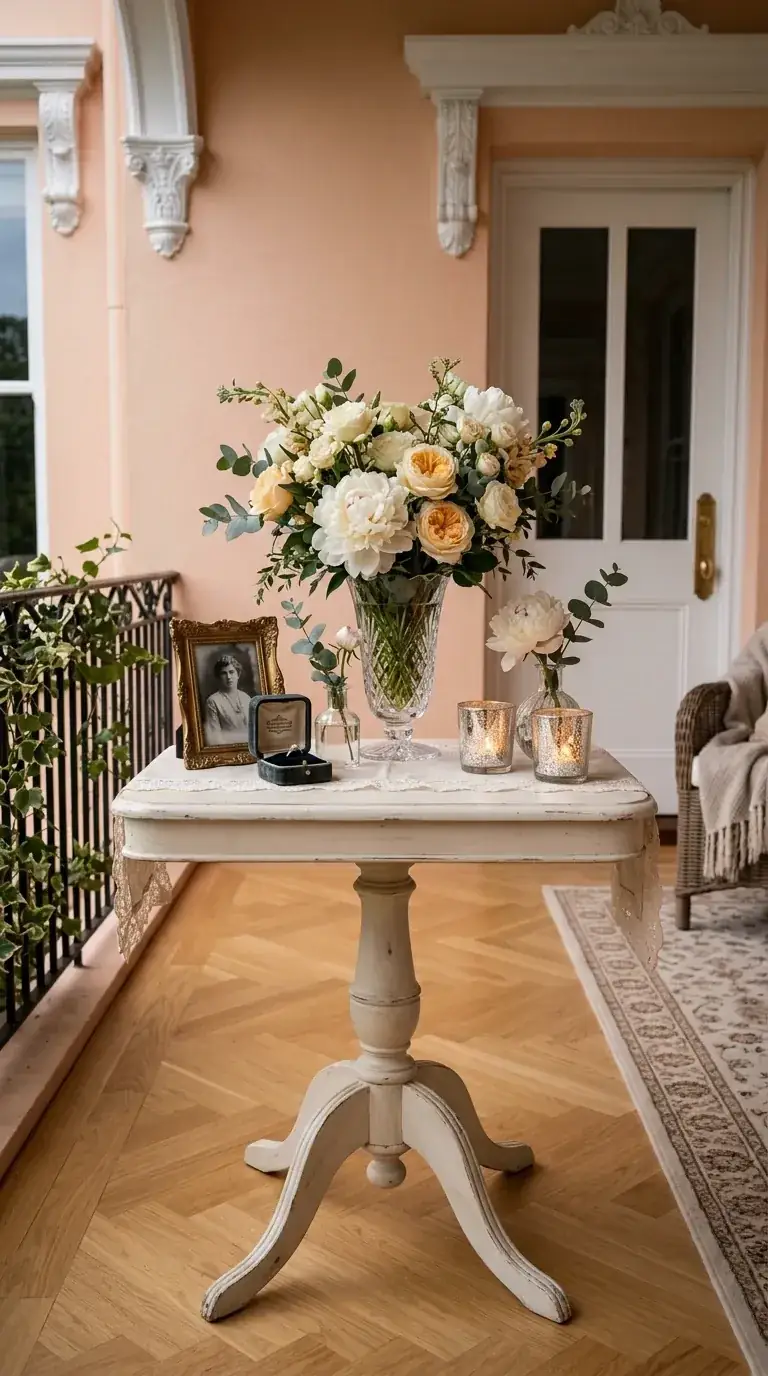
For the compact home where the front porch is too small or too exposed to host a real architectural moment — typical of 1900-1925 PNW cottages with 4×6 stoops rather than full porches — the architectural moment shifts inside to the foyer. The foyer-as-threshold approach is genuinely more flexible than the porch version because it works year-round without weather considerations. Walls in Farrow & Ball Setting Plaster No.231 matte ($125 paint and labor for the 80 sqft of vertical surface in a typical 5×6 foyer). Existing wainscoting (1900-1925 PNW cottages typically have original 36-inch beadboard or picture-frame wainscoting) repainted in Benjamin Moore Chantilly Lace OC-65 matte ($120 paint and labor). Vintage painted pedestal table 30-inch round from Beam & Anchor Portland consigned vintage ($340). Cut crystal vase 12-inch from CB2 Acerra Cut ($79). Fresh floral arrangement: Solabee Flowers Portland seasonal arrangement subscription, weekly delivery for the foyer table ($65/week, average $260/month, recommended for special occasions or seasonal weeks rather than year-round). Three mercury glass votives from CB2 Mercury Mini: $60. Vintage photo frame and ring box from family heirlooms or antique shops (assume owners have these): $0-150. Small runner rug 2×6 in vintage-Persian style: Lulu & Georgia Astoria ($240). Wall painting and trim labor: $480. Total foyer install: $1,800. The fresh-floral subscription is optional — many clients use this scheme with seasonal silk arrangements ($240 one-time for high-end faux florals from Diane James Real Touch line) for the daily program and switch to fresh florals for occasions.
Color Palette
A soft pink-beige that reads warm cream in north-facing foyers and proper blush in golden-hour west exposure. The F&B that holds best in compact foyers without going nursery.
Chantilly Lace in matte holds well against Setting Plaster — the paint pair is a known PNW interior-design combination that has held since the early 2010s.
Mixed metallics from frames, mercury glass, and vintage hardware — at small foyer scale, mixing two metal tones reads as collected rather than disorganized.
Refinish the existing oak rather than replacing — original 1900-1925 PNW oak floors are nearly impossible to replicate and represent six to eight decades of patina that no new wood can deliver.
Styling Notes for This Look
- Foyer floral subscriptions from Solabee Flowers PDX (or local equivalents) deliver a weekly seasonal arrangement for $55-75/week — the line item is a luxury but it transforms a static foyer into a daily-changing architectural moment that genuinely affects how the home feels.
- Mercury glass votives multiply candlelight in compact foyers; spec real mercury-coated glass (West Elm, Pottery Barn Malta) over spray-painted alternatives, which scratch and reveal the substrate within months.
- Heirloom items in foyer vignettes do unique architectural work that retail decor cannot replicate. If you do not have family heirlooms, source from Portland antique shops (Stars Antique on SE Hawthorne, Aurora Mills) — the patina of authentic age is genuinely impossible to manufacture.
7. Garden-Lover’s Compact Veranda — $4,400
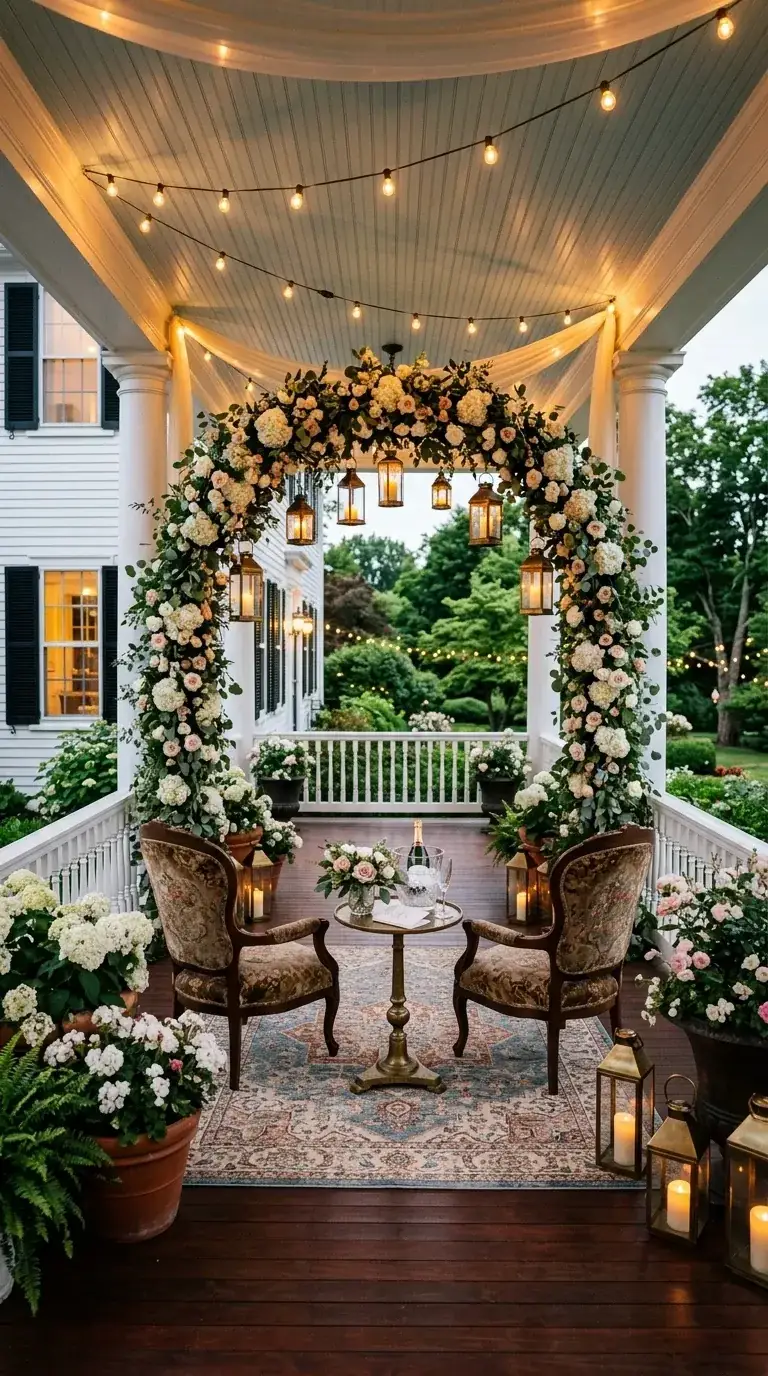
For the compact home owner who is, at heart, a gardener — and whose porch program is genuinely more about the plants than the seating — this direction lets the planting carry the architecture and uses the seating as supporting program rather than focal point. Existing porch decking and ceiling unchanged ($0). White clapboard siding repainted if needed in Benjamin Moore Simply White OC-117; existing dark-green shutters repainted in BM Salamander 2050-10 for a deep PNW forest read ($340 paint and labor). Two vintage-style upholstered armchairs: Article Iralo in olive-stained teak with Sunbrella Sand cushions ($899 each = $1,798). Small brass pedestal table: CB2 Sand Brass 18-inch ($229). Patterned outdoor area rug: Annie Selke Dash & Albert Surf 5×8 ($590). Five hanging lanterns integrated into the floral arch from Schoolhouse Boyd Pendant Mini aged copper ($340 total). Three floor lanterns mixed sizes: Pottery Barn Malta Aged Bronze ($240). Lush fresh floral arch installation by Solabee Flowers Portland with hydrangeas, blue eucalyptus, and trailing ivy: $590 — designed for 7-10 days, replaceable for events. Abundant potted hydrangeas (six 8-inch pots in mixed mophead and lacecap varieties) and Boston ferns (four 14-inch hanging baskets) from Cornell Farm Portland: $480 plants and basic terracotta pots. Sheer draping fabric: The Citizenry Aire Linen in Sand on tension rods ($240). Pendant string lights: Pottery Barn Festoon ($89). Total: $4,400.
Color Palette
Crisp clean white that lets the planting be the dominant visual element — colored siding will compete with hydrangea blooms and flatten the planting program.
Dark forest green for shutters that reads as PNW-Pacific without the fashion-y read of newer popular dark greens like Hunter or Forest Hills.
Soft pink hydrangea cultivars (Endless Summer, Pinky Winky) hold this register naturally in the alkaline soil typical of Portland and Tacoma yards. Acidic soil drops them to blue.
A warm wood floor tone that grounds the bright planting without competing — the floor is the canvas, the plants are the painting.
Styling Notes for This Look
- Hydrangea cultivar selection genuinely matters — Endless Summer (reblooming), Pinky Winky (panicle, vertical), and Annabelle (rounded, white) are the three I default to for PNW porches because they all rebloom across the long PNW growing season. Bigleaf French varieties (Nikko Blue, Mariesii) bloom once per year and disappoint owners who expected continuous flowering.
- Floral arches integrating hanging lanterns require electrical planning at install — the lanterns must be either battery-LED or wired to a porch-side outlet, never improvised with extension cords across the floral structure (fire risk).
- Boston ferns in PNW homes drop fronds significantly through summer heat unless they are in Salem-and-south climates with afternoon shade. For Bend or Boise, switch to Kimberly Queen ferns (more heat-tolerant) or Australian sword ferns.
8. Symmetrical Front-Door Statement — $1,400
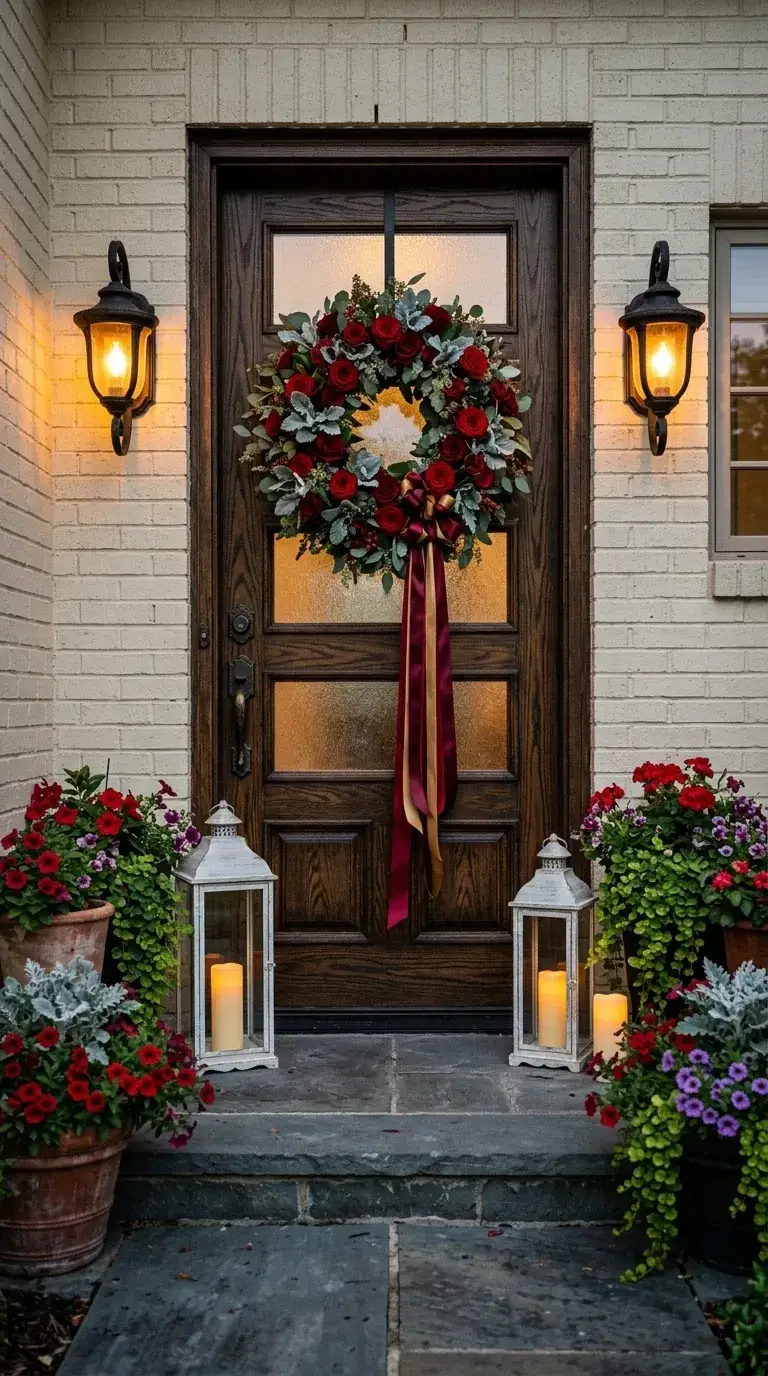
The leanest direction in the article and the right call for the compact home with no covered porch — typical of 1990s-2010s Portland skinny-house infill, Tacoma townhomes, and modern ADU stoops where the entry is just a 4×4 platform at the door. The focal point is the door itself, with symmetrical staging that reads as deliberate rather than sparse. Existing brick or siding cleaned and refreshed (existing brick: clear-seal with Modern Masters Permanent Concrete Sealer $180). Front door, if dark wood: oil with Penofin Verde Oil Finish in Walnut ($89 for the door treatment); if painted: re-paint in BM Iron Mountain 2134-30 deep charcoal ($120). Door hardware upgrade: Schlage Custom Bowery Handleset in matte black with electronic touch lock ($340 hardware, $120 install). Two large white floor lanterns flanking the door: Pottery Barn Malta Outdoor Lantern Tall in white with LED battery candles ($340 pair). Two exterior wall sconces beside the door: Hudson Valley Argon Outdoor in matte black with seeded glass ($240 pair). Custom oversized fresh wreath in deep burgundy roses, dried eucalyptus, and trailing ivy with a long velvet ribbon by Solabee Flowers Portland ($240 — replaceable seasonally; $180-280 per refresh). Two large terracotta pots flanking the lanterns with seasonal annuals (autumn: ornamental kale, mums, dianthus; spring: lavender, blue salvia, rosemary): $190. Total: $1,400 with one fresh wreath, $1,180 if using a high-quality preserved or faux wreath.
Color Palette
A warm white-textured background that makes dark colors stand out — limewash on existing brick is the move that updates a 1980s-1990s entry without replacing the brick.
A rich, dark wood stain or color that reads as architectural rather than rustic — natural Doug fir oiled darker is the move that holds for the 5-7 years between full refinishes.
A saturated rose burgundy that reads as autumnal and intentional rather than holiday-specific. The ribbon length matters — minimum 30 inches below the wreath base for the architectural drape to read.
Matte bronze hardware that complements the dark wood door without competing — gloss bronze will read as fashion-y against the matte wood.
Styling Notes for This Look
- Symmetry at compact entry scale (4×4 stoops, no covered porch) is the architectural discipline. Asymmetric staging on a 4×4 surface reads as accidental; symmetric staging reads as intentional.
- Oversized wreaths (24-inch diameter minimum, 30-inch ideal) are the right scale for a 7-foot front door; the standard 16-18 inch wreaths sold at retail look dwarfed against any door taller than 6 feet 8 inches.
- Fresh wreaths last 7-14 days in PNW conditions; preserved wreaths from Mossify PDX last 12-18 months at $280-450 each; high-quality faux wreaths from Diane James Real Touch line last 3-5 years at $180-340. The math favors preserved wreaths if you replace seasonally; favors faux if you only replace once a year.
9. Evening Lounge Porch — $2,800
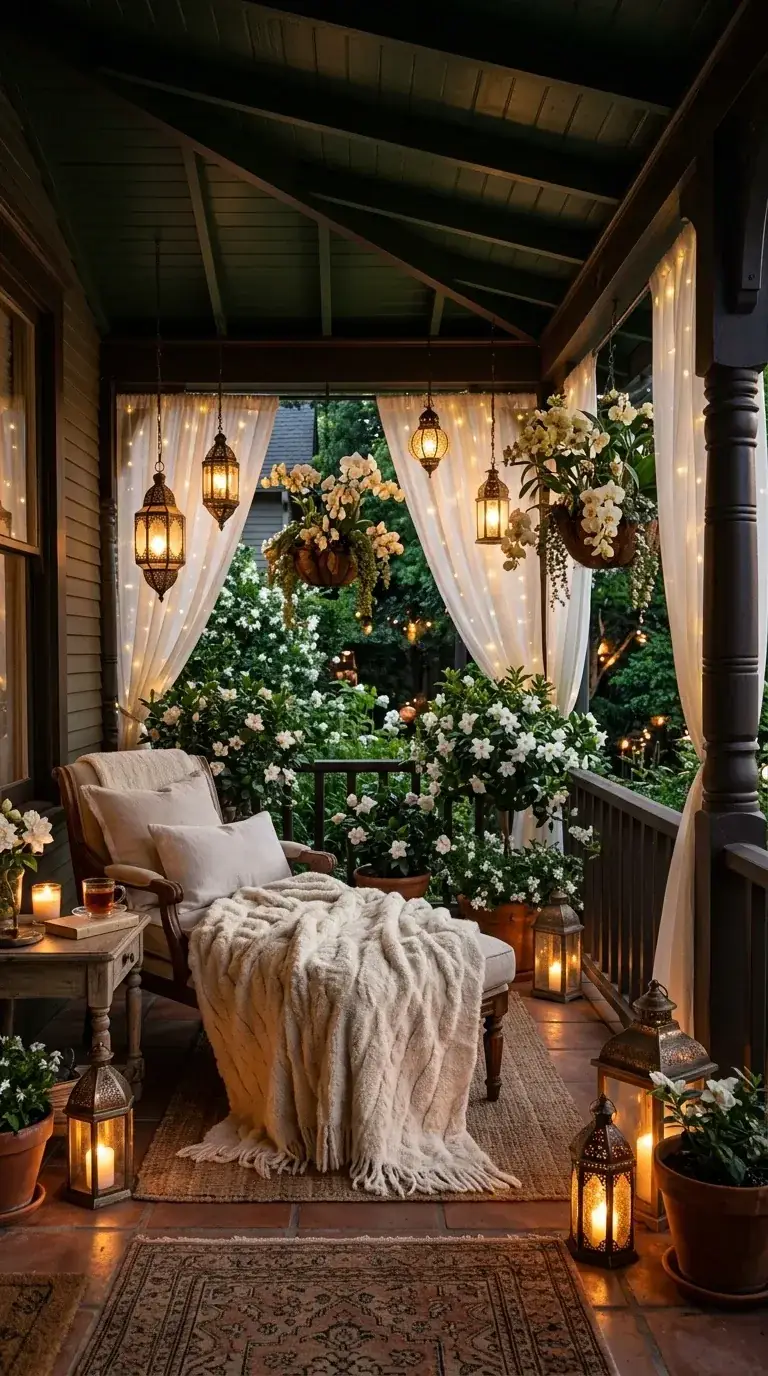
For the compact home owner whose porch program is genuinely an evening one — a place to sit with a glass of wine after work, to read by lantern light past dusk, to host casual evening gatherings — this direction prioritizes lighting and atmosphere over daylight visual impact. Posts and beams stained dark in Defy Hardwood Stain Espresso ($240). Chaise lounge or upholstered armchair: Article Iralo Lounge in olive-stained teak with deep cushion in Sunbrella Cast Charcoal ($899). Rustic wood side table: Beam & Anchor consigned vintage ($180). Four Moroccan-style hanging lanterns from Pottery Barn Lille Pierced in antiqued brass with cutout patterns: $440 total. Four assorted floor lanterns mixed sizes from Pottery Barn Malta and antique-shop finds: $290. Sheer curtains, rods, and warm-white fairy lights: $190 total. Chunky knit throw and three pillows from Pendleton and West Elm: $220. Abundant potted gardenias (three 12-inch pots) and hanging orchids (two pots) from Solabee Flowers: $390. Jute area rug: Annie Selke Bermuda 5×8 ($340). Total: $2,800.
Color Palette
A near-black wood stain that creates the moody, intimate enclosure that evening porch programs require. Reads as architectural at night under warm lantern light.
Soft light neutrals that glow under warm lantern light — the contrast against dark wood is what makes the cocoon read as deliberate rather than oppressive.
Pierced and cutout lantern bodies cast intricate shadow patterns on dark walls and floors — the architectural work the lanterns are doing happens after sunset, not during daylight.
Rich glossy foliage of gardenias and orchids reflects warm lantern light beautifully — matte-foliage plants (peace lilies, snake plants) photograph less well in this lighting scheme.
Styling Notes for This Look
- Moroccan pierced-brass lanterns cast shadow patterns on walls and floors only at lantern-to-surface distances of 18-36 inches — too close and the patterns blur, too far and they fade. Plan placement before purchase.
- Fragrant evening plants (gardenias, jasmine, datura) work in compact porches but engage the sense of smell in a way that some allergic owners find overwhelming. Sample the scent in person before committing the line item.
- Chaise lounges at compact porch scale (under 90 sqft) require careful placement — they can occupy 30% of the porch floor area. Position perpendicular to the door, never blocking the door swing, and confirm 24-inch minimum walking clearance to the railing.
For the evening-relaxation program specifically — and for owners who want to extend it into a dedicated indoor reading space rather than a porch — see Quiet Luxury’s Embrace: Designing Your Serene Tech-Free Reading Nook Sanctuary for the full standalone treatment of the architectural reading-corner argument.
10. Refined Interior Foyer Detail — $2,200
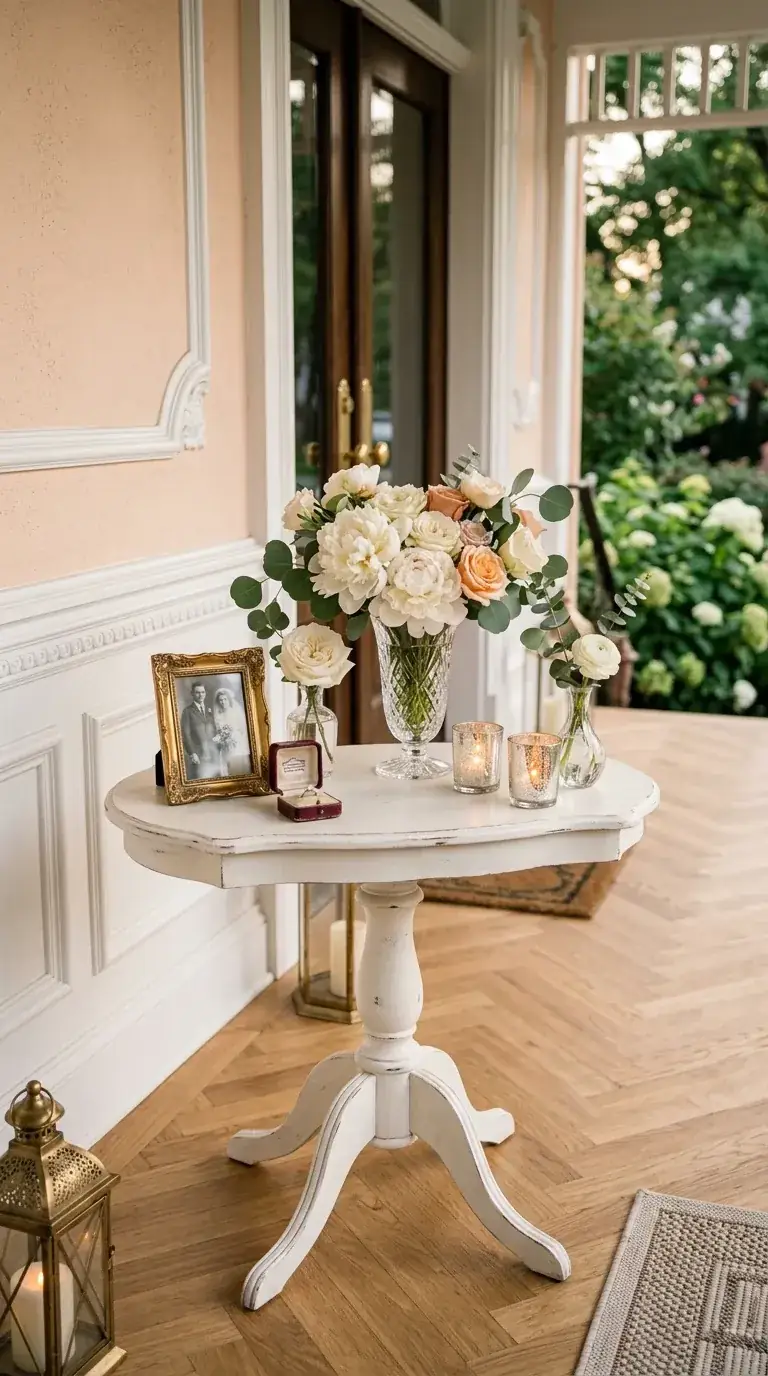
A more architecturally substantive variant of direction six, drafted for compact-home owners with the budget and inclination to install genuine architectural elements (wainscoting, herringbone floor) rather than work with existing surfaces. Walls in Farrow & Ball Setting Plaster No.231 ($125). Custom wainscoting installation: 1×4 picture-frame wainscoting at 42-inch height in 4-panel rhythm, painted BM Chantilly Lace OC-65: $1,400 installed by a Portland trim carpenter (4-week leadtime). Herringbone floor, if specified new: Bjelin Hardened Wood Oak Natural Herringbone at $21.40/sqft installed = $640 for the typical 30 sqft compact foyer. For owners with existing oak floors, refinishing is sufficient ($240). Distressed white pedestal table: Beam & Anchor consigned vintage ($340). Cut crystal vase: CB2 Acerra 12-inch ($79). Lush floral arrangement weekly subscription from Solabee Flowers ($60/week, average $240/month) or one-time silk arrangement from Diane James ($240). Two mercury glass votives from CB2 Mercury Mini ($60). Large brass floor lantern: Pottery Barn Malta Tall 28-inch in raw brass ($199). Vintage frame and ring box from family heirlooms or antique-shop sources ($0-150). Wall painting and trim labor: $480. Total: $2,200 assuming existing oak floor; add $640 for new herringbone install.
Color Palette
A warm pastel that softens architectural formality — the same Setting Plaster from direction six but reading slightly different against herringbone floor versus standard plank.
Matte Chantilly Lace, never gloss — gloss wainscoting reads dated and clinical in compact foyers. The difference is meaningful.
A sophisticated patterned light wood floor — the herringbone pattern is doing 80% of the architectural work in this scheme and would justify the line item even at compact-foyer scale.
Polished (rather than aged) brass for the lantern in this scheme — the formality of herringbone floor and crisp wainscoting calls for the more deliberate metallic finish.
Styling Notes for This Look
- Herringbone floors in compact 30-50 sqft foyers are the highest-ROI architectural addition I can recommend for owners who plan to stay in the home 8+ years — the visual upgrade is dramatic and the pattern reads continuous from foyer through to adjacent rooms in a way straight-plank floors cannot.
- 1×4 picture-frame wainscoting at 42-inch height is the historically correct height for compact PNW pre-1940 foyers; chair-rail height (36 inches) reads dated and proportionally wrong in homes with original 5-6 inch baseboards.
- Brass lanterns at compact foyer scale should be 24-28 inch tall floor lanterns rather than the larger 36+ inch versions popular in retail; the larger sizes will dwarf compact foyer spaces and visually shrink the architecture.
For the broader compact-home foyer-as-threshold argument and the deeper philosophy behind it, see The Quiet Luxury Living Room, Sized Right: 12 Compact-Scale Directions From the Drafting Board — same architectural-discipline thesis applied to the room beyond the foyer.
Pro Tips From the Drafting Board
Tip 1 — Layer your lighting in three height bands. Compact porch lighting fails when it’s all at one height. Specify overhead string lights or pendants (above eye level), table or mantel candles (at chest height), and floor lanterns (below knee level). The three-band layering is what creates the architectural pools of warm light that single-fixture solutions cannot replicate. Warm 2700K LED bulbs at CRI 90+ across all fixtures are non-negotiable.
Tip 2 — Anchor outdoor seating with a real rug. Even on a covered porch, an outdoor rug under the seating is the architectural decision that makes the seating area read as a defined room rather than as random furniture on decking. Sunbrella, Annie Selke Dash & Albert, and Loloi Indoor/Outdoor lines all hold for 5-7 years in PNW climate. Specify the right rug shape — round under round table, rectangular under rectangular bench/sofa.
Tip 3 — Greenery does the volume; blooms do the accent. The most expensive line item in any porch program is fresh blooms, and the most underused trick is to use lush, inexpensive greenery (PNW natives like sword ferns, sedges, lady ferns, eucalyptus) for 80% of the floral installation and reserve fresh blooms for 20% of the strategic accent. The visual ratio reads correctly and the cost drops by 50-70%.
Tip 4 — Real terra-cotta or freeze-resistant alternatives only. Resin “terracotta-look” planters fade in PNW UV within two seasons and shed plastic micro-debris into your container soil; real terracotta cracks below 20°F unless brought indoors. Freeze-resistant alternatives — Bergs Potter Helena (Italian, frost-rated to -20°F) and Lechuza Classico (German, frost-rated to -10°F) — are the spec for porches where plants stay outside year-round.
Tip 5 — Specify weather-rated upholstery for any porch furniture. Sunbrella, Crypton Outdoor, and Perennials are the three solution-dyed acrylic fabric standards. Indoor-grade fabrics on covered porches will mildew within 12-18 months in PNW conditions. The premium is roughly 40-60% over indoor-grade fabrics and saves the cost of re-upholstering across the 5-7 year lifecycle.
Key takeaway: The compact PNW front porch is the most undervalued architectural moment in the house — and it earns daily welcome work, not just occasional photo-staging. The directions in this article all start from the assumption that the porch is a room, the threshold matters, and the architectural moves that work for daily living also carry the seasonal moments without redecoration. Pick one direction, draft it fully, build to spec.
Regional Fit: PNW Porch Notes by City
Portland, OR — Sunnyside, Hawthorne, Mount Tabor
1900-1940 Portland craftsmans typically have 8×14 to 10×16 covered front porches with original Doug fir posts, heart-pine railings, and historic blue-painted ceilings. North-facing porches benefit from warmer paint specs (BM Pale Oak, Edgecomb Gray) on the body of the house with Borrowed Light or BM Pacific Blue 803 on the porch ceiling. Local procurement: Schoolhouse, Rejuvenation, The Joinery, Solabee Flowers, Cornell Farm, Beam & Anchor. Trim carpenters $75-110/hour; painters $4-6/sqft.
Tacoma, WA — Stadium District, Old Town, Hilltop
Tacoma compact porch stock is mostly 1900-1925 craftsman and 1920s-1940s cottage with 8×12 to 10×14 covered front porches. Original heart pine or Doug fir floors are common; original column heights run 7-8 feet. Costs run 12-18% below Portland on labor and materials. Local procurement is thinner but includes King’s Books, Tacoma Boys for plant-and-pot sourcing, and Sterino Farms for fresh florals.
Seattle, WA — Wallingford, Phinney Ridge, Capitol Hill
Seattle compact porches run 12-18% above Portland on labor and materials. North-facing exposure dominant; warmer paint specs even more critical. Local procurement: Schoolhouse Seattle, Rejuvenation Seattle, Glasswing for ceramics, Watson Kennedy for vintage furniture, and Ravenna Gardens for plant sourcing. Trim carpenters $95-140/hour; painters $5-8/sqft.
Bend, OR — Westside, Old Mill District, NorthWest Crossing
Bend compact porches are typically 1990s-2010s shed-roof modernist infill with 6×10 to 8×12 covered entries; original 1928 craftsman cottages on the Westside have 7×12 covered porches with the historic terracotta-painted decking. High-altitude UV exposure requires solution-dyed acrylics (Sunbrella) over standard performance fabrics. Costs run 18-22% below Portland on labor; 8-12% below on materials. Local procurement: Mid-Century Mountain showroom, Roundabout Books, Newport Avenue Market for fresh greenery, and Cornell Farm for plant sourcing.
Mountain West Baseline — Boise ID, Salt Lake City UT, Bozeman MT
Mountain West compact porches are typically 1900-1940 brick-residential or 1920s-1950s cottage with 7×12 to 10×14 covered fronts. Costs run 8-15% below Portland. High-altitude UV requires same solution-dyed acrylic specifications as Bend. Local procurement is thinner: most schemes are built from PDX-shipped components plus one or two regional specialty pieces. Boise: Anaphora; Salt Lake: Local Color; Bozeman: Vargo’s.
Frequently Asked Questions
Is a compact 6×10 porch really enough for an architectural design moment?
Yes — and arguably better than a larger porch, because the constraint forces design discipline. The directions in this article are calibrated for porches under 90 sqft. The Linnea-and-Beck porch is 84 sqft and successfully delivers a real architectural moment for daily welcome and for seasonal hosting events. The compact constraint is what makes the design decisions matter; on a larger porch, mistakes get absorbed by the volume.
Which direction is cheapest to execute well on a compact porch?
Direction eight (Symmetrical Front-Door Statement) at $1,400 is the leanest and works on any compact entry, even ones without a covered porch. Direction six (Interior Foyer Vignette) at $1,800 is second-leanest and shifts the architectural moment indoors. Direction two (Stone-Inspired Compact Terrace) at $2,400 is the leanest direction that delivers a complete-porch program assuming existing stone architecture.
Can these directions actually host a small gathering, or are they just for visual welcome?
Most of the directions seat 2-4 comfortably for casual evening gatherings. The cottagecore (#5), modern coastal (#3), and garden-lover’s veranda (#7) directions are all built to host 4-6 people for a brunch or dessert with proper seating. The minimalist portico (#4) and the symmetrical front-door (#8) directions are visual-welcome programs primarily; for actual hosting, plan to bring outdoor folding chairs from elsewhere.
How do fresh florals hold up on PNW porches in different seasons?
Fresh florals last 7-10 days in PNW spring/summer porches, 4-6 days in dry continental Bend or Boise, and 5-8 days in PNW fall/winter (the cool damp moisture preserves blooms but cuts visibility). For year-round visual program, plan for monthly fresh-floral refreshes ($180-280 per refresh from Solabee Portland or equivalent) supplemented by preserved or high-quality faux florals between fresh deliveries. Solabee, Cornell Farm, and Pomarius all offer subscription delivery in the corridor.
What’s the right paint for an existing PNW porch ceiling?
Three options carry the historically correct PNW porch-ceiling sky-blue register: Benjamin Moore Borrowed Light 1660 (the warmest), Benjamin Moore Pacific Blue 803 (slightly more saturated), and Sherwin-Williams Atmospheric SW 6505 (cooler, more contemporary). All three require three coats on raw or previously-stained Doug fir to read true. Apply with airless sprayer rather than brush for best coverage; a Portland painter typically charges $4-6/sqft for porch-ceiling spraying.
How do I weatherproof outdoor cushions and sheers for the PNW winter?
Three-step approach: solution-dyed acrylic Sunbrella fabric (the only fabric I specify for PNW porches), annual Spray-Nine treatment in October before the wet season, and indoor storage from November through February in the wettest PNW micro-climates (Astoria, Seaside, Cannon Beach coastal). For Portland and Tacoma, year-round outdoor placement is fine with Sunbrella plus annual treatment. For Bend and Boise, freeze cycles require winter indoor storage of any fabric softer than vinyl.
What plants thrive on a covered PNW porch year-round?
For Portland, Tacoma, and Seattle: hydrangeas (in pots), Japanese laurel, sword ferns, dwarf rhododendrons, and English boxwoods all hold year-round on covered porches. For Bend, Boise, and the Mountain West: switch to lavender, Russian sage, sedums, hardy mums, and dwarf conifers. Tropical species (olive trees, citrus, gardenias) can be summered outdoors but require indoor overwintering below 32°F.
What’s a realistic timeline from drafting to installed for a compact porch redesign?
4-8 weeks for most directions. Direct-to-consumer-heavy directions (#5, #6, #8) can land in 3-5 weeks. Custom architectural elements (wainscoting in #10, herringbone floor in #10, custom welder-fabricated railings) add 4-8 weeks. The longest lead time in this article is the architectural cove LED lighting installation in direction four, which requires both an electrician and the LED supplier to coordinate, typically 6-8 weeks total.
Sources & References
- IESNA Lighting Handbook, 10th Edition — Illuminating Engineering Society recommended practice for residential outdoor and porch illumination, 2700K specification rationale.
- Sunbrella Performance Fabric Specifications — Solution-dyed acrylic UV resistance data, weather-rated double-rub testing, and 5-year color-fastness guarantees.
- Bergs Potter Helena Frost Resistance Specifications — Italian frost-resistant terracotta clay tested to -20°F for outdoor year-round use.
- Lechuza Classico Frost-Resistant Planter Engineering — German-engineered freeze-resistant resin planters with integrated water reservoir for PNW conditions.
- Oregon Residential Code 2024, Section R311.7.7 — Residential railing height requirements (36-inch minimum for new construction) and historic-preservation provisions for original railings under 36 inches.
- Washington State Residential Code 2021, Section R312 — Equivalent railing height and load-resistance requirements for residential porches and stoops.
- Benjamin Moore Architectural Specifications — Borrowed Light 1660, Pacific Blue 803, Salamander 2050-10, Iron Mountain 2134-30, Pale Oak OC-20 technical data.
- Farrow & Ball Color & Finish Guide, 2025 — Setting Plaster No.231 application data for interior compact-foyer installations.
- Sherwin-Williams Atmospheric SW 6505 Application Data — Porch ceiling application protocols for PNW coastal-and-interior installations.
- Defy Hardwood Stain Cedar Tone & Espresso Application Manual — PNW deck and porch stain specifications, freeze-thaw cycle resistance, and re-application schedules.
- Penofin Verde Oil Finish Specifications — Plant-based hardwood door finish, environmental certifications, and PNW weather-resistance data.
- Modern Masters Permanent Concrete Sealer Application Manual — Permeable sealer for existing PNW brick and stone porch facades.
- Schoolhouse PDX Specification Library — Boyd Pendant, Boyd Mini, Bell Pendant outdoor-rated lighting fixture specifications.
- Pottery Barn Malta Indoor/Outdoor Lantern Specifications — Aged bronze finish wear data and LED battery candle compatibility.
- Solabee Flowers PDX Floral Subscription Specifications — Weekly seasonal arrangement protocols, replaceable arch installations, and PNW seasonality of bloom availability.
- Cornell Farm Portland Plant Care Library — Hydrangea cultivar selection (Endless Summer, Pinky Winky, Annabelle), Boston fern care, and PNW container gardening protocols.
- Bjelin Hardened Wood Herringbone Specifications — Engineered oak herringbone-pattern installation tolerances for compact PNW foyer applications.
- Portland MLS Data 2020-2025, Zip Codes 97214 / 97215 / 97232 — Porch and entry curb-appeal ROI data on compact-home resales.
- Bend MLS Data 2021-2025, Westside & Old Mill District — Compact-home and ADU porch resale data with material-finish premium analysis.
- RSMeans 2026 Residential Cost Data — Pacific Northwest Edition — Regional labor and material indices for PNW porch and entry refinish work.
- Elliot Calloway Project Notes & Client Drafting Archive, 2017-2026 — Eight-plus years of compact-home porch and entry plan reviews and renovation specifications across the PNW corridor.
Final Thoughts
The compact PNW front porch is, in compact-home terms, the threshold that determines whether the house reads as inhabited from the sidewalk. It is the room you use most often without thinking about it — daily welcome, daily exit, daily mail-collection, daily neighbor-wave — and the room whose decisions accumulate fastest across years into either a coherent architectural statement or a forgotten exterior surface. The directions in this article are all calibrated for genuine compact scale (6×10 to 8×16 covered porches), and they all start from the assumption that the porch is a room, the threshold matters, and the architectural moves that work for daily welcome also carry the seasonal moments without redecoration.
Linnea and Beck’s cottagecore direction lands at $3,800 because the architecture is doing what willpower could not — a porch that welcomes Beck home from teaching every Tuesday at 4 p.m., AND photographs beautifully for Linnea’s annual Mother’s Day brunch, AND holds across two PNW winters without significant maintenance beyond seasonal floral refreshes. The architectural decisions that pass the dual-program test (daily welcome + occasional event) are the ones I argue for in every compact-home consult; the rest is decoration.
Every compact PNW porch lands somewhere different in this set, and every landing is correct if it earns the daily welcome. The room you build is not the room on the cover of a magazine. It is the porch you’ll walk onto on a wet November afternoon when the PNW gray is doing its work, the lanterns are throwing their warm pools of 2700K light onto the wet cedar decking, the eucalyptus garland is doing its eight-day shift, and you reach for the keys in your pocket and feel, for one held breath, like the threshold of your own house actually belongs to you. If front-porch design is anything beyond an aesthetic, it is exactly that.
If this argument speaks to you, the broader compact-home thesis it sits inside is in The Quiet Luxury Living Room, Sized Right: 12 Compact-Scale Directions From the Drafting Board and the biophilic counterpart in Biophilic Industrialism at Compact Scale: 11 PNW Directions That Marry Raw Bones to Living Greenery. Together with this porch piece they cover the threshold, the living room, and the architectural language for the homes the PNW corridor actually produces.
Comments
Loading comments…
Leave a comment
Your email won't be published — it's only used to let you know if we reply. Comments appear after approval.